






Vinaora Nivo Slider 3.xVinaora Nivo Slider 3.xVinaora Nivo Slider 3.x

Cg 8 million surplus, Just Cg 2 million in Cash: Budget answers expose government’s thin financial buffer.

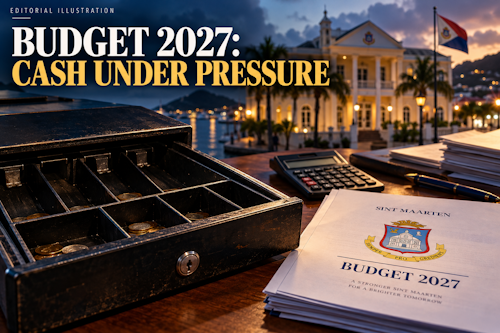
budgetpressure22102026PHILIPSBURG:---  Government’s projected Cg 8 million budget surplus for 2027 comes with a stark warning from the Minister of Finance herself: the country expects to close the year with approximately Cg 2 million in free liquidity, leaving little room for unexpected financial demands.

The written answers accompanying the draft 2027 budget show a government operating with a narrow cash buffer, facing unresolved healthcare liabilities, exposure to government-owned companies, and rising borrowing costs.

A surplus may help government meet its budgetary requirements. It does not, by itself, guarantee that sufficient cash will be available when bills become due.

The minister explicitly makes that distinction. Government projects opening free liquidity of approximately Cg 5 million in 2027, falling to about Cg 2 million by year-end.

That leaves the Treasury vulnerable if revenue collections disappoint, healthcare obligations increase, or a government-owned company requires financial support.

These are risks identified in the minister’s own answers.

Government’s exposure includes a Cg 75.6 million loan associated with GEBE’s generator investments and a Cg 3.5 million guarantee connected to TelEm’s severance programme. TelEm has also requested a further Cg 5 million guarantee, which the answers describe as under assessment when the budget was prepared.

These amounts represent different forms of exposure and should not be treated as immediate cash demands. Nevertheless, the minister acknowledges that the full financial exposure to some government-owned entities cannot yet be quantified because current audited financial information is unavailable.

Meanwhile, interest costs are projected to climb from approximately Cg 26 million in 2026 to Cg 31 million in 2027.

That increase is already part of the budget outlook. It nevertheless shows how much more of the country’s resources must go toward financing debt rather than delivering services.

The minister also identifies refinancing risks in 2029 and 2030: if interest rates are higher when existing loans must be refinanced, future budgets could face additional pressure.

The government argues that its projections reflect the best available information and that it can address material changes through budget amendments.

But amendments cannot substitute for cash.

Parliament's central test is whether the projected surplus is supported by credible collections, a complete picture of outstanding obligations, and a practical response to financial shocks.

On the minister’s own account, several of those risks remain unresolved. The Cg 8 million surplus therefore offers a much narrower measure of financial comfort than the headline figure might suggest.


Government cannot give Parliament a complete, verified picture of its unpaid bills.

unansweredquestions22102026PHILIPSBURG:---  The government is presenting its 2027 spending plans without a complete, fully verified overview of how much it owes in outstanding payments or how old those obligations are.
That admission appears in the Minister of Finance’s written answers to Parliament and exposes a serious weakness in the country’s financial administration.

When asked for the current value of payment arrears, their age, and the expected settlement timetable, the minister says the obligations span multiple ministries and budget cycles. Some remain subject to verification or reconciliation.

The answer does not supply the requested total or an overall payment schedule.

For businesses supplying government, those missing details have practical consequences. Suppliers must pay employees, meet operating expenses, and manage their own commitments while awaiting payment.

For Parliament, the gap makes it harder to assess how much pressure existing obligations could place on future cash resources.

The government’s projected closing free liquidity of about Cg 2 million in 2027 makes that uncertainty particularly significant. A narrow cash buffer is difficult enough to manage when the outstanding bills are fully known. An incomplete overview adds another layer of risk.

The minister identifies reforms intended to improve control.

A purchase order process records commitments when government enters into them, giving Finance earlier visibility into future payments.

The Ministry of Finance has also centralized invoice registration. The minister explains that invoices previously sent directly to individual departments could remain in administrative processes for extended periods before reaching Finance.

Under the centralized approach, ministries must still confirm delivery of goods or services before Finance approves payment.

These measures address a clear administrative problem: Finance cannot plan payments properly if obligations arrive late or remain scattered across departments.

The minister also expects the ERP and SOLL systems to improve tracking and reporting.

However, the answers do not establish when government will produce the complete, verified overview Parliament requested.

The disclosure does not mean every outstanding bill is overdue, disputed, or missing from the accounts. It means government could not provide Parliament with a fully verified consolidated picture of the value and age of its outstanding payment obligations.

That distinction matters. So does the absence of the picture itself.

Parliament needs a dated reconciliation plan, an assessment of the oldest obligations, and a credible settlement strategy. Until those are supplied, the government’s financial projections remain accompanied by a basic unanswered question: how much must still be paid, and when?

Healthcare funds lose about Cg 50 million a year, but reform timetable remains unfinished.

fundshealthcare22102026PHILIPSBURG:--- Healthcare funds have recorded average annual deficits of approximately Cg 50 million, yet the Minister of Finance’s answers on the draft 2027 budget provide neither a finalized reform package nor a definitive implementation date.
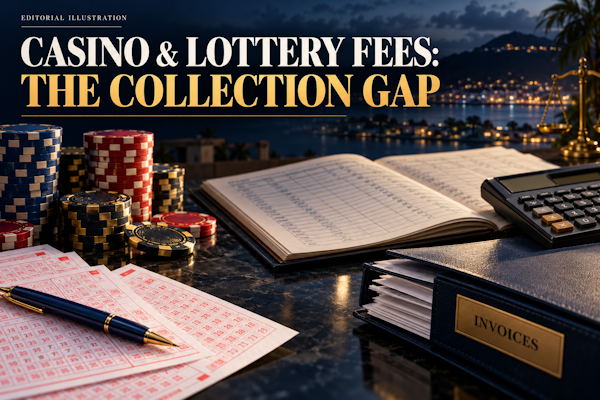
The document acknowledges that the deficits are unsustainable. It also leaves unresolved how much of the financial pressure will ultimately fall on the country’s budget.

The answers describe structural reform as necessary, with Finance, VSA, and SZV expected to work together to contain costs and strengthen the funds.

What Parliament is not given is an agreed timetable showing when those changes will take effect.

The projections described in the answers place the ZV, OV, and FZOG funds in negative reserve positions in 2026, with those positions worsening through 2030 under the current policy scenario.

This does not mean every social fund will exhaust its reserves. The minister states that AOV, AWW, AVBZ, and Cessantia are projected to retain positive reserves through 2030.

But the deterioration identified in the other funds demands more than a general commitment to reform.

Asked what portion of the healthcare or SZV shortfall would become a country obligation, the minister points to ongoing General Health Insurance discussions and the broader healthcare reform process.

The answer does not quantify that potential obligation.

The document also says a formal stress test specifically assessing the budgetary impact of SZV reserves declining faster than projected has not yet been completed.

Government is therefore identifying a significant fiscal risk while still assessing its possible consequences.

Historical balances between government and SZV present another unresolved issue. The minister says the detailed breakdown is being compiled and verified, and information will be provided before the public budget meeting.

At this stage, the 2027 budget includes no specific provision for a repayment or settlement arrangement.

The budget does provide Cg 22 million for Medical Assistance and Cg 5.5 million for the government’s annual contribution to SZV. Those allocations should not be mistaken for a confirmed settlement of historical debt.

There is also uncertainty over the legal assessment of cross-financing between social insurance and healthcare funds. The minister says she cannot confirm whether an independent legal opinion exists and will verify the position with VSA and SZV.

That answer does not establish that cross-financing is unlawful. It establishes that the requested legal assurance was not supplied.

The financial warnings are substantial. The implementation commitments remain incomplete.

Parliament’s task is to demand the missing figures, the stress test, the legal clarification, and a reform schedule against which the government can be held accountable.

Casino and Lottery fees: Cg 9.9 million recorded, Just Cg 3.2 Million collected in 2021.

budgetgap221020206PHILIPSBURG:--- Government recorded Cg 9.9 million in casino and lottery fee revenue in 2021, but collected only Cg 3.2 million in cash that year, according to the Minister of Finance’s written answers on the draft 2027 budget.
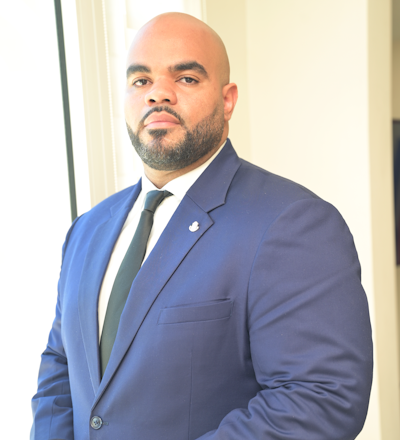
The Cg 6.7 million difference illustrates a fundamental problem for a Treasury facing tight liquidity: revenue recorded in the government’s accounts does not automatically become money available to pay bills.

The minister uses the figures to explain accrual accounting. Fees are recognized as revenue when invoiced, while collecting those outstanding amounts later improves cash resources without creating new revenue for the later year.

The accounting distinction is valid. It also exposes the importance of collecting what government has billed.

The figures mean approximately one-third of the revenue recorded for that category in 2021 was collected in cash during that year.

They do not establish that the entire Cg 6.7 million difference remains outstanding today. The answers do not provide a reconciliation showing subsequent collections, adjustments, or the remaining balance from that year.

That missing update is central to assessing collection performance.

When asked whether the casino and lottery fee collection backlog had been cleared, the minister repeated that approximately Cg 10 million in revenue is projected for 2027.

A revenue projection does not answer whether the backlog has been resolved.

Parliament still needs an updated account of outstanding fees, their age, amounts recovered, and the steps being taken to collect legally enforceable balances.

The same distinction appears in the minister’s explanation of business-license revenue, which is projected to rise from Cg 7 million to Cg 12 million.

According to the answers, that increase reflects improved information about invoiced amounts and the use of accrual-based projections. It does not necessarily mean businesses will suddenly pay substantially more cash.

That makes collection performance essential to judging the budget's strength.

Government expects to finish 2027 with approximately Cg 2 million in free liquidity. In that environment, turning valid receivables into cash is a direct financial priority.

The minister is right that collecting previously recognized revenue does not create new revenue. But that explanation doesn't answer whether the money has actually been recovered.

For Parliament and the public, the question remains straightforward: how much is still collectible, and what is government doing to collect it?

VROMI Minister Gumbs on Road Fund

patrice08102026PHILIPSBURG:--- The Minister of Public Housing, Spatial Planning, Environment, and Infrastructure(VROMI), Patrice Gumbs, issued a statement regarding the discussion around the road fund.


Minister Patrice Gumbs acknowledged that additional work on the legal structure (Road Fund) was still needed, as confirmed during Wednesday's Council of Ministers Press Briefing, and the aim is to have this finalized and fully implemented in 2028. This will allow the total amount collected in road tax to finally be allocated towards the islands' infrastructure. This comes following the response of August 2026 from the Council of Advice, the final legal review authority before a budget goes to Parliament, on the proposed implementation plan submitted by the Ministry earlier this year. Gumbs stated that the Council of Ministers had decided to allocate all road tax to roads.

The Ministry of Finance later communicated that the decision to allocate all road tax collected to the roads was not taken up, and a second decision was made to allocate all road tax funds to the roads. It was later communicated that any changes would delay the 2027 budget and that the remaining road tax funds were allocated elsewhere in the budget.

The Minister of VROMI confirmed that a compromise was reached to increase the amount going towards roads in 2027 without requiring other ministries to cut their own budgets. The compromise also included assurance that, as of 2028, the entirety of the road tax would go towards roads. For the 2027 budget, VROMI will receive XCG 5 million once Parliament passes the budget, with the line item unrevised during the approval process (budget debate).

The Minister of VROMI said the population continues to pay road tax, but the allocated amount has steadily decreased since 2010. The audit chamber flagged this lack of direct allocation as contrary to existing law. Gumbs said that whether a legal road fund exists is not a reason not to allocate all road tax to roads. “People pay this tax in good faith that it is being applied to the roads, and their mounting frustration is understandable when it is not. I must advocate for rectifying something left unfinished since its inception”, Gumbs stated. 

 "I do understand that my colleague, the Minister of Finance, is ultimately responsible for balancing a budget and its priorities, which is no easy feat. As a coalition member, we will continue to work together to find solutions or compromises like the aforementioned for the greater good. This is what I meant by the full implementation of the road fund, not that the Ministry of Finance itself delayed its legal implementation. Any insinuation of such was therefore not intended." Gumbs finished.

Budget 2027 is scheduled to be debated in Parliament the first week of November.


Subcategories

Vinaora Nivo Slider 3.x
Vinaora Nivo Slider 3.xVinaora Nivo Slider 3.x
Vinaora Nivo Slider 3.x