




Dear Editor,
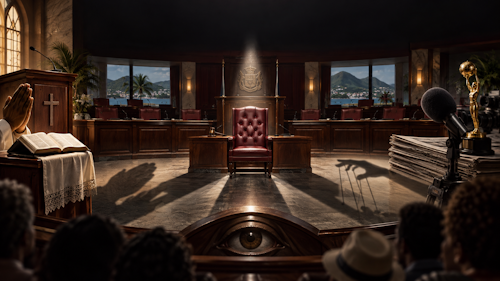 The solemn opening of St Maarten’s 2026-2027 Parliamentary Year should force this country to confront two serious questions: Where is the boundary between Church and State, and what happens when Parliament begins rewarding the media institutions that are supposed to scrutinize it?
President of Parliament Sarah A. Wescot-Williams opened the solemn meeting by referring to Article 46, paragraph 2, of the Constitution. That provision states that the Parliamentary Year begins on the second Tuesday of September with a speech by or on behalf of the Governor outlining the policies of government.
Immediately afterward, the Chairlady invited Pastor Nigel Brooks to deliver an invocation prayer.
Pastor Brooks said he represented the Saint Martin United Ministerial Foundation, supported by the Christian Council and the Seventh-day Adventist Church.
“I stand here to pray the will of God on the opening of this 2026-2027 Parliament session,” he declared.
The prayer invited the Holy Spirit into the parliamentary chamber and ended “in Jesus’ mighty name.”
Let me be clear: this is not an attack on Christianity, prayer or Pastor Brooks. His appeal for wisdom, integrity, justice and the removal of selfish ambition, partisanship and pride was appropriate and desperately needed in a Parliament where political games too often overshadow the suffering of the people.
The question is whether an explicitly Christian prayer should be incorporated into the official proceedings of a state institution that represents every citizen.
Parliament belongs to every citizen
St Maarten is home to Christians, Muslims, Hindus, Rastafarians, members of other religious communities, people with personal spiritual beliefs and citizens who do not subscribe to any religion.
Parliament belongs equally to all of them.
Freedom of religion means that every person is free to pray, worship and practice his or her faith. It does not automatically mean that Parliament, as an institution of the State, should adopt one religious tradition as part of an official constitutional ceremony.
The Constitution recognizes religious belief without forcing it upon everyone. Public officials can swear a religious oath or make a secular affirmation. That choice demonstrates respect for both believers and non-believers.
Why, then, was no such balance visible during the opening of Parliament?
When did Parliament decide to introduce an invocation prayer? Was this decision discussed by the Presidium? Were all 15 Members of Parliament consulted? Is it contained in the Rules of Order? Was any consideration given to people of other faiths?
The public announcement for the solemn opening referred to the Governor’s address, invited dignitaries and the President of Parliament Award. It did not inform the population that Parliament had added an explicitly Christian invocation to the official ceremony.
If Parliament intends to continue this practice, it must establish an inclusive and transparent policy. It could introduce a neutral moment of reflection or invite representatives from different religious and belief communities on a rotating basis.
Parliament should not quietly turn a constitutional ceremony into a denominational event without public discussion.
The Church must remain free to guide the nation's conscience and criticize political wrongdoing. The State must govern fairly on behalf of every citizen, regardless of religious belief. When the State begins selecting which religion will officially bless its proceedings, that important distinction becomes blurred.
Why is Parliament awarding the media?
The second matter is equally troubling.
During the activities surrounding the opening of the Parliamentary Year, Parliament recognized The People’s Tribune, a media house.
That recognition must not be confused with the annual President of Parliament Award presented to an outstanding young person. The media recognition was separate, and it raises a serious question:
Why is Parliament awarding a media house that is supposed to be independently scrutinizing Parliament and the politicians sitting inside it?
This is not about whether any journalist works hard or deserves recognition. Journalists perform an essential public service, often under difficult conditions and with limited resources.
The issue is who gives the award.
Recognition from an independent professional organization is one thing. An award from the political institution a journalist or media house is expected to monitor is something entirely different.
The media is called the Fourth Estate because it is supposed to stand apart from the legislative, executive, and judicial branches. Its responsibility is to investigate those who exercise power, expose wrongdoing, test official claims, and provide the public with information that politicians may prefer to keep hidden.
The press is not supposed to seek applause from Parliament.
It is supposed to hold Parliament accountable.
The Public deserves full disclosure
Parliament should immediately disclose:
- Who nominated The People’s Tribune for recognition;
- Who selected the media house;
- What criteria were used;
- Whether other media houses were considered;
- Whether the decision was approved by Parliament or made solely by the Chairlady;
- Whether Parliament or government has purchased services from the recipient;
- Whether the recipient or its representatives have performed political, governmental, consultancy or public-relations work;
- What public funds were spent on the award and related activities.
Asking these questions is not an accusation of corruption. It is a demand for transparency.
An award does not, by itself, prove that a media house has been compromised. However, it creates an appearance of closeness between the watchdog and the institution it is supposed to watch.
That appearance matters.
Will the recipient vigorously investigate the Chairlady who recognized it? Will it question Parliament’s spending, expose its failures and criticize MPs without fear or favor? Or will the award create a sense of gratitude, loyalty or obligation?
The public should never have to wonder whether favorable political coverage is journalism, public relations or repayment for access and recognition.
Media operatives in political pockets betray the people
St Maarten is a small community where politicians, journalists, consultants, party officials and government communications personnel frequently share the same social and professional circles.
That reality demands more disclosure, not less.
Anyone working in journalism while also performing political consultancy, public relations or communications work must reveal those relationships. A person cannot privately help package a politician’s message and then publicly report on that politician while pretending that no conflict exists.
The same principle applies to government advertising, contracts, appointments, travel opportunities, privileged access and awards.
Media houses cannot demand transparency from government while hiding their own financial and political relationships.
They cannot condemn conflicts of interest inside government while refusing to acknowledge conflicts of interest within the media.
A media house that openly supports a political party can at least be judged by the public with that knowledge. Far more dangerous is the media operation that calls itself independent while quietly protecting selected politicians, suppressing damaging information, softening headlines, attacking political opponents or publishing prepared political narratives as objective journalism.
When media operatives enter the pockets of politicians and government, truth becomes the first casualty.
Public trust becomes second.
Democracy cannot function properly when the watchdog is being fed, praised or rewarded by the very people it is supposed to monitor.
Parliament must answer
Parliament must explain both decisions.
It must explain when and how an explicitly Christian invocation became part of the solemn opening of the Parliamentary Year.
It must also explain why a media house was selected for recognition, who made that decision and what safeguards exist to protect the independence of the press.
The cost of the opening ceremony and all connected awards should also be made public, including expenditure on trophies, plaques, receptions, decorations, entertainment and promotional materials.
The Church must be able to speak truth to political power without becoming an instrument of the State.
The press must be able to expose political power without becoming dependent on its money, access, praise or awards.
The Church may guide consciences. The State must govern everyone. The Fourth Estate must scrutinize both.
When those boundaries are erased, those in power can surround themselves with prayer, praise and favorable publicity while escaping the independent scrutiny that democracy—and the people of Sint Maarten—deserve.
J. Jones is a native of Sint Maarten who deserves to know who and what I am voting for.