Alston Lourens draws on his St. Kitts family roots to explore the connections among seven neighboring Caribbean islands.
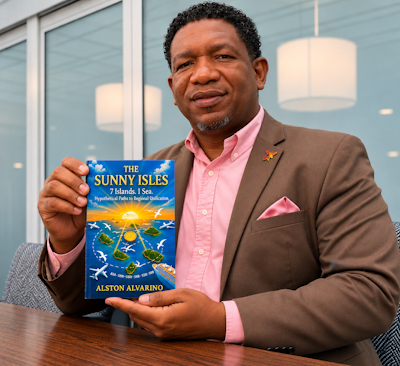 PHILIPSBURG:--- St. Martin media professional and author Alston Lourens, writing under the pen name Alston Alvarino, has released a new book, The Sunny Isles: 7 Islands. 1 Sea. Hypothetical Paths to Regional Unification, which explores the historical, cultural, economic, and political connections between seven neighboring Caribbean islands.
The publication focuses on St. Martin, Anguilla, St. Barths, Saba, St. Eustatius, St. Kitts and Nevis, a group of islands so geographically close that neighboring shores can be seen from one another's coastlines, yet separated by different political systems, administrative arrangements and international boundaries.
Despite these divisions, the islands share centuries of history, family connections, migration, trade and cultural exchange.
For Lourens, the book's inspiration is deeply personal. Born and raised in St. Martin, with family roots in St. Kitts, where his mother was born, he grew up understanding that Caribbean identity and family relationships often extend beyond the boundaries of any single island.
"My connection to St. Kitts through my mother has always been part of how I understand who I am and where I come from. Like so many Caribbean families, our roots don't begin and end on one island. That connection made me think more seriously about how closely related our communities really are, and why we don't always approach our development with that same understanding," Lourens said.
The Sunny Isles examines the practical challenges facing small island communities, including regional transportation, economic vulnerability, trade, mobility and the limitations created by differing administrative arrangements.
However, Lourens argues that despite these obstacles, regional cooperation is already part of everyday Caribbean life.
"Every single day, people from these islands are doing business with one another. Our people travel between islands for food, healthcare, business, sporting events and family connections. We trade, we compete, we celebrate together, and we depend on services and opportunities that sometimes exist just across the water. All of this is happening despite the obstacles. Imagine what could be possible if we made those connections easier instead of more difficult," he said.
Lourens also questions whether St. Martin has devoted sufficient attention to strengthening its relationships with its closest Caribbean neighbors, particularly when compared with the political and institutional attention given to Europe.
"On this island, we put so much energy into figuring out how we fit, sometimes quite awkwardly, into European structures and the European Union, while overlooking the natural connections that exist just across these shallow waters. We are talking about seven islands close enough to see neighboring shores from their coastlines, yet we often approach development as though we are worlds apart. How can we expect to truly thrive if we are not seriously exploring the opportunities that exist with the people closest to us?" Lourens questioned.
He stressed that closer Caribbean cooperation does not necessarily require abandoning existing relationships with European institutions, but rather recognizing that regional partnerships deserve greater attention in discussions about economic development and the future of the islands.
Rather than advocating a single political solution, the book explores several hypothetical approaches to regional cooperation, ranging from improved transportation networks and economic partnerships to shared institutions, regional compacts and more ambitious possibilities involving confederation and federation.
Lourens emphasizes that the publication is intended to encourage discussion rather than prescribe a particular political future.
"This is not a book telling seven islands that they must become one country. It asks whether we have fully explored what we could accomplish together. Sometimes the opportunities we are looking for may be much closer to home than we realize," he said.
The book also examines opportunities for cooperation in tourism, education, healthcare, entrepreneurship and the creative industries, while acknowledging the distinct identities, political circumstances and interests of each island.
One of its central messages is captured in the phrase, "Seven islands. One sea. Too many borders."
Beyond exploring regional cooperation, Lourens hopes the book will encourage younger generations to think differently about the Caribbean and their potential role in its development.
He is currently undertaking a school-based literary and educational initiative introducing students to the book's central themes, with plans for complimentary book distribution, author presentations and opportunities for students to explore regional challenges through research, writing and entrepreneurship.
The initiative also proposes a student essay competition encouraging participants to develop original ideas for businesses, projects or programmes that could connect St. Martin with neighboring Caribbean communities.
Lourens is inviting other interested schools and educational institutions to explore similar collaborations.
"I would love to see students begin asking questions about the region they are inheriting. If a young person can identify a problem affecting two or three neighboring islands and imagine a business or initiative that addresses it, then we have already started a valuable conversation," he said.
The Sunny Isles is one of five books Lourens has published on Amazon under his pen name, Alston Alvarino. His writing explores questions of Caribbean identity, history, power, development and the systems that influence the lives and futures of communities.