Nine years after Hurricane Irma, residents are still waiting for fiber and reliable mobile coverage. Orange and Madiacom are awaiting local permits for 5G installations, and budget approval could come in December.
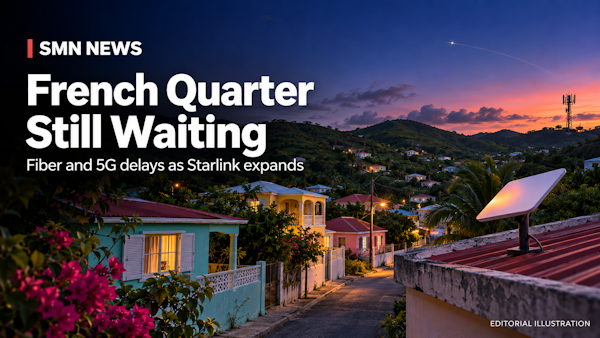 QUARTIER D’ORLÉANS, Saint-Martin:--- Nine years after Hurricane Irma, residents in parts of French Quarter are still waiting for fiber they can order and mobile internet they can use reliably indoors. The July 24, 2026 deadline to provide mobile voice and high-speed data in the designated Quartier d’Orléans coverage zone passed without the obligations being met, according to information SMN News obtained. Orange and Madiacom are still awaiting permits from the Collectivité to install 5G equipment. Budget approval is also pending and could come in December 2026.
For local carriers, each month of delay makes it harder to win back households and businesses that have already installed Starlink. Now the satellite company is preparing to deliver faster data directly to compatible mobile phones. If that service becomes available on plans visitors already use, carriers could also lose some of the money they earn selling data to travelers.
French Quarter was named in the coverage obligation
France’s telecom regulator, Arcep, explicitly identified a zone in Quartier d’Orléans in its frequency decisions. The July deadline applied to mobile voice and very-high-speed mobile data in the defined zone. Arcep’s October 2026 survey confirmed that Orange and Dauphin Telecom had deployed 5G in parts of French Saint-Martin. It also found that Orange led the territory on measured mobile speeds and shared first place with Dauphin for fast web-page loading. Those territory-wide results leave residents with the same practical question: can they use the service at home and in business?
SMN News previously identified antenna structures listed to Digicel on Route de Coralita, Orange on Rue Martha Illidge, and Dauphin Telecom on Rue Mullet Fish. Residents continue to report dead zones and unreliable service. The antenna listings establish where infrastructure is recorded. Street-by-street tests would establish where residents can actually make calls and use mobile data, including indoors.
Madiacom operates the shared radio network of Digicel and Free Caraïbe. Earlier local reporting documented a proposed shared 4G tower in French Quarter and opposition to a separate antenna project. According to SMN News, the current Orange and Madiacom 5G applications are awaiting local permits. The filing dates, permit references, and sites still need to be made public. The possible December budget approval also leaves open which works it will finance and when equipment could go into service.
Fiber remains out of reach on underserved streets
In its November 5 investigation, SMN News identified Impasse Alexandre Adams as one of the locations where reported fiber availability does not match residents’ experience. Orange lists Quartier d’Orléans as a fiber deployment area and took responsibility for deployment there under a 2020 agreement with Dauphin Telecom. Residents on affected streets still need a firm answer on whether they can place an order and when a technician can connect them.
In a November 7 response to SMN News, Tintamarre President Gilles Gumbs said the first phase of the underground duct network was complete and in service. The second phase still awaited financing after an expected 2024 grant failed to materialize. Gumbs said the alternative financing package was still being prepared when the November 13 Territorial Council agenda was drawn up. Tintamarre builds and operates the ducts. The operators install and activate the fiber and must correct inaccurate coverage declarations.
President Louis Mussington’s RSMA lost its Territorial Council majority after five members left. If the Tintamarre financing package comes before the council in December, the administration would need support beyond its own bloc to secure approval. Opposition and independent councilors could ask for a full accounting of the funding shortfall, each partner’s contribution, and a timetable for connecting underserved streets before backing the proposal. If Mussington cannot secure enough votes, a decision could slip beyond December and further delay the second phase of work.
A tourism economy is missing out on visitor data sales
Tourism carried Saint-Martin’s economy in 2025, according to the territory’s economic report from IEDOM. Connectivity is part of what visitors pay for. They use mobile data for directions, restaurant reservations, rental check-ins, and contacting tour operators. Local carriers can earn money through prepaid SIM cards, eSIMs, data top-ups, and wholesale roaming when a visitor’s foreign provider uses a local network.
A visitor who expects patchy coverage may skip a local data package, rely on accommodation Wi-Fi, or buy a travel eSIM before arrival. Some travel eSIMs still use a local network and may generate wholesale revenue, depending on the arrangement. Direct sales and any subsequent top-ups can still go elsewhere. Hotels, villas, and rental managers that use satellite for guest Wi-Fi can also shift broadband spending away from local providers. No public figures establish how much visitor spending or carrier revenue Saint-Martin has already lost.
Starlink is already reaching ordinary smartphones
Starlink has been available on the French side since July 2022. Early adopters have had more than four years to use it. Households that already bought a dish and have a dependable connection have little reason to switch while a local provider cannot give them an installation date. Working fiber still has a strong sales case. It can offer faster uploads and lower latency, and a business can keep satellite as a backup.
The next threat is Starlink Mobile, which connects compatible phones directly to satellites. T-Mobile in the United States already uses Starlink to provide satellite connectivity for messaging and selected apps, including WhatsApp and Google Maps, outside terrestrial coverage. Starlink says its next generation of satellites will bring broadband directly to mobile phones. Reuters has also reported that SpaceX acquired wireless spectrum licenses from EchoStar as part of its mobile expansion. The confirmed development is service for compatible phones people already own. No Starlink handset has been announced, and there is no confirmed retail launch date for satellite mobile service in French Saint-Martin or Sint Maarten.
If travelers can use satellite data through their home carrier in Saint-Martin, some may have less reason to buy a local SIM or data pass. If the satellite service carries traffic that would otherwise roam on a local network, local operators could also lose some wholesale revenue. The size of the impact would depend on local authorizations, coverage, device compatibility, pricing, and whether a local carrier participates. The U.S. example shows how an operator can sell satellite access as part of its own service.
Orange and Dauphin face the most direct pressure on home broadband. Dauphin Telecom Infrastructures also holds 20% of Tintamarre, giving the group a stake in completing the duct network. For Digicel and Free, the immediate risk is that customers keep a basic phone plan while doing most of their internet use over Starlink Wi-Fi. Broader satellite mobile service would put more of their data and roaming business in play. A Madiacom network upgrade could improve service for both brands once permits are issued and the equipment is installed.
The Collectivité can now answer three questions residents and businesses have waited years to resolve. When will it decide the Orange and Madiacom permits? Which works could receive budget approval in December? And when will residents on the streets still waiting be able to order fiber or use reliable mobile service at home?