Minister says new companies can qualify and access to equipment can satisfy submission requirements—but operational capacity must be verified before contracts are finalized.
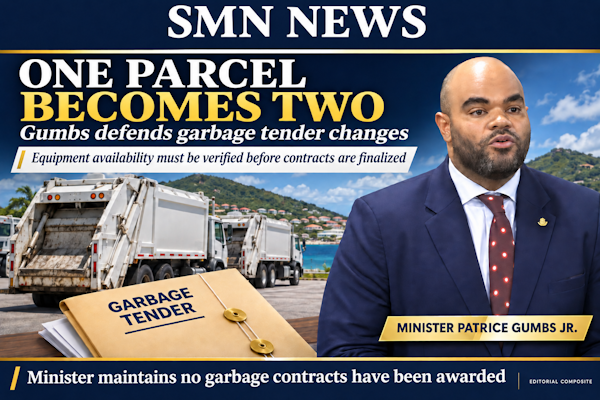 PHILIPSBURG: Minister of VROMI Patrice Gumbs Jr. confirmed that the government changed the garbage tender rules to allow a company to receive two parcels instead of one, defending the adjustment as a way to improve service quality and continuity while acknowledging that prospective contractors must still demonstrate they have the equipment and capacity to perform.
His additional responses during the 2027 budget deliberations provided a fuller account of the disputed procurement process, including the treatment of newly established companies, equipment requirements, missing government documents and the use of funds left over after roadside-cleaning contracts ended.
The minister maintained in his earlier answers that no garbage contracts had been awarded. He described the names circulating publicly as the outcome of individual parcel assessments rather than a final contracted list.
Taken together, his responses place the next stage of scrutiny on the verification process: which companies can substantiate their capacity, what records support that determination, and whether any parcel must be reallocated.
Minister Confirms One-to-Two Change
Gumbs said the original tender limited each company to one parcel. The revised tender permits a maximum of two.
He defended the change as an attempt to balance competition with service quality and operational efficiency.
According to the minister, a one-parcel limit could prevent a qualified contractor from serving another area even where it has sufficient equipment, personnel, experience and capacity.
Allowing two parcels, he argued, gives the evaluation committee greater flexibility to place work with contractors demonstrating the strongest ability to deliver the required service.
He also said bidders from the previous tender had expressed concerns about the earlier restriction.
The minister did not identify those bidders during this response or present a comparative assessment showing how the change would affect competition, costs or service reliability.
His explanation establishes the government’s stated justification. It does not, by itself, resolve concerns about how the revised rule was applied to individual companies.
Equipment Access Can Qualify at Submission
Gumbs confirmed that tender submissions can include documentation showing either ownership of equipment or access to it.
He said that provision had not changed from the previous process.
What had changed, according to the minister, was an additional verification stage at which bidders must demonstrate that the equipment is actually available.
Gumbs linked the measure to problems during the 2021–2026 contracting period, saying contracts were awarded to companies without all the equipment needed to service their parcels.
The distinction matters: permission to submit evidence of equipment access differs from verification that trucks and other resources will be available to execute the work.
The minister said the ministry must be satisfied that prospective contractors have access to the necessary trucks, machinery, personnel and other resources before contracts are finalized.
His response did not provide a bidder-by-bidder verification outcome.
New Companies Are Not Automatically Excluded
Asked how a newly established company without a history in garbage collection could receive multiple parcels, Gumbs said a company’s age or incorporation date does not automatically disqualify it.
Instead, bidders are assessed against the eligibility, technical, financial and operational requirements in the tender documents.
A new company could potentially receive two parcels, he said, provided it satisfies the relevant qualification requirements and demonstrates sufficient operational capacity.
However, he emphasized that participation in a tender and the ability to successfully perform a contract are separate matters.
That answer neither confirms that a particular new company met the requirements nor establishes that any specific bidder should be excluded. It sets out the ministry’s position that it must determine qualification through the published criteria and subsequent verification.
Failure to Verify Can Lead to Reallocation
The minister said the revised process includes meetings with prospective contractors to establish which parcels they can realistically manage.
Bidders must complete the required documentation and substantiate equipment availability before contracts are awarded. Failure to satisfy those requirements can trigger reallocation.
He also explained that parcels are evaluated individually. A company may therefore rank highest for several parcels even though it cannot ultimately receive more than two.
In his earlier responses, Gumbs said two companies had been assessed as eligible for two parcels each.
Their ability to execute remained subject to confirmation through the meetings and verification process, he said.
The additional explanation reinforces his distinction between assessment results and final awards. It also makes the verification records essential to understanding how the final allocation will be reached.
Seven-to-Ten-Year Recommendation Still Hangs Over Shorter Term
The equipment discussion unfolded alongside questions about whether contractors can make sustainable investments within the proposed contract period.
Gumbs previously told Parliament that a Grant Thornton assessment commissioned by the ministry recommended solid-waste contracts lasting at least seven to ten years.
Government nevertheless chose a shorter period because of anticipated changes to landfill management and pricing associated with the Trust Fund project to rehabilitate and close the landfill, he said.
He also argued that government contracts are meant to purchase services rather than finance private companies' full investment needs.
Asked in additional responses how contractors could do more work for less money, Gumbs said bidders are expected to submit realistic and sustainable proposals that account for personnel, equipment, fuel, maintenance, transportation and other operational costs.
He stressed that the ministry’s responsibility continues after award through performance monitoring and contractual standards.
However, he did not provide a cost comparison showing how the required services could be delivered sustainably at the questioned amounts.
No Mid-Tender Relaxation for Delayed Documents
Gumbs also addressed companies struggling to obtain required documents, including tax documentation, from other government entities.
He acknowledged the difficulty but said all bidders receive the same period to prepare their submissions.
“We cannot change terms for a few during an ongoing tender,” he said.
He urged companies experiencing delays to raise them as early as possible so the ministry could determine whether assistance might be available.
The response did not announce an exemption, an extension or a remedy for a particular bidder.
Roadside-Cleaning Surplus Used Elsewhere
The additional data also disclosed that money remaining after roadside-cleaning contracts ended was used beyond cleaning activities.
Gumbs said the surplus helped finance temporary road and beach cleaning. Although household bins had been among the intended uses, remaining funds also helped address shortages under other budget posts and urgent projects, including cemetery vaults and car-wreck collection.
He did not provide the total surplus, a breakdown of transfers or the amount ultimately available for bins.
Those figures remain necessary to establish precisely how the allocation was used.
Separately, the minister said district-cleaning bids submitted on October 9 were still being evaluated. He announced plans for another island-wide cleanup before the new district-cleaning contracts begin.
District cleaning and garbage collection are separate processes and should not be treated as the same tender.
Documentation Will Determine Whether Assurances Hold
Gumbs’s responses provide a clearer defense of the revised garbage tender: two parcels are permitted, new companies can qualify, equipment access can support an application, and final capacity checks can result in reallocation.
He has also acknowledged receiving bidder documentation and questions, which he said were under review.
What Parliament has not yet received through these answers is a complete account of the individual verification results, the disposition of bidder complaints and the basis for each final allocation.
The minister’s assurances now depend on those records. They will show whether the flexibility introduced into the tender is matched by consistent enforcement of its requirements—and whether the contractors ultimately selected can deliver the service residents are paying for.