PFP MP calls for a capital gains tax of at least 4.5%, challenges the benefits of offshore property transactions and clashes with opposition MPs over school donations.
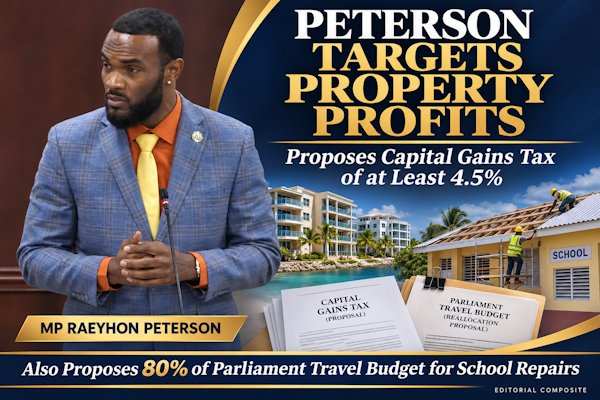 PHILIPSBURG:--- Party for Progress MP Raeyhon Peterson called for a greater financial contribution from the real estate sector during the 2027 draft budget debate, asking Finance Minister Marinka Gumbs to examine a capital gains tax of at least 4.5%.
Peterson also announced his intention to bring an amendment reallocating 80% of Parliament’s travel budget to the Ministry of Education, Culture, Youth and Sport for comprehensive public school repairs.
His intervention combined a challenge to the country’s approach to property investment with a defense of school donation procedures and a warning that MPs should respect the distinction between parliamentary oversight and executive decision-making.
“It's time those who don't live here, but make millions in passive income off of us, begin to pay their fair share,” Peterson said.
Who benefits from property development?
Peterson questioned whether St. Maarten was receiving an adequate return from an investment model that, in his assessment, allowed substantial property profits to leave the country while residents helped finance the infrastructure supporting those investments.
He argued that the absence of a capital gains tax had been promoted as an attraction for investors, but said the country needed to examine the balance between investment benefits and residents’ quality of life.
Peterson described developments presented as hotels that subsequently became condominiums. He also raised concerns about properties being held and transferred through offshore companies.
To illustrate his argument, he offered a hypothetical example of a condominium acquired through one offshore company for US$800,000 and later sold to another for US$1.5 million after generating short-term rental income.
He suggested that the ultimate beneficial owners behind separate companies could be the same people.
The example was not a documented transaction involving an identified developer or property. His remarks did not establish wrongdoing by any particular company.
Nevertheless, Peterson used it to question whether the existing system captured a fair public contribution from property-related gains.
A proposed tax collected through notaries
Peterson asked Minister Gumbs whether she had examined introducing a capital gains tax of at least 4.5%, with notaries potentially responsible for collecting, holding and transferring the proceeds to government.
He said he had checked the feasibility of involving notaries in the collection process.
His intervention did not provide a complete legislative model, including the proposed tax base, exemptions or treatment of different ownership structures. The measure was a proposal for examination, not an adopted tax.
Peterson also recalled earlier discussion of a condominium-related tax, which he placed roughly between 2010 and 2015. He said the initiative had not progressed and argued that opposition from developers should not prevent the country from reconsidering how it taxes the sector.
He rejected the suggestion that construction activity alone settled the question of economic benefit.
As a property owner familiar with the industry, Peterson argued that materials and other inputs were frequently sourced outside the Dutch side. Meanwhile, he said, government remained responsible for roads, electricity, water and other services supporting developments and their occupants.
His challenge was to assess what remained in the local economy after weighing those costs and benefits.
Residents should not carry the burden alone
Peterson acknowledged public concerns about additional taxes and charges.
He said he was not necessarily in favor of expecting residents to continue bearing the cost of living in St. Maarten alone.
Instead, he argued that people earning substantial income from the island without living here should contribute more fairly toward its upkeep.
He also questioned taxing short-term rental income, identifying it as part of the broader discussion about revenue from property.
His remarks placed real estate alongside other revenue-generating industries being debated by Parliament, including gambling and a potential cannabis industry.
Peterson said he agreed with MP Dimar Labega that the country needed concrete, potentially uncomfortable discussions about generating enough revenue to operate properly. He also endorsed the willingness to consider unpopular fees and charges where justified.
Revenue proposals need staff to process them
Peterson asked the Finance Minister whether the department responsible for reviewing revenue-generating measures had sufficient personnel.
He noted that ministries could develop proposals, but those initiatives still depended on Finance’s ability to examine and advance them.
He requested the number of people assigned to that work and asked whether the department planned to strengthen its capacity.
Peterson linked that capacity question to the government’s wider staffing constraints: proposals would struggle to progress if the departments required to assess them lacked the people to do so.
He separately asked VROMI Minister Patrice Gumbs Jr. to identify where the proposed spatial economic plan appeared in the budget and clarify its financial provision.
School repairs trigger a parliamentary clash
Peterson’s intervention became more confrontational when he defended the ECYS Ministry’s procedures governing donations to public schools.
He said he had personally used the procedure and did not consider it unduly complicated.
Responding to concerns raised by MP Darryl York about assistance to his former primary school, Peterson argued that offers involving roofs, windows, bathrooms and other structural work raised questions of responsibility and accountability.
He also maintained that a donation associated with an MP or minister carried political implications different from assistance provided by a private business.
Peterson warned that political involvement in schools could create perceptions of vote-buying, manipulation, or influence over young people, even when the stated intention was to help.
He referred to past political objections to branded school supplies distributed by a politician and argued that the principle of keeping politics out of schools should be applied consistently.
York rejects the implication
York interrupted to challenge Peterson’s argument.
He said politicians had historically assisted schools and students, including through supplies and other donations, and questioned why structural assistance was now being treated differently.
York maintained that his initiative concerned the needs of schools rather than personal political promotion. He said he had shared the initiative with several other MPs.
He rejected the suggestion that helping his former school should be characterized through the lens of vote-buying and argued that students should not be left without needed repairs because of political disagreements.
MP Ardwell Irion also intervened, redirecting the discussion toward his allegations about procurement and permitting in Sucker Garden.
Irion questioned whether rules were being applied consistently when businesses participated in public projects. His allegations did not establish a permitting violation or improper procurement award.
Peterson pledges a travel-budget amendment
Peterson maintained his support for the school donation procedure and its restrictions.
He said the requirements were not new and argued that MPs should comply regardless of whether they belonged to the coalition or opposition.
He added that he had followed the procedure without publicizing his involvement through photographs or social media.
Peterson then challenged MPs to use their legislative authority to fund school repairs.
“I will bring an amendment to relocate 80% of the travel budget of Parliament to the Ministry of ECYS for comprehensive repairs of our public schools,” he said.
He called for support from members who had spoken strongly about school conditions while continuing to participate in parliamentary travel.
The statement was a commitment to bring an amendment. His remarks did not establish that the reallocation had already been submitted, approved or implemented.
Procurement dispute opens the intervention
Earlier in his address, Peterson disputed criticism that PFP had gone silent on procurement.
He said the party had sent a formal letter to the Finance Minister concerning procurement in February and urged MPs to check the facts before making broad statements.
York interrupted to say he had already questioned the Finance Minister about the procurement initiative during an earlier budget debate and had been told that nothing had come of it.
Peterson responded that York should communicate that distinction within his own faction.
The exchange raised two questions: whether PFP had raised procurement concerns, and whether that intervention produced a substantive outcome.
Parliament must oversee, Peterson argues
Peterson also questioned repeated offers by MPs to help ministers carry out executive work.
He argued that St. Maarten’s parliamentary arrangements required a distinction between supervising the government and taking over its decision-making responsibilities.
He urged ministers to resist pressure that, in his assessment, blurred that boundary.
At the same time, Peterson identified budget amendments as a direct means for MPs to act within their authority.
His intervention left two proposals before the government and Parliament: examine a larger contribution from property gains, and redirect a substantial share of parliamentary travel spending toward public school repairs.