DP leader demands stronger collection from nonresident earners, clarity on short-term rentals and a coherent choice about the direction of tax reform.
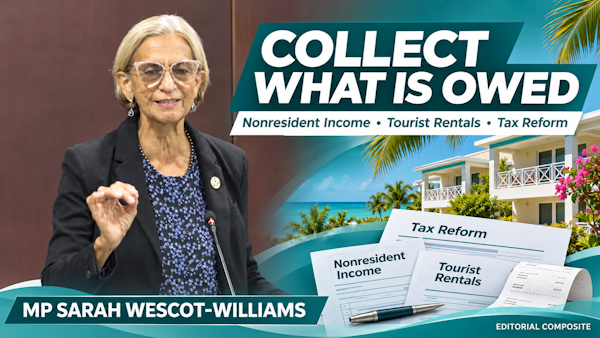 PHILIPSBURG:--- MP Sarah Wescot-Williams has challenged the government to explain how aggressively it is collecting taxes from people who earn money in St. Maarten but live elsewhere, arguing that revenue leakage deserves attention before further pressure is placed on resident taxpayers.
During the 2027 budget debate, the Democratic Party leader demanded clarity on nonresident income, short-term tourist accommodations and the relationship between existing tax-reform work and newly discussed tax concepts.
“How hard are we going behind the money that is made on St. Maarten by persons not residing on St. Maarten?” she asked.
Her intervention linked the country’s need for additional revenue to concerns raised throughout the debate about how the system treats existing taxpayers.
“There is so much leakage in terms of income in this country that we should be looking at before we continue the kind of tax measures against the people who work and live here,” she said.
Tax notices must translate into collection
Wescot-Williams said she had seen Tax Administration notices addressing people earning income locally without residing in St. Maarten.
She wanted to know how actively those obligations were being pursued.
Observing that substantial economic activity involved people living elsewhere, she asked the government to explain its enforcement approach and the results.
Her argument focused on collecting legally due revenue, rather than treating residence elsewhere as proof that a person had failed to pay.
She linked the question to accounts MPs shared about residents’ experiences with tax collection.
Those experiences, she said, made it especially important to establish whether government was pursuing other sources with comparable determination.
What will the short-term rental law cover?
Wescot-Williams requested the scope of the proposed legislation concerning short-term tourist accommodations.
She asked which accommodation categories would be included and whether the draft addressed people living abroad who owned properties or apartments used locally.
Her concern was whether the framework would identify and capture taxable activity that might otherwise escape collection.
She also renewed questions about work involving CARTAC, Airbnb and VRBO.
Was vacation ownership being treated as a separate category? What progress had been made? And when would government receive revenue from that part of the economy?
Wescot-Williams said she understood the focus remained on the visitor tax and that related revenue had not been included in the 2027 budget.
She wanted a clearer account of when that source could begin contributing.
Visitors must contribute to the services they use
Wescot-Williams argued that the country could not separate its tourism economy from the cost of maintaining services and infrastructure.
She linked visitor contributions to the pressures facing a small community, including healthcare coverage and other public obligations.
She said people coming to enjoy what St. Maarten offered should contribute appropriately, and residents should not be left carrying unresolved costs alone.
She did not announce a new charge or propose a specific visitor-tax rate during this contribution.
Instead, she demanded clarity on implementation, legislative progress and whether the revenue would appear through a budget amendment.
Tax reform needs a complete history
Wescot-Williams asked Finance Minister Marinka Gumbs to explain what she inherited in tax reform and how the current approach related to commitments and studies dating back to 2020 and earlier.
She recalled that tax reform had been discussed even before constitutional change in 2010.
She also referred to country-package material that, in her reading, contemplated a value-added tax.
Wescot-Williams mentioned rates appearing in the material, and in the international discussion she referenced, but did not identify an enacted VAT or announce that the government had selected one.
She demanded that the minister establish what had actually been agreed, what work had been completed, and what the present government considered binding or still open for decision.
“I want to know, with respect to tax reform, where that started in 2020, what has happened,” she said.
The question was especially important, she argued, as Parliament considered other tax ideas.
New tax concepts cannot remain disconnected from the existing plan
Wescot-Williams questioned how the transaction-tax discussion fitted into the reform already underway.
She referred to international reservations about transaction taxes in small economies and alternative discussions involving VAT.
Those observations were part of her argument for a clearer policy choice; her statement did not include the underlying studies needed to assess each comparison independently.
Her central point was that government should not continue presenting separate tax concepts without explaining whether they replaced, complemented or contradicted the existing reform phases.
“We can’t have both,” she said in challenging the continuation of competing approaches without a decision.
Before choosing a new direction, she urged the minister to present the full history and current position to Parliament.
Development bank study must build on existing work
Wescot-Williams also requested clarity on the feasibility study for a national development bank.
She reminded ministers that the concept had been discussed for years and asked whether they were aware of SER advice dating back to 2016.
She proposed examining whether the Kingdom’s relationship with the Inter-American Development Bank could help develop the idea.
She had raised the suggestion in correspondence to the Finance Minister and Prime Minister and requested a response to the specific points.
Her intervention did not establish that she had secured financing or technical assistance.
It sought to ensure that a new study took account of previous advice and possible institutional connections.
Put incentives and senior tax policy on the table
Wescot-Williams requested more than a general statement that tax reform would address charitable donations and community incentives.
She said that subject required fuller discussion.
She also asked where government stood on tax policies for seniors and requested an answer to her letter concerning APS and solar financing.
Together, those questions challenged government to explain how reform would affect households, investment and community contributions, alongside its revenue objectives.
Wescot-Williams demanded a financial strategy that residents and Parliament could follow: identify income escaping the system, collect what is due, explain the treatment of visitors and nonresident earners, and settle the direction of reform.
For her, another round of general references to tax reform was insufficient without the policy choices and implementation steps behind them.