MP proposes removing economic development from TEATT, warns against another Finance–TEATT policy clash and confronts ministers with residents’ accounts of blocked savings and uneven cruise business.
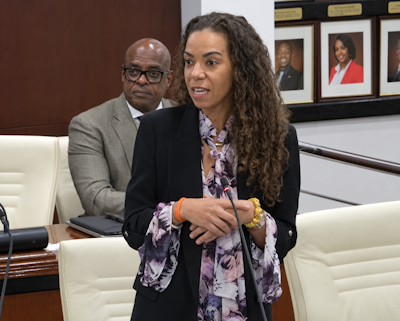 PHILIPSBURG:--- MP Ludmila de Weever has warned the government against letting ministerial disagreements obstruct economic recovery, telling ministers to “get over yourselves” as residents struggle with tax collection and businesses question why cruise arrivals are not translating into customers.
Speaking during the 2027 budget debate, the former TEATT minister argued that economic development and fiscal policy were too closely connected to be handled through competing ministerial agendas.
She proposed removing the economic development function from TEATT and offered to initiate the legislative change needed to reconsider the division of responsibilities.
Her intervention combined a candid account of her own clash with former Finance Minister Ardwell Irion with two messages she said she received from the public: one concerning a senior reportedly unable to access her savings and pension during tax collection, and another from a boardwalk business complaining that water taxi arrivals were concentrated elsewhere.
For de Weever, those accounts illustrated the consequences of treating revenue collection and economic development as separate concerns.
“You can’t do that without giving businesses an incentive to want to exist here,” she said of economic recovery.
Transaction tax discussion revives an old conflict
De Weever said the renewed discussion of a financial transaction tax reminded her of proposals she had presented in Parliament as TEATT minister in 2020.
She questioned the way MPs were discussing the concept without first addressing how it would be calculated and collected.
Her principal warning, however, concerned the relationship between the ministries responsible for economic and fiscal policy.
De Weever recalled a substantial disagreement with Irion when he was Finance Minister, and she was TEATT minister. She said TEATT’s effort to discuss taxation as part of economic recovery had been viewed as an encroachment on Finance’s responsibilities.
“There was no cohesion, no coordination, just no collaboration on the right way,” she said.
She urged current TEATT Minister Grisha Heyliger-Marten and Finance Minister Marinka Gumbs to avoid reaching a similar impasse.
An argument over whose idea should prevail, she warned, could consume time that a struggling country could not afford to lose.
Acknowledging her own part in the disagreement
De Weever did not present that earlier dispute solely as a failure by the former Finance Minister.
She acknowledged that she had not initially understood why her proposal had provoked such a strong response.
Through difficult conversations, she said, she came to understand his concern about the division of responsibilities and recognized the resources available within Finance to evaluate a proposed tax’s implications.
“I would have done the same thing,” she said.
That reflection formed the basis of her warning to the current ministers: policy proposals needed collaboration from the beginning, with economic objectives considered alongside collection methods, implementation requirements and fiscal consequences.
Her criticism focused on the risk of repeating an institutional conflict rather than simply revisiting an old personal disagreement.
Economic development should move out of TEATT
De Weever argued that the structure itself deserved reconsideration.
Under the approach she outlined, TEATT could retain licensing, tourism, maritime affairs, civil aviation and its other operational responsibilities.
The economic development function, however, should no longer remain there, she said.
Her reasoning was that decisions about increasing government revenue could not be separated from decisions about business incentives, investment, and economic development.
She acknowledged that changing the allocation of responsibilities would require legislation, not a ministerial policy decision alone.
“Economic development should not be in TEATT,” she said. “I’m sorry, it just should not.”
De Weever offered to initiate the legislative change but urged colleagues and ministers to consider the proposal carefully.
She did not present a completed restructuring bill, identify a fully developed replacement structure or provide a costed transition plan during this contribution.
Tax collection cannot keep returning to the same pool
Addressing Gumbs, de Weever renewed her criticism of repeatedly collecting from the same identifiable group of taxpayers.
She argued that people living, doing business or owning property in St. Maarten should face comparable obligations, including those who were not permanently resident.
“You have to make it a level playing field,” she said.
Her concern was that residents whose addresses and circumstances were already known to the Tax Administration felt they remained the easiest people to pursue.
She referred to earlier parliamentary discussion of arrangements involving foreign taxpayers and CRIB numbers, arguing that the government needed to address the imbalance rather than keep returning to the same pool.
De Weever linked that issue particularly to the financial vulnerability of seniors.
Some, she said, were struggling to such an extent that they were ashamed to disclose that they were homeless.
Senior reportedly left without access to savings
De Weever read a message concerning a woman whose bank accounts had reportedly remained blocked during a tax collection matter.
According to the account sent to the MP, the woman had offered a substantial lump-sum payment and requested a payment arrangement.
The sender said the situation had continued for approximately two months and asked how someone could be left without access to money for food and bills, including an old-age pension.
The message described the woman seeking assistance from both the Tax Administration and her bank without resolving the problem.
De Weever presented the account as an example of the distress she had been made aware of.
“I get stories like that every week,” she said.
The message did not establish the legal basis for the restrictions, the precise status of the tax debt or whether the proposed arrangement had been accepted. Her statement did not include either the bank’s or the Tax Administration’s response.
Her intervention nevertheless put a direct question before the Finance Minister: how was the government’s collection process affecting vulnerable people’s ability to meet basic living expenses?
Cruise ships are arriving, but where are the customers?
De Weever then read a separate message she said had arrived at 1:23 p.m. that day from a business operator on the Philipsburg boardwalk.
The operator complained that, although the season had started and cruise ships were arriving, businesses on that section of the boardwalk were not receiving the expected trade.
According to the message, water taxis were bringing tourists toward the Sea Palace Hotel side, while restaurants closer to the Greenhouse and St. Rose Arcade area remained quiet.
“All the restaurants on the boardwalk on our side are empty,” the message stated.
The operator asked where to take the complaint and appealed for assistance, saying it was becoming increasingly difficult to cover expenses.
That was the business operator’s account. De Weever did not present passenger-distribution data or establish that water taxi movements were the sole reason for the reported lack of customers.
She used the complaint to challenge TEATT to examine how tourism activity was reaching businesses beyond aggregate arrival figures.
Ministers must exercise their executive responsibilities
De Weever emphasized that MPs were receiving these appeals even though they did not administer the departments responsible for resolving them.
She acknowledged that listening to residents was part of the responsibility they had accepted as public servants.
But she rejected the suggestion that legislative action alone could address every operational problem.
“The Council of Ministers is executive,” she said.
She called on ministers to identify the best way forward rather than resist one another’s proposals.
In her view, the seniors’ tax difficulties and the business operator’s lack of customers belonged within the same economic discussion: government needed revenue, but residents and businesses also needed the means to remain financially viable.
“Those are the two issues that you all are splitting, but they’re the same,” she said.
A warning against losing more time
De Weever placed her remarks against the administration’s approaching two-year mark, noting the disappointment expressed by other MPs during the debate.
She warned the Finance and TEATT ministers that another territorial dispute would consume the time remaining to produce results.
“You got two years left,” she said.
Her contribution left government with two connected challenges: to examine whether its ministerial structure supports coherent economic policy, and to respond to the immediate problems residents and businesses are already bringing to Parliament.
De Weever reserved the remainder of her questions for the second round.