MP Francisco Lacroes accuses government of internal competition and incomplete answers, pressing ministers for financial records, delivery deadlines and measurable results across their portfolios.
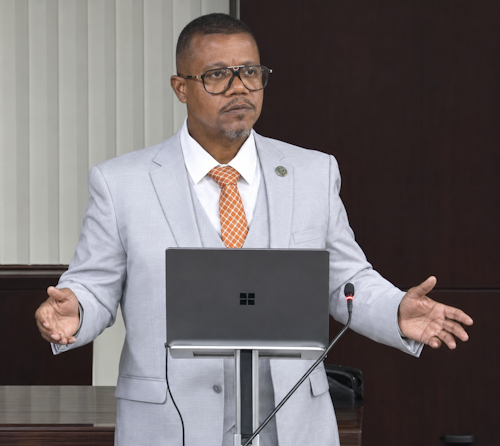 PHILIPSBURG:--- MP Francisco Lacroes delivered a frustrated challenge to government during the 2027 budget debate, accusing its members of competing for attention while the country’s problems demand cooperation, new revenue and accountable leadership.
“The government has a problem, and the problem is within,” Lacroes said. “Everyone wants to shine. Everyone wants to be the top dog. Everyone wants the most articles. Everyone wants the most likes.”
His criticism was accompanied by an extensive series of follow-up questions on government finances, GEBE, healthcare, education, tourism spending, prison readiness, housing and deteriorating roads.
Lacroes repeatedly argued that earlier replies described activities and intentions without providing the documents, deadlines, and performance targets he requested.
He also offered a blunt message to those unable to work together.
“If you can’t get it together, vacate,” he said. “If you don’t know how to get it together, ask for help.”
Cooperation must replace competition
Lacroes warned against a government driven by social media commentary rather than a coordinated plan.
He alleged that some online criticism originated from people connected to political parties themselves, contributing to internal division. His broader argument was that political actors appeared to overlook the consequences of government failure for the entire country.
“When this government fails, we all fail,” he said.
Describing himself as tired, exhausted, and frustrated, Lacroes used a disagreement between his children to illustrate the danger of drawing conclusions without hearing everyone involved.
He acknowledged that he had initially handled that family disagreement incorrectly by intervening before understanding both accounts.
He urged politicians to apply the same lesson: sit down, listen and work toward solutions.
Lacroes renewed his offer to participate in a closed-door brainstorming session on revenue generation, explaining that such a setting would remove the pressure to perform for an audience.
Revenue generation is every minister’s responsibility
Although he questioned Finance Minister Marinka Gumbs about the absence of additional revenue measures, Lacroes rejected the idea that she alone should develop every proposal.
He argued that ministers should identify opportunities within their portfolios, work out the details and bring those proposals to Finance for consideration and execution.
Referring to TEATT Minister Grisha Heyliger-Marten’s tax proposal, he said the approach demonstrated how ministries could contribute ideas.
“It is everyone’s responsibility,” he said.
Lacroes recalled an example from his time working in TEATT, when he raised the application of turnover tax within fuel pricing and was told to identify replacement revenue before a reduction could proceed.
He also expected VSA Minister Claret Connor to follow up on possible revenue from excise or “sin tax” measures.
He said Finance should be held accountable for its decisions, but other ministers first needed to do the work required to bring viable proposals forward.
Financial risks need figures, not general descriptions
Lacroes challenged the Finance Minister to provide a consolidated financial-risk schedule covering healthcare funds, government-owned companies and liquidity.
He said an earlier answer identified average healthcare deficits of approximately 50 million and other exposures but did not provide a complete, quantified account.
He requested a schedule for 2027 onward distinguishing existing budgeted expenditure, loan guarantees, contingent liabilities and possible additional cash requirements.
He also renewed his request for an independent legal opinion on cross-financing.
According to Lacroes, different faction replies had not clearly established whether the opinion already existed or when Parliament would receive it.
“Neither supplies the opinion or a firm delivery date,” he said.
On outstanding social insurance obligations, he requested a complete liability register and a timetable for funding and settlement.
He said references to reconciliation between the relevant institutions, audits, cost containment and future repayment discussions did not answer those requests.
“What is the plan?” he asked.
Deductions from workers’ salaries must mean actual coverage
Lacroes raised the case of a woman who, he said, showed him payslips recording social insurance deductions although she had never been registered with SZV.
He asked who would take responsibility for resolving such a situation.
He presented his account as an individual case brought to his attention, rather than a finding about the wider system.
Lacroes also questioned who ultimately pays when uninsured people require hospital treatment and criticized obstacles facing people willing to regularize their position and contribute.
He urged a more humane approach toward migrants, reminding Parliament that generations of St. Maarten families had themselves left the island to work elsewhere.
Casino revenue and rehabilitation
Lacroes asked the Finance Minister to explain the proposed casino revenue measures.
He questioned the suitability of turnover tax as he understood it would apply and instead proposed examining a tax on winnings.
He suggested a 10 percent charge, with 3 percent allocated to rehabilitation, but did not provide a detailed model defining the taxable base or how the allocation would work.
Lacroes linked the proposal to concern about elderly people spending long periods in casinos.
In his assessment, the lack of alternative activities contributed to seniors seeking company there.
He called on VSA to address that social dimension alongside any discussion of additional government revenue.
GEBE: Which recommendations remain unfinished?
Turning to Prime Minister Dr. Luc Mercelina, Lacroes requested a complete implementation schedule for outstanding PwC recommendations concerning GEBE.
He said the Prime Minister had described progress in reporting, governance, operations and infrastructure without identifying every incomplete recommendation and its completion date.
He also requested clear dates for reviewing and transmitting GEBE’s financial statements.
According to Lacroes’ account of the earlier reply, the shareholder had the audited reports through 2024 for review, while the 2025 statements were being prepared for the external auditor.
He asked when the relevant steps would be completed and when Parliament would receive the documents.
Lacroes criticized the accumulation of studies without sufficient follow-through.
“The government building is filled with reports and studies,” he said, asking what was being done with them before requesting further studies.
He also renewed his request to evaluate the public-sector remuneration framework, arguing that salary limits could affect government-owned companies' ability to recruit qualified leadership.
Appreciate civil servants and pay teachers properly
Lacroes nevertheless acknowledged an example of visible progress: civil servants providing Saturday services for identification cards and driver’s licenses.
He thanked those workers and urged the Prime Minister to recognize their contribution through practical gestures of appreciation.
“It is the little things that you do that make people feel appreciated,” he said.
He advised Mercelina to speak with staff rather than simply speak to them.
Lacroes also called for a plan to improve teachers’ pay, arguing that educators should not need multiple jobs to support their families.
He described the pressure on teachers who encounter hungry students while struggling with their own household finances.
Beyond salaries, he asked Education Minister Melissa Gumbs when ECYS would establish quantitative targets for education access, quality and learning outcomes.
He requested the baselines, target values and review dates, saying references to program milestones and available data had not supplied the complete framework he sought.
He also asked what the ministry intended to do on autism awareness and support.
Healthcare must be measured by the patient’s experience
Lacroes asked VSA to explain how its reform allocations would improve access, waiting times, safety, quality and patient costs during 2027.
He requested baselines, responsible departments, intended outcomes and reporting dates for the ministry’s priorities.
His questions covered health insurance reform, professional registration, inspection, mental healthcare and pharmaceutical cost containment.
He illustrated the concern through his family’s experience, saying it took eight years to secure an operation after he noticed a difference in the length of his son’s legs.
He also said the family had been waiting several weeks for payment of an invoice connected to a shoe insert.
Lacroes raised broader concerns about delays facing patients, including people seeking cancer investigations and treatment.
Those remarks reflected his criticism and personal account; he did not present a clinical review establishing the causes of the delays.
He further asked what insurance or other protection applies when patients are referred abroad, and something goes wrong during treatment.
Ambulances: What is operational now?
Lacroes demanded a clear inventory of ambulances, identifying which were operational, repairable or eligible for disposal.
He referred to presentation figures of approximately 862,000 Caribbean guilders for fleet renewal, including an ambulance, 312,000 for shelter and equipment, and 1.015 million for other VSA vehicles.
He asked the minister to reconcile those figures with the written reply and provide procurement and delivery dates.
He also sought the expected proceeds from disposing of vehicles and an explanation of how services would be maintained while replacements were awaited.
Lacroes additionally referred to a meeting with Connor and MP Egbert Doran about food additives and said he was awaiting the minister’s proposed next steps.
Tourism spending needs measurable returns
Lacroes questioned TEATT about numerical tourism targets, business licensing standards, inspection goals and reporting to Parliament.
He said the minister had indicated that tourism targets depended on confirmed 2026 results, but had not supplied a date for finalizing the baseline or the numerical objectives for 2027.
On licensing, he cited the minister’s earlier account that the backlog had fallen from more than 400 applications in 2025 to approximately 60 by May 2026.
He requested the current number, a clearance date, and service standards for different application categories.
For economic inspections, he asked for numerical enforcement targets rather than lists of activities.
He also pressed for a parliamentary reporting schedule and flight and passenger information, questioning how tourism data were collected and used to allocate marketing resources.
Referring to tourism development programs totaling 5.105 million, Lacroes asked ministers to distinguish individual campaign expenditure from the combined program allocation.
He wanted target markets, expected results and reporting dates, including a method for distinguishing campaign-generated arrivals and spending from general tourism growth.
He also asked whether the cannabis legislation highlighted during the previous budget cycle was still moving forward.
Subsidies should come with financial accountability
Lacroes asked the Finance Minister whether organizations receiving government subsidies had submitted the required financial statements before receiving further allocations.
He referenced events and festivals, including Regatta and Carnival.
He proposed that, when an established event became profitable, the government should consider reducing its subsidy over time and redirecting part of the funding to new activities during the slower season.
His figures illustrating that proposal were hypothetical. He did not present audited results establishing the financial position of each organization mentioned.
Residency insurance and fair competition
Lacroes questioned the difficulties older residents face obtaining insurance needed to collect residency documents.
He said he had encountered three such cases in recent weeks and described premiums quoted to some older applicants as prohibitively expensive.
He asked whether short-term coverage could provide a workable bridge and questioned the situation of applicants who were employed or had employment guarantees.
He also requested scrutiny of businesses handling yacht and crew clearances, asking whether all operators were registered and paying taxes.
He said compliant local companies should not face unfair competition from unregistered operators.
A completed prison is not automatically an operational prison
Lacroes pressed Justice for dates separating prison construction from commissioning, detainee transfers and actual opening.
He cited the previously supplied milestones of September 2027 for phase-one construction and July 2028 for full construction.
He asked what readiness conditions must be met and whether the project remains on schedule.
Staffing was another concern. Lacroes questioned whether the 22 recruits referenced during the debate would be sufficient and asked about recruitment of local personnel.
He also sought a consolidated register for carried-over capital projects and outstanding commitments, including borrowing, procurement milestones and verified delivery updates.
Lacroes announced that he intended to bring forward a legislative change concerning the Crime Fund, but reserved his explanation for another meeting.
“Fix St. Peter’s road”
Lacroes’ message to VROMI was direct.
“Fix my road. Fix St. Peter’s road. I’m tired,” he said.
He asked why water remained on the main road and why repeated questions had not produced a clear explanation or solution.
He also asked for clarification on two projects he said had received BZK approval and how their financing related to the budget.
On the land returned by Rainforest Adventures, Lacroes asked what government intended to do with it.
He recalled earlier consideration of agricultural use and urged the minister to weigh housing proposals against existing traffic and drainage pressures.
He warned that removing vegetation could worsen flooding and asked that those concerns be considered before making development decisions.
Lacroes further requested an update on possible transfers of public housing to long-term residents, the ministry’s housing plan and the Rental Tribunal.
His contribution ended as it began: with a demand that the government explain what it would do, when it would do it, and how Parliament could ensure the work was completed.