National Alliance leader challenges the Prime Minister to explain the government’s results, defend its legal safeguards, and resolve outstanding commitments.
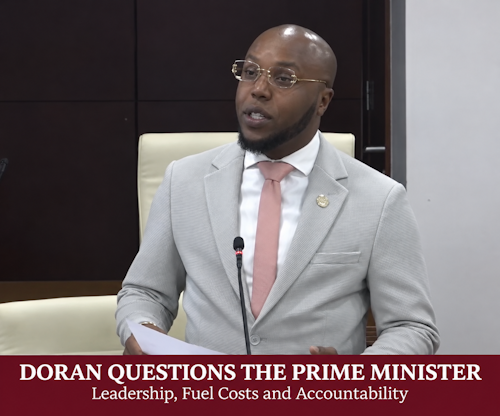 PHILIPSBURG:--- National Alliance faction leader MP Egbert Jurendy Doran placed Prime Minister Dr. Luc Mercelina at the center of a broad accountability challenge during the 2027 budget debate, arguing that the leader of government must answer for unresolved problems across the Cabinet.
Doran questioned the Prime Minister about fuel costs, the performance of government-owned companies, legal oversight of procurement, conflict-of-interest safeguards and outstanding commitments to firefighters.
He also called on Mercelina to intervene over a school safety concern and explain how government would move beyond responding to crises toward preventing them.
His closing warning was blunt: the country could not continue on the same course for another two years.
“The time to act is now,” Doran said. “Enough is enough.”
Fuel costs: Doran rejects a blame-shifting exercise
Doran challenged the Prime Minister to explain a reported statement linking high fuel costs to Sol rather than GEBE.
He asked Mercelina to clarify the statement and the reasoning behind it, pointing out that residents receive their electricity bills from the government-owned utility.
“Because according to me, when I get my bill, it does not say Sol,” Doran said.
His argument was that government could not treat the conduct of a private fuel supplier as a substitute for examining the decisions and responsibilities of its own companies.
Doran described Sol as a commercial business pursuing profit and argued that public policy should rest on enforceable rules and decisions within government’s control.
He called for scrutiny of the arrangements that had allowed fuel infrastructure to become concentrated in private hands and asked for evidence of efforts by GEBE’s former management to acquire the Texaco tanks.
MP Veronica Jansen-Webster challenged part of his argument about the ability to prevent a private company from buying tanks. Doran subsequently clarified that he was questioning what efforts GEBE had made to acquire them.
He demanded records that could establish what had actually been attempted.
Could the port’s throughput fee reduce the burden?
Doran disclosed that he had attended a meeting involving the Prime Minister, the Finance Minister, Sol representatives and other faction leaders to discuss possible solutions.
He defended his participation, saying his responsibility extended beyond party politics.
“I don’t represent one person, one party and/or one group,” he said.
But attendance did not amount to an endorsement of the meeting’s results.
Doran identified the port’s fuel throughput fee as an issue requiring a direct answer. Because the port is government-owned, he asked whether lowering that fee could reduce energy costs for consumers.
He directed the question to the Prime Minister or the TEATT minister and demanded an explanation of the actual effect on the end user.
The proposal remained a question, rather than a demonstrated saving. Doran did not provide a calculation showing how much bills would fall or establish that a reduction would automatically be passed through.
His challenge was for government to determine whether that option could produce relief and explain the result publicly.
Cabinet coordination comes under scrutiny
Doran also highlighted what he interpreted as criticism from TEATT Minister Grisha Heyliger-Marten of how the fuel discussions had been presented.
He read a reported statement from the minister about judging meetings by the answers they produce and characterized it as a pointed criticism of the Prime Minister.
That was Doran’s interpretation of her remarks; it did not establish that the ministers were engaged in a personal dispute.
Nevertheless, he used the episode to question Cabinet cohesion.
He made a similar argument about what he described as conflicting explanations from the Finance and VROMI ministers concerning the Road Fund.
For Doran, those differences required Mercelina’s attention because residents needed a coherent government position on financing and delivery.
The Prime Minister’s role, as framed in the speech, was to ensure that Cabinet decisions produced a clear account of what government could fund, what it had approved and what it would deliver.
Legal oversight: Why Doran directed VROMI questions to the Prime Minister
Although many of Doran’s complaints concerned VROMI, he repeatedly asked Mercelina to address their legal implications.
He questioned how bidders were treated in the solid waste tender and the fairness of restarting a competition after earlier bid information had become known.
He also asked about the timing of publishing a building permit associated with a private company involved in a bridge repair partnership.
Doran explained that he was directing these questions to the Prime Minister because of the legal responsibilities under General Affairs.
His intervention sought to prevent the issues from being treated solely as disputes between an opposition MP and an individual minister.
The questions concerned whether the government’s procedures were legally defensible, whether Cabinet had approved the relevant arrangements and whether public decisions had been adequately explained.
Doran’s allegations did not establish that the procedures were unlawful. They did demand a reasoned response from the government officials responsible.
Firefighters: Which commitments have been fulfilled?
Doran pressed Mercelina for a detailed update on the Fire Department’s placement process, outstanding payments and employment protections.
He referred to the function book’s approval in March 2025 and the government’s previously indicated target of completing placements during the fourth quarter of 2026.
He asked whether that timetable remained achievable and how many placements were still outstanding.
Doran also wanted to know whether government had calculated the additional back pay that could accumulate if the process continued to slip.
Referring to the April 9 agreement with WICSU/PSU and Fire Department representatives, he asked which commitments had been fulfilled and which remained open.
He requested an update on negotiations concerning the broader agreement and on life insurance and protection for firefighters.
These questions sought an account of implementation: the remaining cases, the financial exposure, the outstanding obligations and the deadline for resolving them.
Who polices conflicts of interest in oversight bodies?
Doran asked the Prime Minister to explain how potential conflicts of interest are handled within the General Audit Chamber, Integrity Chamber, Ombudsman, Council of Advice and Social Economic Council.
He requested institution-specific answers about who determines whether a conflict exists, whether individuals must declare it and when they must withdraw from a matter.
He also asked what safeguards protect the independence and credibility of those bodies.
Doran did not identify a particular official as having committed a conflict-of-interest violation in this section of his statement.
His question focused on whether procedures were clear and adequate when an institution investigated, reviewed, or advised on a matter involving one of its own members or officials.
School safety and the cost of constant crisis management
Doran also asked Mercelina to intervene over an area at a school where he said concrete had fallen and cracks remained visible.
He described the caution tape as an inadequate barrier and called for a more effective way to keep children away from the area.
He asked for an immediate protective measure while the safety concern was addressed.
That appeal connected to the broader criticism with which he opened his speech: government, he argued, had become too accustomed to chasing problems after they escalated.
“Sometimes when somebody is working on fixing a crisis, somebody else should be working on planning the future,” he said.
Doran acknowledged the return to timely budget preparation but challenged the assumption that meeting a submission deadline demonstrated an ability to execute the plans.
He characterized the proposed budget as lacking sufficient new revenue measures and warned that unresolved borrowing conditions could undermine capital projects. His prediction about future financing remained a political assessment, rather than a decision already made by financial supervisors.
The challenge to Mercelina was ultimately about responsibility for the whole government: explain the decisions, reconcile conflicting positions, fulfill outstanding commitments and show residents what has improved.
The supplied statement does not include the Prime Minister’s answers. Doran’s intervention nevertheless set out a concrete test for those answers—whether they identify actions, responsible officials and deadlines that Parliament can subsequently measure.