VROMI Minister’s 2027 presentation includes proposed household waste contributions, permit digitization, sewage upgrades and a new cemetery, while key financing and implementation decisions remain outstanding.
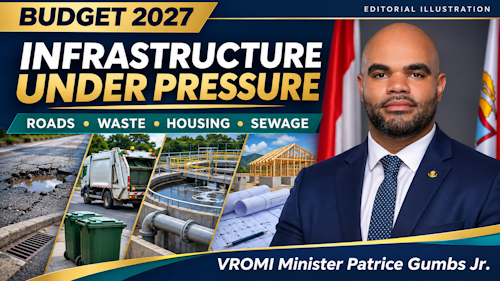 PHILIPSBURG:--- Minister of Public Housing, Spatial Planning, Environment and Infrastructure Patrice Gumbs Jr. has acknowledged that St. Maarten’s infrastructure has failed to keep pace with development, presenting a 2027 agenda intended to address mounting pressure on roads, housing, sewage systems, waste management and government services.
Speaking during the draft national budget debate, Gumbs described a ministry confronting expanding responsibilities with limited financial resources, staffing constraints and outdated administrative systems.
“In a recent meeting of Parliament, I was asked, has infrastructure kept up with development? Very simply, it has not,” he said.
The admission framed a presentation containing substantial investment proposals but also several important qualifications: part of the road program depends on borrowing approval, the Road Fund model requires revision, procurement processes remain unfinished, and proposed waste legislation must still proceed through the legislative process.
Minister Defends Preparatory Work Against Criticism of Slow Delivery
Gumbs said the ministry’s challenges were longstanding, covering waste, wastewater, infrastructure, building permits, land administration backlogs and housing.
What changes each year, he argued, is their scale as the economy and built environment continue expanding.
He also cited volatile prices for oil, steel, concrete and lumber as pressures affecting delivery.
Referring to parliamentary criticism during the 2026 budget process, Gumbs said the ministry’s performance should be assessed in that historical context, while acknowledging the need to respond to concerns.
He identified tighter spending controls, standardized procedures, additional staffing and improved enforcement capacity among measures already undertaken.
The minister said additional capacity and internal coordination had produced the ministry’s highest processing rate to date. His oral presentation did not provide comparative figures or application turnaround times to measure that claim.
Road Program Totals 10.5 Million Guilders, but Financing Is Incomplete
Gumbs outlined 10.5 million guilders for road infrastructure, comprising 1.5 million guilders in operational funding and 9 million guilders in capital investment.
He expressly distinguished the secured portion from anticipated external financing.
Of the capital investment, 3.5 million guilders would come from domestic resources, while the remaining 5.5 million guilders depends on a loan from the Netherlands requested through the Central Bank.
“In short, 5 million guilders is secured to date in the national budget,” he said.
“The remaining 5.5 million will follow once the loan is approved.”
The distinction means the full road program cannot yet be treated as fully financed expenditure available for immediate execution.
For residents awaiting repairs, the practical questions are which works can proceed with secured resources, which depend on borrowing and what schedule governs each category.
Road Fund Structure Being Reworked
Full implementation of the Road Fund remains a stated priority for 2027, but Gumbs confirmed that the initial proposal received critical feedback.
The proposed structure envisaged a foundation receiving annual road tax revenue through a subsidy, with a board involving VROMI, Finance and an independent engineer.
The implementation plan is now being revised.
That leaves an important distinction between the government’s intention to establish sustainable road financing and a final arrangement ready to operate.
The ministry is also working with the Cadastre on a road infrastructure network plan. The project is intended to assess the road system and support maintenance planning based on reliable information.
Such an assessment could help establish repair priorities, but its value will depend on how the findings are translated into funded and scheduled work.
Garbage Collection Tender Still Awaiting Final Steps
Gumbs acknowledged questions surrounding the solid waste collection tender.
“Evaluation of the report is delayed by one day and should be submitted to me by today,” he told Parliament.
He said he would review the report, then meet with all bidders to discuss the results and next steps, and clarify the process and its integrity.
His statement did not announce final contract awards.
The proposed allocation for solid waste collection is 6.9 million guilders, while existing contracts have been extended through the end of the year as the new award process is finalized.
Gumbs also outlined 2.6 million guilders for landfill management and maintenance.
Those contracts end on December 15, and the ministry is discussing extensions while determining how the services will align with the Emergency Debris Management Project.
Wastewater treatment plant management and maintenance is budgeted at 1.1 million guilders. The related tender is undergoing final review and is expected to be published before year-end.
Together, these processes require coordination to maintain services while new contracts and project arrangements are completed.
Proposed Waste Ordinance Could Enable Household Contributions
Gumbs said the Council of Ministers had approved the proposed waste ordinance and that it was proceeding to the Council of Advice before eventual submission to Parliament.
That approval is a stage in the legislative process, rather than final enactment.
According to the minister, the proposal would establish a waste authority and create the possibility of charging contributions toward waste collection.
He also outlined a Waste Investment Fund intended to ring-fence revenue from sources including tipping fees, entrance fees and household contributions for waste management.
The presentation did not specify household contribution rates, commencement dates or detailed collection arrangements.
Those omissions leave significant policy questions for further consideration: how charges would be calculated, who would pay, what protections would apply, and how expenditure would be reported.
The minister’s stated objective is a more sustainable and adequately financed waste management system.
Landfill Works Include Relocation of Three Affected Parties
Gumbs said stabilization and closure works at the landfill are expected to begin in 2027 as part of the Trust Fund-supported waste project.
A 2.7 million guilder allocation is earmarked for relocating three affected parties who cannot remain at their current sites during the works.
The relocation funding is therefore part of the preparation required for implementation, rather than a separate general housing initiative.
The minister also identified a waste export assessment among the ministry’s priorities, alongside work on environmental impact assessment policy and stronger environmental enforcement.
Security Services Require a Budget Amendment
Gumbs disclosed that security services were not included in the draft budget submitted to Parliament.
He explained that discussions had initially contemplated transferring those services to General Affairs. The discussions subsequently concluded that the transfer would not be possible.
An amendment will therefore be required to introduce approximately 1 million guilders for security services in 2027.
The services cover locations including the landfill, VROMI’s operations site and the wastewater treatment plant.
The disclosure identifies an existing operational responsibility that still needs to be incorporated into the budget under consideration.
Other service allocations include approximately 4.3 million guilders for district cleaning and 1 million guilders for trench and waterway maintenance.
Bids for district cleaning contracts covering 2027–2032 are under evaluation, while the trench and waterway maintenance contract continues into next year.
Two Million Guilders Requested for Digital Building Permits
Gumbs outlined a 2 million guilder request to modernize building permit processing.
The proposed system would introduce online submissions, digital tracking and an approval process designed to improve workflow and allow applicants to monitor progress.
“This will minimize paper, as well as the risk of losing client documents,” he said.
The minister linked the investment to earlier efforts to strengthen the permits department through additional personnel and standardized procedures.
The intended benefits include greater efficiency, better visibility for applicants and reduced pressure on staff.
However, the presentation did not provide a launch date, specific processing-time targets or a detailed implementation schedule.
Those measures will be necessary to assess whether digitization produces faster decisions rather than merely transferring existing procedures onto a screen.
Sewage Pumping Stations and Dutch Quarter Connections
The ministry is requesting 1.6 million guilders to upgrade sewage pumping stations, responding to pressure on the aging network.
Gumbs also confirmed that the Dutch Quarter house connection project has been awarded through public tender and has commenced.
He corrected the description used in the presentation, emphasizing that the project concerns house connections rather than road development.
The works will connect additional homes to the main sewer line.
On enforcement, the minister said the ministry had procured caps for sewage-related action and was working toward stronger administrative enforcement capacity.
His presentation placed network investment and enforcement together as components of the response to wastewater problems.
Housing Plan, Mortgage Guarantees and Rental Oversight
Housing priorities include implementing and monitoring a ten-year national housing plan, progress toward a mortgage guarantee fund, and a new building code.
Gumbs said the mortgage guarantee initiative is intended to assist potential first-time homebuyers.
He also confirmed that the Rental Tribunal is being transferred from General Affairs to VROMI, describing the change as part of efforts to strengthen housing oversight and protection for vulnerable groups.
The presentation did not establish when the mortgage guarantee fund would begin accepting applications or specify its eligibility and financial terms.
On government land, Gumbs said the land issuance policy was complete and would soon be submitted to the Council of Ministers for approval.
Other priorities include a land pricing policy, a spatial economic strategy and a single national zoning framework.
New Cemetery and Other Capital Commitments
The minister outlined a 3.5 million guilder request for initial preparation of a new cemetery, associated with the Belvedere remainder land.
He also identified continuing investment in the Prins Bernhard Bridge and listed 75.6 million guilders for purchasing generators for GEBE in the capital overview.
The different projects carry different financing and implementation arrangements. Their appearance in the presentation should therefore be assessed alongside the relevant approvals, procurement status and funding conditions.
Private Partnerships Help Bridge Funding Constraints
Gumbs defended the use of private-sector partnerships for infrastructure repairs, saying limited government resources had made alternative arrangements necessary.
He said that, apart from the Billy Folly/Pelican Road repairs, the partnerships he described had received no government funding.
“All the work is carried out by the private partner with oversight by the ministry,” he said.
Such arrangements can provide additional implementation capacity. Parliament’s oversight role includes examining their terms, responsibilities and the public benefits delivered.
Delivery Depends on Capacity, Procurement and Reform
Gumbs identified staffing limitations, delays in policy and legislation, procurement processes and digital transformation as major risks to execution.
His proposed response includes recruitment, technical support, training, phased implementation and improved internal controls.
The ministry’s 2027 agenda is consequently substantial, but its success will depend on resolving the conditions attached to it.
Residents awaiting better roads, functioning sewage systems, timely permits and reliable waste services will ultimately judge the program through completed work. Parliament now has to establish which commitments are secured, which remain conditional, and when each is expected to deliver.