Two politicians who ran on the same Democratic Party slate are now at the center of a pointed budget confrontation, as MP Dimar Labega challenges reform delays, vague timelines and the minister’s leadership of fiscal policy.
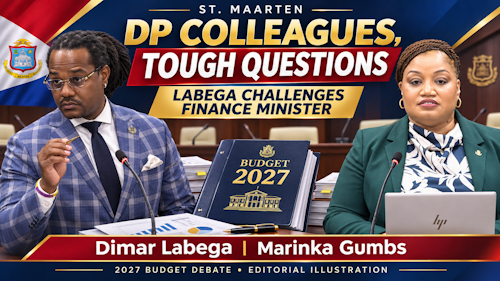 PHILIPSBURG:--- Democratic Party MP Dimar Labega delivered a sharply critical assessment of Finance Minister Marinka Gumbs during the 2027 budget debate, questioning whether his own party colleague has a solid strategy beyond upgrading the Tax Administration and accusing the government of failing to give Parliament and the public a sufficiently clear account of its reform plans.
The intervention carries particular political weight because Labega and Gumbs ran on the same Democratic Party slate. After supporting and defending the minister in Parliament over the past two years, Labega’s latest contribution marks a striking change in tone.
His remarks raise questions about relations within the DP, although the contribution alone does not establish a personal feud or a formal party split.
It does establish that the Finance Minister is facing forceful criticism from within her own political ranks.
Labega questioned her urgency, challenged her explanations for delayed legislation and insisted that she assume responsibility for coordinating the government’s revenue agenda.
On-Time Budget Earns Praise, but Not a Free Pass
Labega opened by congratulating the government and the Finance Minister for submitting the 2027 budget on time.
He then drew a sharp distinction between meeting a deadline and delivering substantive results.
“Submitting the budget on time is one thing, but what is in the budget, well, that is what we gathered here today and this week to discuss,” he said.
He characterized the minister’s approach as effective in procedural compliance but lacking actual deliverables.
Referring to Gumbs’ statement that she would reserve her applause until the budget process was completed, Labega suggested that the applause would have to wait longer.
The exchange pitted the minister’s main procedural achievement against a tougher demand: evidence that reform is producing results.
“No Solid Strategic Plan Past Tax Administration Upgrades”
Labega acknowledged the minister’s efforts to modernize tax administration and improve compliance.
However, he questioned whether that work was accompanied by a sufficiently developed strategy for broader tax reform and additional revenue.
“I believe there is no solid strategic plan past tax administration upgrades. I hope that I’m wrong,” he told Parliament.
He asked which phase government had reached in its stated strategy to stabilize, repair and reform, and demanded clarity on proposed changes affecting profit tax, wage tax and relief for the elderly.
He also questioned whether the information needed to support reform was still being collected or had already been analyzed, and whether implementation depended on that analysis.
His central complaint was that Parliament kept hearing ideas without a concrete roadmap explaining how and when they would become policy.
Parliament Cannot Approve Bills It Has Not Received
One of Labega’s strongest challenges concerned the minister’s repeated references to legislative procedures and parliamentary approval.
He accepted that legislation must pass through the required process. His objection was to invoking Parliament’s role without explaining whether the relevant proposals had reached Parliament.
“But we can’t approve or deliberate what hasn’t reached us,” he said.
Labega demanded precise information about the stage each initiative had reached, rather than general assurances that measures were moving through the legislative process.
He also challenged the minister’s earlier call for government and Parliament to get matters together, asking what Parliament was specifically expected to do while awaiting submissions from the executive.
The criticism went beyond impatience with legislative delays. It challenged how responsibility for those delays was being presented publicly.
“We Are Not Being Truthful With the Status of These Plans”
Labega’s language became especially pointed when discussing transparency.
“We are not being truthful with the status of these plans,” he said, extending that criticism to the information reaching Parliament and, consequently, the public.
He subsequently acknowledged that government’s statements about legislation undergoing review could be true. He argued those statements remained too broad to explain the actual position.
“It's coming when? When is it coming?” he asked.
That distinction is important: Labega accused the government of providing an incomplete and unsatisfactory account of progress, while demanding the specific stages, obstacles and timelines behind its assurances.
Dividend Withholding Tax Becomes a Test Case
Labega cited dividend withholding tax as an example of what he described as unresolved reform.
He recalled that the minister had previously indicated the measure was expected to take effect on January 1, 2026, and that concerns raised in Parliament had prompted a commitment to return with further explanation and expert assistance.
He said he had not supported a motion on the matter because he understood that implementation would be halted and an explanation provided.
Now approaching 2027, he demanded an update on the measure’s status and the reason for the delay.
These were Labega’s recollections and questions during the debate. The contribution did not itself establish the measure’s current legal or implementation status.
His broader point was that an initiative presented as an early element of reform remained, in his assessment, inadequately explained.
“Captain” Must Lead the Revenue Agenda
Labega repeatedly returned to ministries’ stated need for additional funding.
He argued that government could not continue redistributing the same limited resources while postponing measures intended to expand revenue.
Describing the Finance Minister as the captain of the fiscal policy ship, he urged her to assume responsibility for bringing colleagues together and setting priorities.
He asked whether she had held collective meetings with other ministers on new revenue measures and requested the dates of the last two such meetings.
In his view, the minister should actively coordinate proposals, identify bottlenecks and establish a sequence for legislative work, particularly where ministries depend on scarce legal drafting capacity.
He requested specific updates on tourist tax legislation, short-term rental and Airbnb-related legislation, and discussions concerning transaction tax.
He also asked which measures would come first, second and third.
Minister’s Position Is That Uncertain Revenue Should Stay Out
Earlier in the debate, Gumbs defended excluding revenue from measures that still require legislative approval and implementation.
She argued that counting such income prematurely could overstate government’s financial position. She identified the tourist tax, revised fees, compliance measures, and an exploration of a gaming tax among initiatives under development.
Labega’s intervention challenged the pace and detail behind that agenda.
The disagreement therefore concerns both timing and accountability: Gumbs presented caution in revenue forecasting as prudent budgeting, while Labega demanded a clearer explanation of when the proposed measures would become deliverable.
Development Bank Study and Spending Lines Challenged
Labega also questioned the priority given to commissioning a development bank feasibility study when tax and revenue reforms were competing for limited resources.
He said he supported the development bank concept but asked whether earlier studies existed, when the current study had been commissioned, and whether it represented the most urgent use of capacity.
In a provocative comparison, he suggested that ChatGPT could quickly produce an outline of the advantages, disadvantages and financing questions.
That assertion was part of his criticism of spending priorities; a general AI-generated outline would not establish a development bank's country-specific financial viability.
He also questioned a 60,000 Caribbean guilder marketing allocation and an approximately 1.3 million guilder increase in an advisory budget line, asking how much would support new revenue measures.
Loan Questions Add to the Pressure
Citing a newspaper report that the CFT could not issue positive advice on a 42 million guilder 2026 loan request, Labega asked what that meant for the projects associated with the borrowing.
He questioned why anticipated financing had been included before positive advice and what would make the 2027 request different.
Those questions sought an explanation; his contribution did not establish that the 2027 borrowing request had been rejected.
A Political Shift the DP Cannot Ignore
Labega’s intervention was more than a routine request for clarification. He challenged the minister’s planning, communication, priorities, and leadership, while expressing frustration that his answers had remained broadly unchanged.
Coming from a Democratic Party colleague who previously defended her, the criticism creates an unmistakable political contrast.
Whether it reflects a temporary disagreement, growing frustration or a deeper deterioration in relations remains unresolved. His contribution made no mention of a party rupture.
For now, the clearest development is that Marinka Gumbs’ revenue and reform agenda is being challenged from her own party benches. Her answers will have to address both the detailed budget questions and Labega’s central accusation: that procedural progress has not yet been matched by sufficiently visible results.