Heyliger-Marten outlines approximately 722,000 guilders in economic-relief activities and explores supermarket partnerships beyond the regulated basket
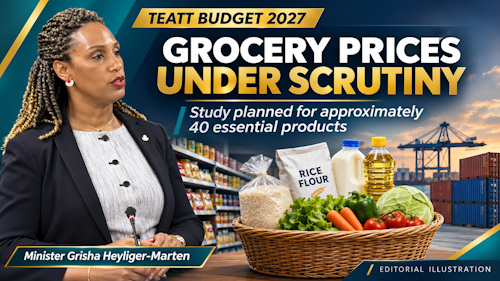 PHILIPSBURG:--- TEATT Minister Grisha Heyliger-Marten says government is preparing a public tender for an independent study tracing how the prices of approximately 40 commonly purchased essential supermarket products are formed.
The proposed research will examine costs from source to shelf, including purchasing, freight, logistics, local operating expenses and wholesale and retail margins.
Presenting her ministry’s draft 2027 budget, Heyliger-Marten said the study would also compare prices with selected regional markets.
The initiative aims to identify which factors drive grocery costs and interventions that could improve affordability without disrupting reliable supplies.
“I don’t want us guessing,” she told Parliament. “I want the evidence.”
Beyond comparing shelf prices
The minister said a useful assessment must go further than identifying whether one supermarket sells an item for more than another.
It must establish how the final price develops and whether the main pressures arise from international acquisition costs, transport, local expenses, margins, market structure or a combination of factors.
The presentation did not announce a selected consultant, a completed tender, a study-specific contract price or a publication date.
The approximately 722,000 guilder figure cited by the minister covers the broader economic-relief policy activities proposed for 2027. It should not be interpreted as the price of the grocery study alone.
Maximum-price enforcement will continue
Heyliger-Marten said the government would continue enforcing existing maximum prices for regulated essential goods while the research proceeds.
Her presentation did not announce an immediate expansion of the regulated basket or new maximum prices.
Instead, the ministry intends to strengthen digital monitoring, price analysis and consumer information so that the existing system becomes more responsive.
The minister acknowledged that St. Maarten’s dependence on imports exposes households to international fuel prices, freight costs, inflation, supply disruptions and geopolitical developments.
“Government cannot control every price,” she said, while arguing that those limitations do not remove its responsibility to act within its authority.
Supermarket partnerships could broaden relief
Alongside regulation, TEATT is exploring cooperation with supermarkets, wholesalers and retailers to make a wider selection of everyday products available at clearly advertised affordable prices.
The minister suggested examining individual products and combinations of essential goods that could help families stretch their grocery budgets.
Such arrangements would need clear rules on product selection, communication and availability, she said.
Consumers must be able to identify participating stores and make meaningful comparisons.
However, Heyliger-Marten emphasized that the discussions remain exploratory. The presentation did not identify participating businesses, agreed prices or a launch date.
The proposed partnerships therefore should not be presented as a discount program already operating.
Import information could strengthen oversight
The minister also linked more effective price regulation to the planned introduction of the ASYCUDA customs system through the Ministry of Justice.
She said better access to import information and invoices would help government assess costs and calculate maximum prices more effectively.
The anticipated benefit is a stronger evidence base for regulation. The presentation did not establish that the system was already providing those results.
Consumer protection must preserve reliable supply
Heyliger-Marten said the ministry must protect purchasing power while recognizing the role of businesses that supply essential goods.
Intervention should be evidence-based and remain within the government’s legal authority, she said.
That balance requires the study to distinguish between costs beyond local control and factors that policy, competition or enforcement could realistically address.
The minister also encouraged consumers to compare prices, arguing that informed shopping can stimulate competition.
Yet access to information will only help if comparisons are clear, products are available, and advertised offers can reliably be obtained.
From study to relief
The proposed research could provide a firmer basis for decisions about essential goods, but its value will depend on the action that follows.
The public will need to know which products were examined, how the regional comparisons were made, what cost drivers were identified, and which recommendations government accepts.
Where enforcement identifies breaches of existing maximum prices, those protections should remain in place while longer-term research continues.
For households facing pressure from groceries, electricity and transportation, the practical test is whether the proposed work results in fairer prices, clearer information and more affordable choices.
The presentation sets out the investigation and cooperation TEATT intends to pursue. It does not yet establish how much families will save or when that relief will reach supermarket shelves.