Prime Minister outlines neglected facilities and staffing failures as General Affairs spending rises to approximately 95 million guilders; repeated overseas missions demand an equally clear explanation of costs and benefits
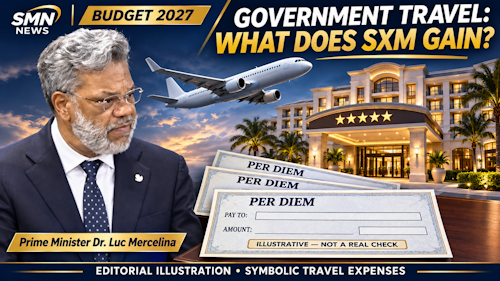 PHILIPSBURG:--- Prime Minister Dr. Luc Mercelina’s request for an approximately 95-million-guilder General Affairs budget raises a question that his presentation did not answer: while government seeks additional money to repair neglected facilities, recruit essential personnel and equip firefighters, how much is being spent on overseas travel, and what measurable benefits are residents receiving?
Presenting the draft 2027 budget, Mercelina described a government struggling with longstanding maintenance failures, recruitment delays and inadequate support services. He proposed increasing General Affairs spending from 82 million guilders in 2026 to approximately 95 million guilders.
He also defended sharp increases in operating allocations, including 161 percent for electricity and water and 72 percent for communications, saying previous budgets had failed to reflect actual costs.
That argument for realistic, transparent budgeting deserves to apply just as firmly to travel.
A review of public announcements and reporting identifies at least 12 distinct overseas missions involving Mercelina since 2024. That is a minimum documented count, not a complete government travel register. The available disclosures do not establish the full cost of those missions or the expenses of every accompanying official.
Government’s own examples expose spending priorities
Mercelina told Parliament that elevators in the Government Administration Building had not received proper maintenance for at least five years and possibly longer.
More than a quarter of the building’s lighting required replacement. More than 300 bulbs have since been replaced.
The department responsible for overseeing substantial government assets lacked a maintenance employee in its formal function book, as well as dedicated insurance and procurement expertise.
The prime minister also acknowledged that the government should have purchased replacement breathing equipment for firefighters years ago. The equipment has now been ordered, with delivery expected in the first quarter of 2027.
These are basic requirements for functioning government and public safety.
They sharpen the question of how government evaluates discretionary expenditure: what controls determine the frequency of overseas missions, the size of delegations, and the cost of travel arrangements when essential needs at home remain unresolved?
The evidence does not establish that travel spending caused maintenance failures or equipment delays. It does establish a legitimate need to examine both against the same standard of necessity, affordability and results.
At least 12 documented overseas missions
The public record reviewed includes Washington, the Netherlands, and New York in 2024; Curaçao, the Netherlands, a combined Washington–New York itinerary, Suriname, and another Netherlands mission in 2025; and Aruba, Miami, Curaçao, and the Netherlands in 2026.
These were not all ceremonial visits. Announced purposes included Trust Fund projects, energy, regional security, student housing, institutional cooperation and economic development.
For example, Mercelina’s July 2024 Netherlands program included discussions on the energy crisis, technical assistance and housing for St. Maarten students. His September 2025 Washington visit addressed delays in Trust Fund projects. Those are substantive responsibilities.
But announcing a legitimate subject does not establish that every trip, every accompanying official or every expense was necessary.
The government must show what required the prime minister’s physical presence, why the delegation had its particular composition, what was agreed, and what changed afterward.
Repeated references to cooperation and opportunities cannot substitute indefinitely for a report on delivery.
Three missions cost more than Cg. 31,000
SMN News previously reported government budget responses identifying three 2026 missions involving Mercelina and Chief of Staff Stuart Johnson: Aruba at Cg. 10,428.02, Miami at Cg. 12,174.96 and Curaçao at Cg. 8,612.94.
Together, those reported figures total Cg. 31,215.92.
That is a partial figure covering those three missions, not the prime minister’s total travel expenditure since taking office.
The same report cited accommodation at US$750 per night for a 2025 New York delegation. It also recorded government’s acknowledgment that it could not then produce a fully consolidated, independently verified travel overview because information was dispersed across administrative records.
The hotel rate does not establish a five-star classification, and the available figures do not establish the final cost for every traveler.
Those limitations make complete accounting more necessary. They do not justify filling the gaps with estimates presented as expenditure.
First-class travel requires a public explanation
SMN News has separately confirmed that government-funded travel includes first-class tickets for ministers and cabinet staff. A complete invoice-based breakdown remains necessary to establish the amount spent and the arrangements for each mission.
The General Audit Chamber had already questioned the political travel framework before Mercelina took office.
Its January 2024 report identified first-class entitlements and ministerial allowances of ANG 720 per day, potentially rising to ANG 900 depending on destination. It also highlighted inadequate accountability for how allowances were spent and whether unused money was returned.
The Chamber recommended economy as the standard, with justified exceptions for business class. Those findings concern the framework examined at that time; they are not evidence of Mercelina’s individual ticket purchases or current allowance payments.
Nevertheless, they establish that concerns about economy and accountability were already formally on record.
What has the present government changed? What justification is required for premium travel? Are fares less expensive compared? Who approves the number of accompanying staff? Are actual expenditure and unused advances reconciled after each mission?
Those questions belong directly in scrutiny of the General Affairs budget.
Connor’s UN mission must also be accounted for
VSA Minister Claret Connor undertook the September 2026 New York mission on Mercelina’s behalf. The government’s published account states that the prime minister had originally intended to attend but remained in St. Maarten to address pressing local matters.
Connor’s mission must therefore be distinguished from Mercelina’s personal trips, while still being included in scrutiny of government travel undertaken to represent the country.
St. Maarten has no separate vote in the United Nations General Assembly. The Kingdom of the Netherlands holds the membership and a single vote; St. Maarten participates within the Kingdom delegation. Additional representatives do not create additional votes.
That does not make attendance automatically pointless. It means the benefit must be explained through advocacy, access, partnerships and identifiable outcomes rather than independent voting power.
Connor addressed a sustainable-procurement forum, while other reported engagements concerned health, climate and development. The accountability question is what those engagements produced for St. Maarten and whether their value justified the complete delegation cost.
Delegation announcements are not expense accounts
The September 2024 UN delegation named Mercelina, Patrice Gumbs, Stuart Johnson, Cameron Wathey and Rogelio Voges.
However, the government identified Voges as already seconded to the Kingdom’s UN mission. His participation cannot automatically be counted as another round-trip ticket from St. Maarten.
Likewise, the October 2026 Netherlands program named Minister Plenipotentiary Gracita Arrindell, Secretary-General Dr. Abel Knottnerus and Johnson alongside Mercelina. Naming officials at meetings does not establish each person’s travel route, funding source or expenses.
That is precisely why government should publish actual delegation records.
Residents should not have to reconstruct the public bill from photographs, press releases and scattered budget answers.
What did the Netherlands missions deliver?
Mercelina’s latest Netherlands itinerary covered institutional cooperation, Kingdom relations, economic matters, Trust Fund discussions and healthcare technology.
The announced October 15–24 program included a Philips visit connected to opportunities for the new hospital. The advance account did not identify a signed purchasing agreement or a secured equipment commitment.
Exploratory meetings can have value. Their value becomes assessable when government reports what followed.
Were written agreements obtained? Was funding committed? Were specific personnel or technical resources secured? Which projects are advanced, and by what deadline? What does an expression of interest mean?
These are practical questions, especially when the prime minister is asking Parliament to finance stronger implementation at home.
The budget already provides a standard for measuring results
Mercelina offered measurable domestic targets: clearing the remaining 44 jubilee cases by early 2027, receiving firefighter breathing equipment in the first quarter and completing most Facility Affairs administrative backlogs in the second quarter.
He highlighted 29 Civil Registry walk-in days serving more than 4,300 people, along with recruitment and additional legal capacity.
Overseas travel should face comparable reporting.
Each mission should have an approved purpose, a justified delegation, a final cost and a record of outcomes. Where benefits depend on future action, government should identify the responsible department and timetable.
Where a mission produces no agreement or immediate result, government should explain what was learned and whether another visit is justified.
A bigger budget demands a complete travel account
The unresolved issue is whether the frequency, delegation sizes and premium arrangements represent excessive expenditure relative to the benefits secured.
The public record reviewed does not provide enough financial detail to answer fully. Government holds the authorizations, invoices, allowance records and financial reconciliations needed to do so.
Before accepting broad assurances about responsible spending, Parliament should require the annual travel allocation, expenditure to date, outstanding commitments and a mission-by-mission breakdown covering the prime minister and accompanying officials.
That review should also identify expenses paid by hosts or external organizations, preventing both omissions and double counting.
Mercelina told Parliament that good governance begins with acknowledging the true costs of government operations.
His travel program should meet the same standard.
As General Affairs seeks approximately 13 million guilders more, residents are entitled to know how much government spends traveling, why those expenses are necessary, and how the resulting benefits reach the people paying the bill.