SMN News examines the gap between earlier demands, remembrance funding, and the results reported from overseas missions as Caribbean reparations advocates organize.
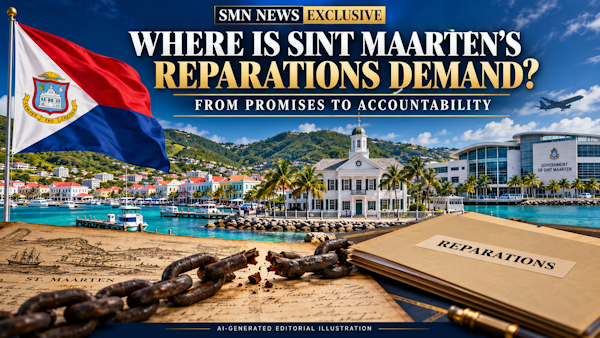 PHILIPSBURG:--- The most pointed question about Prime Minister Dr. Luc F.E. Mercelina’s reparations policy comes from his own political record. Before taking office, he urged St Maarten to demand reparations and criticized the government of the day for taking a passive approach.
In December 2022, Mercelina accused the then administration of “taking a passive and reactive approach” and said that “as a country, we should demand reparations.”
His party proposed development measures including a national university, housing, cultural facilities and stronger social provision.
His first cabinet took office on May 3, 2024; the second was sworn in on November 26 that year. The accountability question is what became of that earlier demand once he acquired executive responsibility.
The public records reviewed for this report do not establish that his government formally abandoned reparations. They also do not establish a separate, quantified government claim, a published negotiating timetable or an agreed compensation settlement with the Netherlands.
That distinction matters because St Maarten has received approval for slavery-related funding under his administration. Describing the entire subject as being at a complete standstill would overlook that record. The unresolved question is whether remembrance and education have been accompanied by an equally visible pursuit of compensation and structural repair.
Former Prime Minister Silveria Jacobs drew a clear political distinction in her December 19, 2022 response to the Dutch apology.
She announced work on an advisory committee and said Sint Maarten needed to identify the damage and determine the necessary action to repair it. She also reached out to CARICOM and its reparations commission for assistance.
“Apologies without action only serve to absolve the perpetrator of guilt with minimal repercussions,” Jacobs said.
She insisted that earlier Dutch aid and loans could not be treated as reparations. Her statement opened a policy process; it did not announce a complete compensation agreement.
The parliamentary campaign also predated Mercelina’s premiership. A November 2020 motion presented by then MP Grisha Heyliger-Marten supported retaining legal counsel to pursue decolonization and reparations. A petition was subsequently filed with UN human-rights mechanisms in March 2021.
By June 2022, Heyliger-Marten told Parliament that the Choharis retainer had ended in December 2021, while reparations-related follow-up continued.
“There is also a part in there for reparations, and that is still ongoing,” she said.
That was a status report in 2022, not evidence that the same arrangements remain active today.
Former Parliament Chair Rolando Brison defended engaging the lawyers.
“The Presidium has the right to engage legal support and third parties,” he said in November 2020.
The reported proposal included pursuing reparations from the Netherlands alongside decolonization objectives. It was broader than a conventional slavery compensation claim and should not be described as a successful damages case.
Heyliger-Marten’s July 2022 correspondence to Jacobs was even more specific about regional strategy. She recommended engagement with CARICOM on reparatory justice and debt forgiveness and questioned whether Sint Maarten should pursue slavery reparations through CARICOM. Those were her recommendations, not settled findings about Dutch legal liability.
Today, the political responsibility to explain continuity extends beyond Mercelina: Heyliger-Marten’s earlier campaign should also be measured against the executive record of the government she joined.
An official government release confirms that Mercelina’s Council of Ministers met the Advisory Committee on Slavery, Atonement and Reparations on May 28, 2024.
The committee reported that insufficient full-time support hindered its ability to use available funds. Mercelina tasked Culture Department head Clara Reyes with drafting a vision plan, and the Council expressed support for the committee’s work towards reparations and reconciliation.
The release demonstrates engagement early in his administration. It leaves a follow-up test: what staffing, plan, recommendations, and negotiating action resulted?
On August 11, 2025, Education and Culture Minister Melissa Gumbs announced a US$5,351,132 grant for Sint Maarten’s national action agenda on the slavery past.
It covered projects scheduled from October 2025 to September 2029, including public education, cultural preservation, capacity-building, and archival and genealogical research.
The grant is a documented achievement. Its announcement does not describe a negotiated settlement of Sint Maarten’s reparations claims or establish that such claims were waived. The government should explain how this program relates to any separate compensation demand and publish implementation results.
Against that background, official travel deserves scrutiny through its mandates and outcomes.
Mercelina announced a Netherlands mission from October 15–24, 2026, covering Dutch institutions, Kingdom relations, and the Trust Fund. An October 16 government account named Minister Plenipotentiary Gracita Arrindell, Secretary-General Dr. Abel Knottnerus, and Chief of Staff Stuart Johnson as members of his delegation.
Those names establish participation, not who traveled from Sint Maarten, how many officials accompanied the entire mission, or its total cost. The reviewed accounts did not identify reparations as an announced outcome. That supports asking whether the subject was raised; it does not prove it was excluded from every private conversation.
Earlier travel disclosures provide some scale. SMN News reported budget responses listing three 2026 missions involving Mercelina and Johnson: Aruba at Cg.10,428.02, Miami at Cg.12,174.96, and Curaçao at Cg.8,612.94 — a combined Cg.31,215.92.
These are earlier missions, not the cost of the latest Netherlands visit or Connor’s US engagements.
VSA Minister Claret Connor attended September’s UN engagements in New York as part of the Kingdom delegation, substituting for Mercelina. He addressed sustainable procurement, and his later report covered climate and health discussions.
Sint Maarten has no separate General Assembly vote. The UN member is the Kingdom of the Netherlands, and each member has one vote. Participation within a Kingdom delegation can nevertheless provide opportunities to speak, build partnerships and influence policy. Absence of a separate vote does not by itself establish that the visit was pointless.
Connor’s Washington programme also produced a verifiable result: PAHO confirmed the signing of a 2026–2031 Country Cooperation Strategy on September 29.
That health framework deserves recognition and scrutiny of its implementation. It is separate from the New York UN programme and is not a reparations settlement.
The sharper UN accountability issue occurred in March, when the Kingdom abstained on the slavery declaration adopted by 123 votes to three, with 52 abstentions.
In April, MP Sarah Wescot-Williams asked whether Sint Maarten had been consulted and requested an account of government action on reparations. In May, she declared: “This abstention by the Kingdom needs to be repaired.”
European objections included the declaration’s ranking of atrocity crimes and legal concerns over reparations and retroactivity. Those explanations deserve reporting; they do not settle whether Sint Maarten agreed with the Kingdom’s position. This review found no published response that resolves Wescot-Williams’s questions.
Nor has the island’s wider movement fallen silent. Dr. Rhoda Arrindell addressed the September 2026 CARICOM reparations conference in Barbados for One SXM, linking reparatory justice to self-determination.
Civil society participation cannot be treated as evidence of an official government negotiating mandate, but it disproves the suggestion that all local advocacy has stopped.
The public deserves answers to concrete questions: Is there an approved government reparations policy? Has a formal demand been submitted, and to whom? Who is responsible for negotiations? What is the current status of the advisory committee and the earlier parliamentary petition? Were reparations raised during the latest Netherlands mission, and what answer was received?
The record supports a demand for disclosure, rather than a categorical claim of abandonment. Mercelina called for a proactive reparations policy before taking office. He should now publish the claim, the strategy, and the progress — or explain why they do not yet exist.