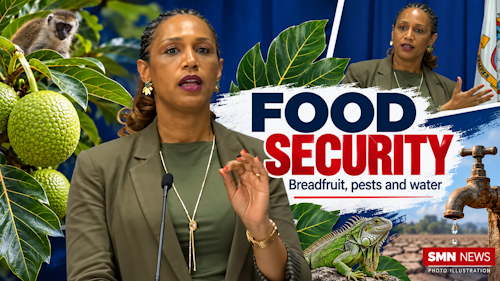
 PHILIPSBURG:--- Efforts to strengthen local food production must confront crop damage from monkeys, iguanas and snails, Minister of TEATT Grisha Heyliger-Marten said Wednesday, as questions about a breadfruit-tree initiative highlighted the practical obstacles facing agriculture in St. Maarten.
At the Council of Ministers press briefing, Heyliger-Marten said support for farmers must be matched by action against animals that damage production. She called for cooperation between the French and Dutch sides and said they were exploring possible European funding.
“I cannot establish support for my farmers without some kind of relief from these invasive species,” she said.
Heyliger-Marten was the only minister present at the briefing. A journalist raised the breadfruit initiative, a proposal discussed at an earlier briefing; it was not a new announcement by another minister on Wednesday.
The question asked whether planting breadfruit trees could deliver meaningful food-security benefits if animals might eat the crop before residents could harvest it. The question also raised how long it would take trees to produce fruit.
Heyliger-Marten’s answer focused on the animals and the need for coordinated action. She described agriculture as a personal priority and acknowledged that these obstacles could hamper the wider initiative.
The minister said a response limited to the Dutch side would be inadequate. She wants an approach involving both sides of the island and indicated that securing funding is part of the work ahead.
However, she did not announce an approved budget, an agreed cross-border programme, a start date or the methods that would be used. Her remarks described an initiative in development, not a funded operation ready to begin.
Water remains an unanswered part of the equation
The lack of water in local food production is another practical issue for the breadfruit initiative and agriculture more broadly. Planting targets alone do not explain how growers will maintain trees and crops where water is unavailable or unreliable.
Wednesday’s briefing did not outline an agricultural water-supply plan, irrigation arrangements, water-storage assistance, or funding to help growers meet those needs. Heyliger-Marten did not make a specific announcement addressing the water concern in her answer on breadfruit and crop-damaging animals.
That leaves important questions about how a planting initiative would be supported: who would receive trees, where they would be planted, who would maintain them, and how access to water would be secured. The discussion did not provide those operational details.
No quantified projections of breadfruit production, household savings, or reductions in food imports were presented either. The briefing therefore did not establish how much the initiative could contribute to the food supply or when residents might benefit.
The agriculture discussion took place alongside the minister’s announcement of a separate supermarket price-and-cost study, for which she wants results in approximately six months. That work will examine the imported-goods market and possible government interventions, while agriculture concerns the development of local production.
Both matter to household food security, but the briefing offered no calculation linking the breadfruit initiative to a reduction in grocery bills.
Heyliger-Marten’s acknowledgment of the damage caused by monkeys, iguanas and snails identifies a problem that government says it intends to tackle. Turning that intention into dependable food production will also require answers about funding, implementation, crop protection and water.