SMN News’ September 16 questions about the Miss Lalie Center remain unanswered despite two reminders, as MPs condemn the Justice Minister and Prime Minister for failing to respond to parliamentary requests.
SMN News Editorial
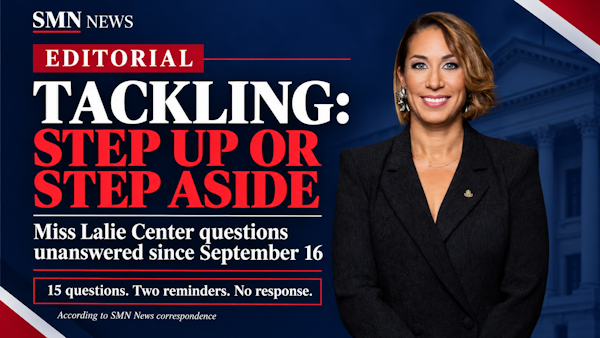 PHILIPSBURG — Minister of Justice Nathalie Tackling must answer for her ministry’s failure to provide basic information about juvenile detention and rehabilitation. More than five weeks after SMN News submitted 15 questions about the Miss Lalie Center, the questions remain unanswered, despite two reminders.
The silence concerns children in detention, the facility’s capacity, staffing, rehabilitation programmes and the arrangements made for minors arrested in connection with the Festival Village break-ins and other crimes.
These are substantive questions about the administration of justice and the treatment of vulnerable young people. A minister entrusted with that responsibility should be able to answer—or, at the very least, explain what information is being gathered and when a response will follow.
Instead, SMN News is still waiting.
That experience now sits alongside complaints made openly in Parliament, where MPs criticized the absence of responses from both the Minister of Justice and Prime Minister Dr. Luc Mercelina.
The message to Tackling is straightforward: step up and account for your ministry, or step aside.
Parliament is waiting for answers too
During the October 22 Central Committee discussion on MP Omar Ottley’s amended initiative draft law concerning residency for locally born children, Ottley told Parliament that requests for information had gone unanswered by the Justice Minister and Prime Minister.
Ottley explained that following his December 16, 2025, presentation, he sent questions on December 17 to the Prime Minister, Minister of Justice and Minister of Education. A reminder followed approximately three weeks later.
Only the Minister of Education had responded, he said.
Consequently, Parliament was discussing proposed changes affecting children’s residency without the requested assessment from the ministry responsible for admission and immigration matters.
Ottley said he could not tell MPs the Justice Minister’s position because he had not received it.
This failure has practical consequences. MPs need information to scrutinize proposals, identify implementation problems and determine whether legislation will achieve its intended purpose.
Leaving those requests unanswered weakens the process through which the public’s representatives are supposed to examine government policy.
Doran challenges government’s treatment of Parliament
MP Egbert Doran criticized the lack of responses, saying the Justice Ministry’s input could help Parliament assess whether the proposal needed additions or adjustments.
His concern was substantive: ministerial engagement could improve legislation before MPs approve it.
Doran also questioned how Parliament could function effectively when requests to ministers remained unanswered. He linked those concerns to the reported difficulties at the Social Economic Council, or SER, which MPs said were holding up legislative initiatives.
His intervention exposed a troubling situation: Parliament is expected to perform its duties while chasing the executive for the information it needs to do so.
Irion and York demand accountability
MP Ardwell Irion likewise criticized the absence of responses and questioned whether political considerations were interfering with engagement on Ottley’s initiative.
That was Irion’s assessment, rather than an established explanation for the silence. Nevertheless, the failure to answer creates space for precisely that suspicion.
A minister who disagrees with a proposal can explain the disagreement. A ministry that identifies legal or operational difficulties can set them out. Silence leaves Parliament and the public without either an explanation or a position to examine.
MP Darryl York broadened the criticism, saying unanswered correspondence had become a persistent problem across multiple ministries.
He cited six outstanding letters to the Ministry of VROMI, including one he said had been awaiting a response for 562 days. Those examples concerned VROMI, but his broader argument was directly relevant to the discussion: Parliament cannot let unanswered requests become normal government practice.
The Prime Minister must also address his own outstanding correspondence and the standards of responsiveness within his government.
Chair describes the burden of chasing ministers
Parliament Chair Sarah Wescot-Williams defended the Secretariat against suggestions that it was inconsistent in pursuing answers.
She explained that staff spend considerable time coordinating with ministers, issuing reminders and arranging parliamentary appearances, regardless of who submitted the questions.
Her explanation reveals an administrative burden that should concern the public. Parliamentary staff should not have to devote excessive effort to persuading ministers to engage with parliamentary business.
Wescot-Williams also stressed the importance of obtaining the government’s position on Ottley’s initiative so that the legislative process could lead to effective implementation.
That makes the absence of a response more consequential. Government’s participation matters, yet Parliament is left pursuing it.
Fifteen questions about the Miss Lalie Center—still unanswered
SMN News’ own experience concerns an equally serious area of the Justice Minister’s portfolio.
On September 16, the newsroom submitted questions asking how many minors were detained at the Miss Lalie Center, how many were male or female, the facility’s official capacity, and whether it was full or approaching capacity.
SMN News also asked whether the Center could accommodate all four minors arrested in connection with the Festival Village break-ins.
If they were not all placed at the Center, SMN News asked the ministry to explain where they were held and why.
Those questions remain unresolved. Without answers, SMN News cannot determine whether the Center could accommodate all four suspects or what alternative arrangements, if any, were necessary.
The questions themselves do not establish that the facility was full or that placements were improper. They establish what the ministry has been asked to clarify—and has still failed to explain.
What rehabilitation are detained children receiving?
The questions extended beyond the number of available beds.
SMN News asked whether the Center has sufficient correctional officers, social workers, psychologists, educators and rehabilitation specialists.
The ministry was asked to identify the educational, psychological, vocational and behavioral programmes available to detained minors.
It was also asked whether it tracks reoffending after release and, if so, to provide the recidivism rate.
Further questions sought details of concrete interventions for repeat offenders, whether structured residential rehabilitation or other programmes were being considered, and what support helps children return to school, enter vocational training or obtain suitable employment after leaving the Center.
SMN News also asked what role parents and guardians play, whether government has a comprehensive juvenile-justice strategy, and whether the minister would provide Parliament and the public with a full report covering the Center’s population, capacity, staffing, budget, conditions and rehabilitation programmes.
These questions go to the purpose of juvenile justice.
Detention carries an obligation to explain what happens to a child during confinement and what support follows release. The public deserves evidence of the work being done, the resources available, and the shortcomings that require attention.
A communications office must communicate
The unanswered correspondence also reflects poorly on the ministry’s communications arrangements.
According to SMN News’ correspondence record, two reminders produced no response from the communications representative approached for the minister’s answers.
Taxpayer-funded communications personnel should facilitate access to information and ensure that questions reach the officials responsible for answering them.
If information is incomplete, they can communicate that. If a response takes longer, they can explain why and provide a realistic timeframe.
Weeks of silence represent a failure to perform that basic function.
Responsibility ultimately rests with the minister. Tackling leads the ministry and must ensure that its public communications serve the people who fund it.
Silence prevents scrutiny
The lack of a response does not prove that the Miss Lalie Center lacks programmes, sufficient staff or appropriate conditions. It prevents the public from assessing those matters through the information requested from the responsible ministry.
That is the accountability failure.
If effective programmes exist, the minister should identify them. If the facility faces shortages, she should explain their extent and the plan to address them. If data are unavailable, she should say so and explain how she will correct that deficiency.
The same standard applies to parliamentary questions. Ministers must engage with scrutiny even when the questions are difficult or politically inconvenient.
Step up or step aside
On this record, Tackling is failing a basic test of ministerial accountability.
SMN News has sought answers since September 16. Two reminders have followed. Parliament has separately heard that the Justice Minister and Prime Minister have failed to respond to requests concerning legislation affecting children born in Sint Maarten.
The subjects differ, but the problem is the same: unanswered questions where public responsibility demands engagement.
Minister Tackling should now provide substantive responses to the Miss Lalie Center questions, explain the delay, and address the outstanding parliamentary requests.
Parliament, in turn, must insist on answers and attach political consequences to persistent failures to provide them.
Minister Nathalie Tackling: step up, answer the questions, and demonstrate that you can lead an accountable Justice Ministry. If you cannot meet that responsibility, step aside.