465 locally born students remain undocumented; MP proposes lowering eligibility age from 16 to 10 and removing a requirement that excludes children who never held residency documents.
 PHILIPSBURG:--- Children born and raised in Sint Maarten could gain an earlier pathway to lawful residency under an amended initiative draft law presented by Member of Parliament Omar Ottley, who told Parliament that hundreds of locally born students remain undocumented despite attending the country’s schools.
During the continuation of a Central Committee meeting on Thursday, October 22, 2026, Ottley outlined a proposal to amend the National Ordinance on Admission and Expulsion. His initiative seeks to expand the categories of people eligible for admission by operation of law, addressing cases where children grow up in Sint Maarten without obtaining legal residency.
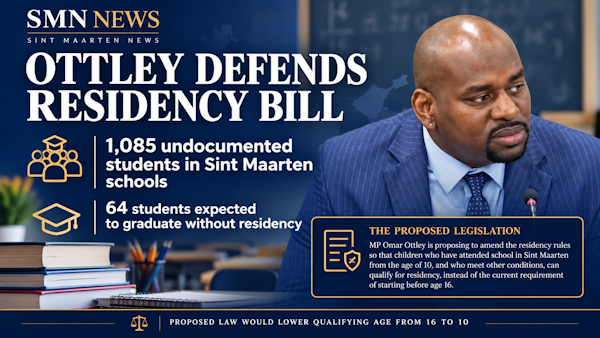
According to figures Ottley said he received from the Ministry of Education, Culture, Youth and Sport, 1,085 undocumented students are enrolled in primary and secondary education, including 465 who were born in Sint Maarten. He further reported that 64 undocumented students were expected to graduate this year.
Ottley argued that these children face barriers extending far beyond immigration paperwork, affecting their ability to pursue further education, travel, participate in overseas sporting activities and eventually secure lawful employment.
The proposal remains under parliamentary consideration. The supplied meeting transcript records further questions and proposed changes from MPs, followed by an adjournment; it does not record a vote approving the legislation.
Replacing “continuously admitted” with residence since birth
A central feature of Ottley’s proposal concerns both the age at which locally born children could qualify and the evidence required to establish their connection to Sint Maarten.
As Ottley described it, the existing provision applies to persons born in Sint Maarten who do not possess Dutch nationality, have reached age 16 and have been continuously admitted to the country since birth.
He identified continuous admission as a major obstacle for children whose parents never obtained residency documents for them.
A child may have lived in Sint Maarten since birth and attended school locally, yet still be unable to satisfy a requirement based on having previously held lawful admission.
Ottley’s amended proposal would lower the qualifying age from 16 to 10 and replace the emphasis on continuous admission with residence in Sint Maarten since birth. School records would help establish that the child has actually grown up in the country.
His stated objective is to prevent children from remaining dependent on discretionary humanitarian decisions because their parents failed to arrange their status.
“And our job as Members of Parliament is to see an issue, identify an issue and try our best to fix the issue,” Ottley told the committee.
A separate pathway based on parents’ tax compliance
Ottley also explained a proposed pathway through which a locally born child could qualify earlier, based on a parent’s record of meeting tax obligations for 10 consecutive years.
In the examples he presented, a child born after the parent had completed the qualifying period could become eligible at birth.
If the parent had completed only part of that period, the child could qualify once the parent completed the remaining years.
For example, Ottley explained that if a parent had three consecutive qualifying years when the child was born, another seven years would be required, allowing the child to qualify at age seven. A parent with nine qualifying years at the child’s birth would need one additional year.
He said this mechanism was intended to recognize longstanding contributions to Sint Maarten while discouraging people from coming to the island solely to give birth in anticipation of residency benefits for their children.
For children whose parents do not meet the tax condition, Ottley described the age-10 pathway, supported by evidence of residence and schooling, as a separate protection.
However, the debate revealed that the precise wording of the tax requirement still needs attention, including whether it would require compliance by both parents or only one.
Residency proposal does not confer Dutch nationality
Ottley stressed that his initiative concerns lawful residence in Sint Maarten.
It would not grant Dutch nationality or automatically provide a Dutch passport.
He explained that nationality is governed at Kingdom level, while the proposed changes address admission and residency within Sint Maarten.
That distinction matters for families: the proposal aims to address children’s local legal status, while nationality and travel-document requirements remain separate.
School records would help establish eligibility
Responding to questions about the education system’s role, Ottley said schools should register children regardless of their documentation status and maintain records that could support residency applications.
He argued that education records offer a practical way to establish whether a child has grown up in Sint Maarten.
MP Sjamira Roseburg nevertheless questioned whether the school-enrollment requirement was sufficiently embedded in the draft's operative text, rather than appearing mainly in its explanatory memorandum.
She suggested expressly including a requirement for at least six consecutive years of school enrollment, reflecting the period between ages four and 10.
Roseburg also asked how interruptions would be treated, including illness, school changes or temporary stays abroad. She was concerned that children should not lose access to the proposed protection because of circumstances that interrupt an otherwise established history of local residence.
These were suggestions raised during the discussion, not changes adopted in the supplied transcript.
Roseburg flags nationality wording and children without parental care
Roseburg also questioned wording that, in her reading, could be interpreted as focusing on children without any nationality.
She warned that the legislation must clearly cover children born in Sint Maarten who possess a foreign nationality, including through Haitian or Jamaican parents, but lack lawful local residency.
Ottley’s presentation described his intended coverage as including locally born children without Dutch nationality, as well as stateless children. The exchange highlighted the need to ensure that the final wording accurately reflects that intention.
Roseburg further proposed clarifying that at least one parent could satisfy the tax requirement, rather than requiring both parents to do so.
She pointed to single-parent households and asked how the legislation would protect children in foster care or youth homes whose parents are absent or uninvolved.
She suggested a mechanism for a guardian or the Court of Guardianship to act on a child’s behalf.
Research describes exclusion, uncertainty and disrupted ambitions
Beyond the education figures, Ottley presented findings from focus groups involving parents and young people.
The parent-focused research included 16 participants aged 23 to 61, with reported periods of residence in Sint Maarten ranging from seven to 38 years.
Participants described financial pressures, dependence on employers, complicated administrative procedures, and prolonged uncertainty when trying to obtain or maintain documents.
Ottley reported that 10 of the 16 participants believed their undocumented status negatively affected their children’s sense of belonging.
A separate youth focus group involved 10 participants aged 16 to 24 who reported being born in Sint Maarten and living there since birth.
Most said they had never held residency documents; two reported previously having documents that later expired.
All 10 expressed ambitions to pursue further education, while seven described delays or changes to their plans. Participants also described teasing, uncomfortable comments and uncertainty about whether others accepted them as belonging to Sint Maarten.
These accounts provide insight into the experiences of those interviewed, although the small focus groups do not establish how widespread each experience is across the entire affected population.
Ottley says Justice Minister and Prime Minister have not responded
The debate also exposed frustration over the government's lack of response.
Ottley said he sent questions to the Prime Minister, Minister of Justice and Minister of Education on December 17, following his December 16 presentation in 2025. A reminder followed approximately three weeks later.
He told Parliament that only the Minister of Education had responded.
As a result, he said he could not provide the committee with the Justice Minister’s position or the Immigration Department’s assessment of the proposed age reduction.
MPs Egbert Doran, Ardwell Irion and Darryl York criticized the lack of responses and raised broader concerns about government accountability to Parliament.
Parliament Chair Sarah Wescot-Williams defended the Secretariat’s efforts to obtain answers and coordinate ministerial appearances, saying reminders are issued across the board.
She also stressed the need to secure the government’s position so parliamentary approval would lead to legislation that could take effect.
Questions remain about parents’ status and implementation
Wescot-Williams questioned how parental responsibility would be addressed when children remain undocumented despite their parents’ longstanding presence and tax contributions.
MP Francisco Lacroes raised another practical concern: what would happen if a child obtained residency under the proposal while the parent remained undocumented?
He asked whether removing the parent could force the child to leave Sint Maarten or remain behind, undermining the security the initiative seeks to provide.
Lacroes also requested clarity on the nature of the residency contemplated by the proposal.
Meanwhile, several MPs warned that the reported lack of a functioning Social Economic Council, known as the SER, was obstructing the processing of legislative initiatives more broadly.
The chair outlined the history of Ottley’s draft: its submission on August 2, 2024; receipt of the Council of Advice’s opinion on October 15, 2024; and submission of his response and amended draft on September 25, 2025.
The October 22 discussion demonstrated support for addressing the position of locally born undocumented children, while leaving substantive questions about eligibility, drafting, and implementation for further handling.
For Ottley, the central issue is whether children who have known Sint Maarten as home should continue reaching adolescence and graduation without a clear route to lawful residence.