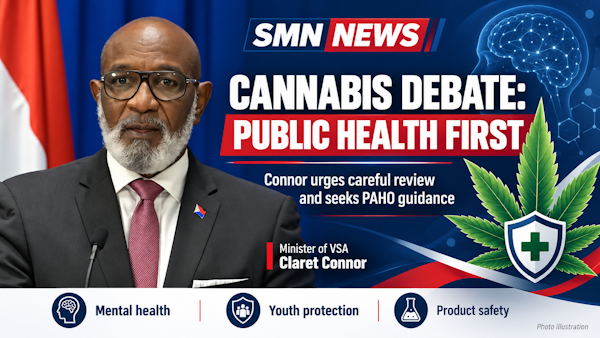
 PHILIPSBURG:--- Minister of Public Health, Social Development and Labor Claret Connor has warned that Sint Maarten’s cannabis debate must account for mental health, substance abuse and the country’s ability to protect vulnerable residents, rather than focusing primarily on economic opportunities.
Answering questions during the October 14 Council of Ministers press briefing, Connor expressed personal reservations about cannabis legalization but said his ministerial responsibility requires a detailed, informed assessment of any proposed legislation.
He said he has sought assistance from the Pan American Health Organization to examine the effects of cannabis policies and the experiences of comparable Caribbean communities.
His responses did not endorse recreational legalization. They outlined a cautious approach that requires evaluating health and social consequences before making decisions.
Personal experience shapes his caution
Asked directly whether he supports recreational cannabis legalization, Connor spoke about witnessing the effects of substance abuse within his community and family.
“If it was Claret Connor, I would say I would not want it,” he said, while explaining that his role as Minister requires him to consider the broader issues surrounding proposed legislation.
His account concerned substance abuse generally. He did not identify cannabis as the substance involved in those personal experiences.
Connor said that background motivates his professional approach and his insistence that the review be thorough.
“No stone will be left unturned,” he stated.
Mental health consequences cannot be overlooked
The question posed to Connor specifically raised concerns about whether Sint Maarten’s mental health infrastructure could manage the consequences of more prevalent use or easier access to cannabis.
Connor said cannabis had been among his leading discussion topics during his recent engagements at the United Nations General Assembly and PAHO meetings.
He also referred to documentation he has had to sign regularly since taking office concerning people affected by mental health or substance-abuse problems. He did not provide figures, diagnoses or a cannabis-specific breakdown.
The Minister cautioned against approaching the issue primarily from an economic-development perspective.
His remarks raise an important question for policymakers: what services, personnel, and safeguards would be needed to manage the health consequences of any change in access?
PAHO asked to support review
Connor said he has held discussions with PAHO’s Caribbean representatives, including its office in Trinidad, to support an examination of different approaches and experiences.
He described that engagement as an opportunity to use the Ministry’s strategic cooperation with PAHO to inform local decisions.
Each step, he said, must be evaluated for its advantages and disadvantages.
When the reporter suggested a phased approach beginning with medicinal use rather than recreational legalization, Connor reiterated the need for a comprehensive review. He did not announce adoption of that proposal or a timetable for legislation.
Unregulated products carry additional risks
International health guidance supports the need to distinguish the effects of cannabis itself from the additional dangers associated with products whose contents and strength are unknown.
Health Canada warns that illegal cannabis may lack reliable quality controls and contain harmful levels of pesticides, heavy metals, mould, bacteria or cutting agents. Information about THC—the principal intoxicating component—and CBD may also be inaccurate or unavailable.
In Canada’s regulated system, products are subject to testing, potency information, and recall mechanisms. Those safeguards can reduce certain product risks, although they do not make cannabis harmless. These Canadian findings are relevant to the policy discussion; they are not evidence that particular products in St Maarten have been tested or found contaminated. canada.ca
Without reliable testing and labeling, consumers may struggle to know what they are taking or how strong it is. That uncertainty creates an additional challenge for prevention, treatment and public education.
Young people face particular concerns
The United States Centers for Disease Control and Prevention warns that cannabis use during adolescence can harm the developing brain, affecting learning, memory and other functions.
The CDC also reports an association between cannabis use and psychosis, including temporary experiences of paranoia or hallucinations. The association with schizophrenia is stronger among people who begin using cannabis earlier and use it more frequently.
These findings do not mean every person who uses cannabis will develop a psychiatric disorder. They do underline the importance of protecting young people and considering patterns of use when assessing risk. cdc.gov
For Sint Maarten, that evidence makes youth access, prevention and the availability of support central considerations in any proposed framework.
Dependence can affect families, school and work
Cannabis can also lead to cannabis use disorder, in which a person continues using despite health or social problems and has difficulty stopping.
The CDC identifies greater risk among people who start during adolescence and those who use frequently. Warning signs include unsuccessful attempts to quit, neglecting important activities, and continuing use despite problems at home, school, or work.
Highly concentrated THC products are also associated with more severe symptoms of cannabis use disorder. cdc.gov
The consequences can therefore extend beyond an individual episode of intoxication, affecting relationships, responsibilities and the demand for treatment.
Road safety remains a concern
Cannabis can impair reaction time, coordination, perception and decision-making—abilities needed for safe driving.
Using cannabis alongside alcohol can increase impairment. The CDC also notes that cannabis affects brain functions involved in attention, memory, and learning, while smoked cannabis can damage lung tissue. These risks exist regardless of whether a product is legally sold. cdc.gov
Regulation must therefore be assessed alongside prevention and enforcement measures addressing impaired driving and other activities requiring alertness.
Health safeguards must be practical
Taken together, Connor’s remarks and the international evidence point to issues a local assessment would need to address: product testing, accurate labeling, protection of minors, public education, treatment access and the capacity to respond to adverse effects.
Those considerations arise from the evidence, rather than from measures Connor announced as an approved government package.
The Minister did not present a completed health-impact assessment, a mental health capacity plan or a budget for cannabis-related prevention and treatment during the briefing.
His position was nevertheless clear: proposed economic benefits cannot be assessed in isolation from the people who may experience harm.
The next test will be whether the promised review transparently assesses those risks and the resources Sint Maarten would need to manage them before any policy decision is taken.