General Affairs has 236 filled posts against an approved formation of 439, no formal ministry-wide multi-year strategic plan, and no fixed quarterly recruitment schedule.
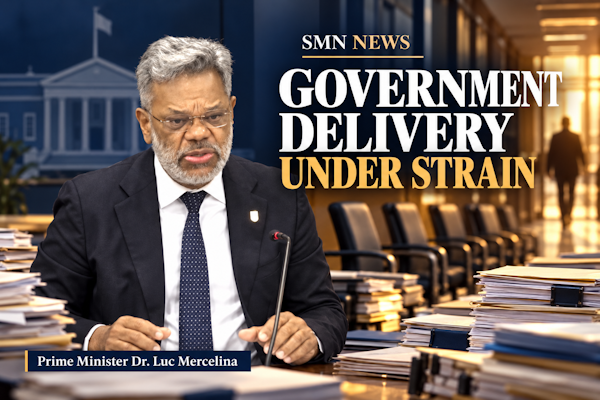 PHILIPSBURG:--- Prime Minister and Minister of General Affairs Dr. Luc Mercelina told Parliament on October 1 that shortages in the departments supporting the entire government continue to delay recruitment, legal work, procurement and digital modernization.
His answers during the Central Committee’s examination of the draft 2027 Budget revealed the scale of the problem: General Affairs has 236 filled positions against an approved formation of 439.
The proposed budget funds 59 vacant positions, bringing the total number of funded posts to 295. Even if all those funded vacancies are filled, the ministry would remain 144 positions below its approved formation.
Funding is therefore a necessary step, but it does not by itself establish when the ministry will have the people needed to deliver.
The Departments Needed to Fix Government are themselves Understaffed
Mercelina identified Personnel and Organization, Legal Affairs and Legislation, ICT, Facility Affairs and the Fire Department as priority areas.
The effects extend across government. Personnel shortages impede recruitment and workforce planning. Legal capacity constraints delay legislative drafting, review and advice. ICT shortages limit digital transformation. Facility Affairs faces difficulties in procurement, contracts, buildings management, security and financial administration.
The Prime Minister said virtually all non-emergency services delivered by these departments are negatively affected.
His explanation identifies a difficult cycle: government needs staff to recruit staff, legal expertise to advance reforms, and administrative capacity to implement the budgets meant to address those weaknesses.
No Fixed Recruitment Timetable
When MP Lyndon Lewis asked for a quarterly recruitment plan, Mercelina said the ministry does not operate on a fixed quarterly schedule.
Recruitment instead proceeds continuously, depending on operational needs, budget availability, priorities and qualified candidates.
Government is broadening its search to Aruba, Curaçao, Suriname, the Netherlands and the diaspora, alongside local recruitment. Temporary expertise and specialist recruitment support may be used to maintain critical services.
Those measures address real constraints. However, the answers did not establish quarterly hiring targets against which Parliament could assess whether the 59 funded vacancies are being filled.
No Formal Multi-Year Strategic Plan
Responding to MP Darryl York, Mercelina acknowledged that the ministry has no formal multi-year strategic plan, and most individual departments do not either.
He said the newly appointed Secretary-General is strengthening planning and control through departmental plans, clearer annual objectives, improved reporting and performance monitoring.
For now, the ministry’s direction rests on the governing program, national development vision, country package reforms and annual budget priorities.
The admission matters because General Affairs is responsible for much of the machinery required to turn the wider government’s promises into results.
Coordination Without a Measurable Delivery Overview
Doran asked how the Prime Minister tracks implementation of the governing program and whether Parliament could receive a ministry-by-ministry account of progress.
Mercelina rejected percentage scoring as his management approach, arguing that the program contains hundreds of initiatives, many intended for the full governing period.
He described regular ministerial communication, coalition meetings and a standing Council of Ministers agenda item through which he raises matters requiring follow-up, including crime prevention, waste management, roads and abandoned vehicles.
Percentages alone cannot capture the complexity of governing. But Parliament’s oversight need remains: which commitments have been completed, which are delayed, who is responsible, and what happens next?
The coordination examples did not provide the project-by-project timetable and allocation of responsibilities Doran requested.
Reforms Continue, With Funding and Deadlines Unresolved
Mercelina said the “It’s All About the People” public service reform program is not yet fully funded. Several components depend on future allocations and continued support for the country package.
Outstanding concerns include career development, succession planning, employment conditions, workforce planning and organizational culture.
Legislative initiatives also remain in progress, with Mercelina declining to provide specific submission dates because of drafting capacity, consultations and legal review.
He said the 2026 Budget had entered into force only the previous week and that implementation of additional support had begun. Many commitments will continue into 2027 and beyond.
Some targets are clear: initial digital services are expected by the second quarter of 2027, alongside work on digital identity, data sharing and a redesigned portal.
The broader challenge is to apply that same clarity to recruitment, legislation and administrative reform. Residents can understand that rebuilding capacity takes time. Parliament still needs a way to determine whether each successive budget is reducing the delays.