MP demands disclosure of St Maarten’s full 30-year commitment and potential Cg. 32.4 million exposures under the peak facility.
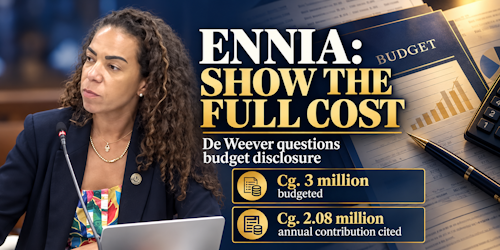 PHILIPSBURG:--- MP Ludmilla de Weever has challenged how government presents its ENNIA obligations in the draft 2027 budget, demanding an explanation for a Cg. 3 million allocation that she says does not reconcile with the Cg. 2.08 million annual contribution specified in the September 2024 addendum.
Speaking during Parliament’s Central Committee budget debate, De Weever warned that a single allocation under the Ministry of Finance does not adequately explain a commitment that will affect the country for decades.
She questioned why the obligation appears under projects and activities rather than being clearly identified as a recurring financial commitment. She also asked where the government discloses the separate risk associated with the ENNIA peak facility.
“In fact, I would go so far as to say I believe it’s hidden,” De Weever told Parliament.
Her criticism concerned the visibility and completeness of the budget disclosures. She demanded that Finance Minister Marinka Gumbs reconcile the figures and explain precisely what the country is expected to pay.
Why Cg. 3 million?
De Weever said the agreement approved by a parliamentary majority in 2024 establishes Sint Maarten’s annual contribution at Cg. 2.08 million, with payments beginning in 2027.
She asked why the draft budget instead provides Cg. 3 million and whether the signed agreement has since been amended, supplemented or replaced.
She also challenged wording in the budget explanation indicating that the contribution was still subject to an actuarial calculation by the Central Bank of Curaçao and Sint Maarten. If the signed addendum already specifies the annual amount, she argued, the explanation must reflect that.
Her questions included whether the Cg. 3 million represents the gross ENNIA obligation or the net amount expected to come from the government’s own resources.
De Weever also requested disclosure of the Central Bank dividend income assumed for 2027, where that revenue is recorded and how much is expected to finance the ENNIA contribution.
Without those details, she argued, Parliament cannot establish how the budget allocation connects to the agreement or what burden falls directly on the country.
Thirty years must remain visible
De Weever reminded Parliament that she opposed the ENNIA agreement because she did not consider the figures sufficiently substantiated to commit Sint Maarten to what she described as a 30-year bailout arrangement.
She said her opposition made her particularly attentive to how the government would prepare for the obligation once payments began.
According to the figures she cited, the agreement apportions 93.51% of the relevant bailout balance to Curaçao and 6.49% to Sint Maarten.
She argued that the commitment must remain visible to successive ministers, MPs and civil servants throughout its lifetime.
A budget may primarily concern the coming year, she said, but it must also give decision-makers a clear understanding of long-term obligations that restrict future financial choices.
She asked whether the ENNIA provision appears in the country’s debt or loan schedules and requested the total estimated exposure over the agreement’s full life.
The additional Cg. 32.4 million risk
De Weever distinguished the annual contribution from the peak facility, which she said creates a potential Sint Maarten exposure of up to Cg. 32.4 million.
She asked where that contingent liability is disclosed in the annual budget, the multi-year projections or the country’s financial risk statement.
The peak facility, as she presented it, is a separate potential obligation. It should therefore be explained alongside the annual payments, rather than left for MPs to identify across different documents.
She asked whether government has established a reserve, sinking fund, insurance arrangement or another mechanism to cover a possible call on the facility.
“If not, how would St. Maarten finance a call on the peak facility without creating an immediate liquidity problem?” she asked.
De Weever pointed to Curaçao’s approach, saying it had provided for a sinking fund to address potential future exposure. She urged Gumbs to consult Curaçao and review how both the annual commitment and the contingent risk are disclosed.
A surplus needs a full explanation
De Weever also demanded a reconciliation of the government’s projected 2027 result before and after accounting for ENNIA and other material financial risks.
She was concerned that an ordinary-service surplus could present an incomplete picture if significant obligations remain outside the calculation.
She asked Finance to review the signed agreement and its addenda, ensure consistency between the English and Dutch documents, and explain the relationship between the Cg. 3 million budget allocation, the Cg. 2.08 million annual contribution and the peak facility.
For De Weever, the issue is larger than a disputed budget line. Parliament must know the annual payment, its funding source, the potential additional exposure, and how the government intends to protect the country if that exposure becomes payable.