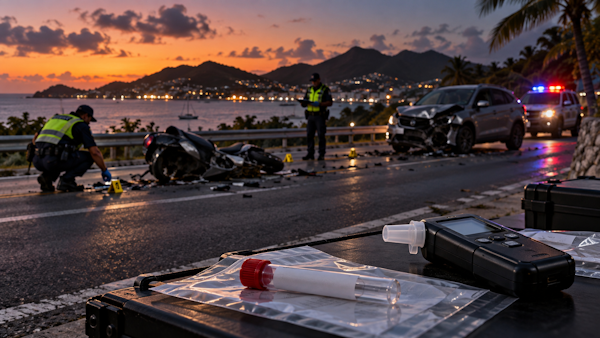
 PHILIPSBURG:--- Police investigating a serious traffic collision cannot compel a driver to provide a blood sample under Sint Maarten’s current criminal and traffic laws, Justice Minister Nathalie Tackling told Parliament. She acknowledged that the lack of compulsory testing can make it harder to establish impairment, particularly when a driver leaves the scene before police arrive.
Tackling said officers may administer a roadside alcohol assessment when a suspected driver is present, but that assessment does not definitively establish how much alcohol or another substance the person consumed. Blood or urine testing, she said, requires the person’s voluntary cooperation.
The timing matters. If a driver leaves before police arrive, investigators may still use witness accounts, camera footage, evidence from the scene and lawfully obtained forensic material. Tackling cautioned, however, that the passage of time can reduce the value of evidence concerning alcohol or drug use.
The minister was answering questions about how police investigate fatal collisions and how prosecutors decide whether the evidence supports charges involving negligent or reckless conduct. She said a fatality does not automatically make everyone involved a criminal suspect. Police investigate under the authority of the Prosecutor’s Office, prosecutors assess the evidence and decide what charges to pursue, and the court determines criminal liability.
Tackling said the existing framework permits traffic prosecutions, but she called for breathalyzers and other equipment that can accurately measure alcohol levels, along with stronger legislation governing impaired driving. She also said she had only recently learned of an earlier policy document on modernizing the road traffic ordinance. A proposal connected to that work carried a quoted cost of €352,800 and included plans for a mobility authority.
The minister reported 681 traffic collisions through week 27 of 2026, compared with 719 over the same period in 2025 and 812 in 2024. Those figures show fewer recorded collisions, but they do not resolve the evidence problem she described: in a suspected impaired-driving case, investigators may lose a chance to measure impairment when a driver leaves the scene or declines voluntary testing.