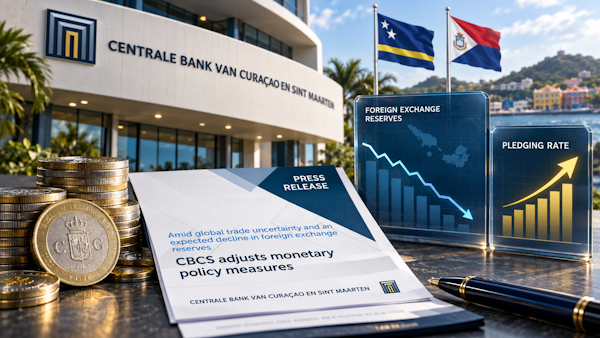
 WILLEMSTAD:--- The Centrale Bank van Curaçao en Sint Maarten (CBCS) has increased its pledging rate to 4.50 percent amid projections that the monetary union’s foreign exchange reserves will decline by approximately Cg. 332 million in 2026.
The decision was taken on September 17 against a backdrop of international trade uncertainty, geopolitical tensions and the possibility of renewed disruptions in global energy markets.
The pledging rate is the interest rate commercial banks pay when borrowing from the central bank.
The CBCS kept the reserve requirement unchanged at 18.50 percent, maintaining what it described as a balanced monetary policy position. It also announced adjustments to its Certificates of Deposit program to reduce the cost of absorbing excess liquidity from the banking system and improve the effectiveness of monetary policy.
The central bank’s decision followed the United States Federal Reserve’s September 25-basis-point increase in its policy rate. The Federal Reserve raised its target range for the federal funds rate to between 3.75 and 4.00 percent.
By increasing its pledging rate to 4.50 percent, the CBCS maintained a 50-basis-point spread above the U.S. federal funds rate.
Reserves Projected to Fall by Cg. 332 Million
Gross official reserves increased by Cg. 468.1 million through August 31, 2026. However, the CBCS expects that trend to reverse, with reserves projected to decline by approximately Cg. 332 million during 2026.
According to the central bank, the expected reduction mainly results from the Dutch State's withdrawals from its CBCS account and lower net capital transfers.
The Dutch State’s withdrawals involve repatriating funds accumulated in its CBCS account, primarily from interest and principal payments made by the governments of Curaçao and Sint Maarten.
Combined with higher projected imports of goods and services, the decline in reserves is expected to reduce the monetary union’s import coverage from 4.7 months at the end of 2025 to 4.3 months by December 2026.
Despite the reduction, import coverage is expected to remain above the three-month benchmark.
The CBCS said the monetary union’s foreign exchange position is still expected to remain strong and contribute to a stable external position. However, the central bank warned that significant risks remain.
Global trade tensions and uncertainty surrounding tariff policies could weaken external demand, increase import costs and create additional inflationary pressure in Curaçao and Sint Maarten.
More restrictive U.S. monetary policy could also tighten global financial conditions, increase external borrowing costs and limit access to financing for both countries.
Certificate of Deposit Program Adjusted
The CBCS also adjusted its Certificates of Deposit program to bring the instrument more closely in line with market conditions.
Certificates of Deposit are interest-bearing instruments the central bank issues to commercial banks to absorb excess liquidity for a specified period. The program provides banks with an alternative for placing part of their available liquidity locally instead of investing those funds abroad.
The instruments form part of the CBCS’s open-market operations and are used to manage liquidity in the banking system and influence the amount of credit commercial banks extend.
The changes are intended to reduce liquidity-absorption costs, improve liquidity management and strengthen the transmission of monetary policy while protecting external stability and maintaining adequate reserve coverage.
The adjustments will take effect at the beginning of October 2026. The CBCS said it will provide additional details in a forthcoming monetary circular.
The central bank pledged to continue monitoring domestic and international economic developments and adjust its monetary policy instruments as needed.