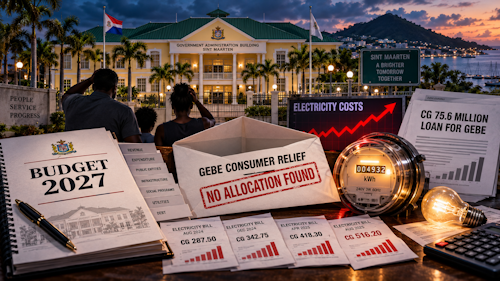
 PHILIPSBURG:--- The Government of St Maarten’s draft 2027 budget contains no clearly identified allocation for the long-promised relief to GEBE consumers struggling under high electricity bills, disputed accounts and accumulated utility debt.
A review of the complete 337-page budget package found extensive discussion about protecting vulnerable consumers, improving price controls and strengthening GEBE’s financial position. However, no dedicated budget line is clearly labeled as GEBE consumer relief, electricity-bill reduction, fuel-clause relief, household utility assistance, or forgiveness of consumer debt.
The government has documented a Cg 75.6 million loan secured on behalf of GEBE in 2024, yet the 2027 budget does not clearly show how much—if anything—will be provided directly to the consumers waiting for relief.
The money went toward supporting the company. The promised relief for the people remains missing from the budget.
Plenty of language, no dedicated GEBE relief fund
The budget repeatedly speaks about “economic relief” and protecting vulnerable consumers. The Ministry of Tourism, Economic Affairs, Transport and Telecommunication states that it intends to protect consumers against inflation and market shocks.
But the relief described by TEATT consists primarily of:
- Strengthening the Maximum Price System;
- Creating a digital platform for monitoring maximum prices;
- Developing dynamic price-adjustment models;
- Increasing enforcement of price regulations;
- Conducting market research;
- Preparing competition and consumer-protection legislation; and
- Supporting possible reductions in certain direct and indirect taxes.
These measures may affect food, fuel and other essential goods. They do not amount to a funded GEBE relief programme.
No amount is stated to lower residential electricity bills. No subsidy has been identified to reduce the fuel clause. No budgeted fund exists to assist households facing disconnection. There is no clearly defined debt-relief programme for consumers carrying disputed or accumulated GEBE balances.
A promise without a budget line is not yet relief.
Cg 75.6 Million Loan for GEBE
While consumers cannot locate their relief in the budget, the document confirms that the government secured a Cg 75.6 million loan for GEBE in 2024.
The capital-expenditure section also contains a bare entry reading “GEBE 75.000”, but it provides no explanation on that page showing that the amount is intended for consumers. The budget’s narrative separately identifies the Cg 75.6 million loan secured in 2024.
Nothing in the relevant GEBE section states that this financing will be converted into lower bills, customer credits, or debt forgiveness.
Government must therefore explain:
- What the Cg 75.6 million financed;
- How much has already been spent;
- Whether any portion was intended for consumer relief;
- Whether consumers received any measurable benefit;
- Whether the capital entry is a carryover of the 2024 financing; and
- Why the 2027 budget contains no separately identified consumer-relief allocation.
Without those answers, the public is left to conclude that millions were mobilized to support the utility company while households were given promises.
GEBE’s Financial Condition Described as “Worrying”
The absence of a consumer-relief programme is made more serious by the budget’s own description of GEBE’s finances.
Government says GEBE’s current situation is “worrying” and expects both its liquidity and equity to have deteriorated over the past two to three years.
Yet government does not have completed financial statements or current financial data for 2023, 2024 or 2025.
The newest available figures are from 2022. Those figures show GEBE’s cash position collapsing from Cg 54.6 million in 2021 to Cg 1.5 million in 2022.
At the same time:
- Trade and other receivables increased from Cg 48.5 million to Cg 306.1 million;
- Short-term liabilities increased from Cg 26.9 million to Cg 198.8 million;
- Equity stood at Cg 226.6 million; and
- The company recorded a 2022 profit of Cg 23.8 million.
The budget itself questions how much of the Cg 306.1 million in receivables can actually be collected.
That is particularly important for consumers. If a considerable portion of GEBE’s receivables consists of questionable, disputed, or unreliable customer balances following the billing crisis, the government must explain how those accounts are being treated.
The public should not be forced to finance accounting uncertainty through higher bills, aggressive collection or disconnections.
Consumers Are Mentioned Everywhere Except Under GEBE
The contradiction is impossible to ignore.
In the TEATT section, the government declares that affordable access to essential goods is a national priority. It speaks about increasing consumers’ disposable income and purchasing power through possible tax reforms.
But in the section dealing specifically with GEBE, the focus shifts entirely to:
- Catching up on financial statements;
- Repairing internal processes;
- Determining whether receivables are collectible;
- Restoring financial reporting;
- Addressing weakened liquidity; and
- Managing the company’s financial risk to government.
No accompanying section explains what happens to the people who must pay GEBE every month.
There is no consumer-relief amount, implementation date, eligibility criterion, or application procedure.
The government does not explain whether it intends to subsidize electricity, reduce the fuel clause, write off disputed balances, or protect vulnerable households from disconnection.
Price Controls Will Not Reduce a GEBE Bill
The government’s plan to modernize the Maximum Price System may assist shoppers by increasing oversight of prices charged for certain goods. It does not automatically lower a GEBE electricity bill.
A consumer-price database cannot replace an electricity subsidy.
A public-awareness campaign cannot cancel disputed utility debt.
Future consumer-protection legislation cannot provide immediate relief to a household facing disconnection.
Possible tax reductions may eventually improve purchasing power, but the budget does not establish the exact taxes to be reduced, the size of the reduction or when consumers will receive the benefit.
The language of relief is present. The actual relief is not.
Parliament must demand a dedicated relief plan
Parliament should not allow government to hide the absence of GEBE consumer relief behind broad references to consumer protection.
Before approving the 2027 budget, Members of Parliament should demand:
- The exact amount promised for GEBE consumer relief;
- The budget line under which that amount is recorded;
- A breakdown of the Cg 75.6 million loan secured for GEBE;
- An explanation of the unexplained “GEBE 75.000” capital entry;
- The number and value of disputed consumer accounts;
- The portion of GEBE’s Cg 306.1 million in receivables considered collectible;
- The amount of consumer debt government proposes to forgive, reduce or restructure;
- The proposed assistance for elderly, low-income and medically vulnerable customers;
- The effect of any relief on the fuel clause and monthly electricity bills; and
- A binding implementation date.
The government cannot continue announcing relief outside Parliament while presenting a budget that does not clearly fund it.
If GEBE consumers were promised assistance, that promise should appear in black and white—with an amount, a responsible ministry and a deadline.
Until then, the 2027 budget offers consumers protection in theory, reforms in the future, and another year of electricity bills in the present.