Former VSA minister says Parliament retains control over legislation as disclosure motion falls 7–8
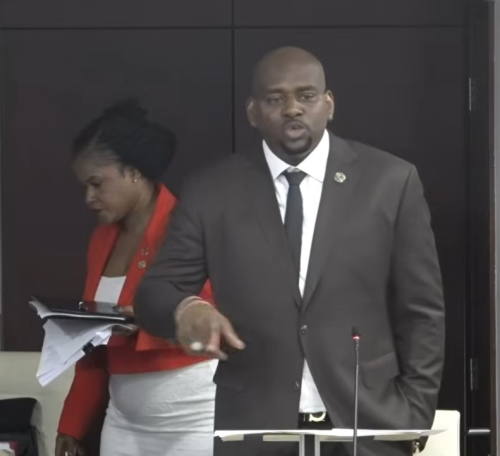 PHILIPSBURG: --- MP Omar Ottley publicly defended his role in signing the Native Nations cannabis agreement, telling Parliament that he remained committed to cannabis regulation and had negotiated a substantial reduction from the 30-year period initially sought during the bidding process.
“I was the one that signed the contract,” Ottley said during the August 27 budget proceedings.
“It's not a secret, and I still believe in the vision of cannabis regulation.”
His intervention came as Parliament debated MP Ludmila de Weever’s motion seeking the agreement, procurement records, legal opinions and information about possible exclusivity and financial exposure.
The motion was subsequently defeated with seven votes in favor and eight against. That vote rejected the requested disclosure measure; it did not approve cannabis legislation.
Ottley says government rejected a 30-year commitment
Ottley said the proposals received during the bidding process sought a 30-year period.
According to his account, the Council of Ministers objected to committing the country for that length of time, and asked the three leading companies to accept a reduction.
Ottley told Parliament that Native Nations was the only one to respond positively to that request.
“I did not tie in the country to 30 years,” he said. “I did a substantial reduction.”
That was his explanation of the negotiations. The complete procurement file, evaluation records and signed agreement were not among the documents reviewed for this article, so his account cannot be treated as an independently verified reconstruction of the tender.
De Weever’s motion sought precisely those underlying records, including clarification of reported 10-year exclusive or preferential rights and the conditions under which any rights would take effect.
“We hold the power”
Ottley argued that signing the agreement did not remove Parliament’s authority to decide whether cannabis legislation should pass.
“We're ranting and raving, but we hold the power,” he said, referring to Parliament’s eventual consideration of the legislation.
He maintained that the agreement remained dependent on parliamentary approval of the legislative framework and that MPs would be able to demand documents when the proposal reached the floor.
The distinction is important: Parliament’s authority to approve or reject legislation is separate from questions about what government has already promised contractually and whether those promises could carry consequences.
De Weever’s motion sought clarification of both issues.
It asked whether parliamentary enactment was an express prerequisite to activating commercial rights, and what legal authority government relied on when making the agreement.
Ottley cites termination provision
Ottley also referred to a termination provision which, according to his explanation, allowed government to end the agreement before its expiration for cause.
He asserted that termination under that provision would not carry a financial obligation.
That assertion remains Ottley’s interpretation of the agreement. Without the full contract, annexes and relevant legal advice, it would be premature to conclude that every possible cancellation, delay or refusal to legislate would leave the country without financial exposure.
The disclosure motion specifically requested termination provisions, compensation arrangements, legal opinions and an assessment of the country’s maximum potential exposure.
Those questions concern the terms and consequences of the agreement, not simply whether an MP supports cannabis regulation.
Closed-door offer shapes Ottley’s position
Ottley said he generally supported ministers providing information to Parliament.
However, he pointed to TEATT Minister Grisha Heyliger-Marten’s offer to meet MPs behind closed doors once the necessary legal review was complete.
He said that offer was why he might oppose the motion at that stage.
Heyliger-Marten had asked Parliament not to adopt the proposal in its existing form. She said the ministry had requested legal advice on the agreement’s confidentiality provisions and wanted to avoid a breach or potential liability.
“This is not a refusal to provide Parliament with information,” she told MPs.
She committed to updating Parliament in writing or through a closed-door meeting once she received the advice.
Her position was that disclosure required legal review—not that Parliament would never receive the information.
Confidentiality remains disputed
Ottley distinguished between references to a nondisclosure agreement and a confidentiality clause in the contract.
He acknowledged that the agreement contained a secrecy or confidentiality provision, while disputing other members' characterization of the arrangements being discussed.
That distinction did not resolve the central disagreement: whether MPs should receive the existing contractual information before submitting the cannabis legislation.
De Weever’s motion requested the complete agreement and supporting records, together with clarification of the legal basis for withholding any requested material.
MP Sjamira Roseburg emphasized that the motion concerned information about an existing agreement, rather than a vote on the future legislative proposal.
MP Sarah A. Wescot-Williams also called for a clear statement from the Prime Minister on the government’s collective position before the draft legislation reached Parliament, while respecting Heyliger-Marten’s request for time to complete the review.
Support for regulation is not an answer to every contract question
Ottley’s intervention made his position clear: he accepted responsibility for signing the agreement, defended the negotiations and continued to support cannabis regulation.
But the debate also demonstrated why the policy question and the contract question cannot be treated as interchangeable.
An MP can support regulation while asking whether an exclusive arrangement offers value to the country. Equally, opposition to commercialization does not establish that a contract was unlawfully concluded.
The documents are necessary to assess those questions fairly.
With the disclosure motion defeated, the Court did not adopt its proposed six-week reporting requirement. The minister’s commitment to provide information after legal review nevertheless remains part of the parliamentary record.
Ottley has put his defense on that record. The outstanding test is whether the agreement and supporting documentation substantiate his assurances about the commitment's duration, Parliament’s freedom to decide, and the country’s potential financial exposure.