Mercelina acknowledges recruitment bottleneck as MPs redirect funds to personnel support and legislative drafting
 PHILIPSBURG: --- St. Maarten’s government says it needs qualified people to deliver services and implement reforms. Yet during the budget debate, MPs raised complaints that people willing to work for government—including graduates seeking to return home—were not even receiving responses to their applications.
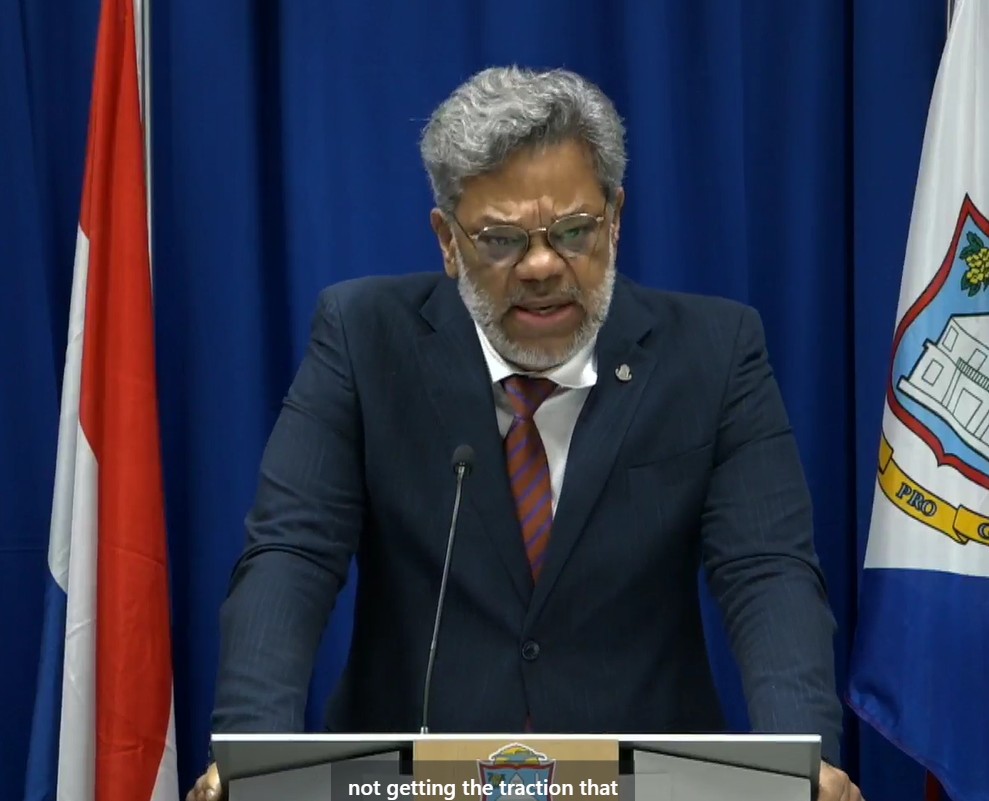
Prime Minister Dr. Luc Mercelina acknowledged the problem and linked it to shortages within the very department responsible for recruitment.
“The Honorable Member also raised a concern that I take seriously, namely that qualified personnel have applied and never received a response,” he told Parliament on August 24.
“That is not the experience we want applicants to have.”
The exchange exposed a damaging cycle: an understaffed personnel department struggles to recruit, leaving other departments without the people they need.
Returning graduates encounter an administrative barrier
MP Veronica Jansen-Webster said former students had reported applying without even receiving confirmation that their emails had arrived.
She asked what the Prime Minister and Secretary General of General Affairs would do to prevent that from continuing.
Mercelina responded that the issue was capacity, not a lack of willingness to reply. He pointed to recruitment within Personnel and Organization, a strategic recruitment plan, and the possibility of using an external recruitment agency.
“No qualified candidate, whether residing abroad or in Sint Maarten, should feel that their interest in serving their country is being ignored,” he said on August 26.
But the debate did not establish that the backlog of unanswered applications had been cleared.
Approved posts and actual staffing tell different stories
Responding to MP Egbert Doran, Mercelina supplied figures distinguishing approved positions, filled positions and budgeted vacancies.
|
Ministry |
Approved positions |
Filled positions |
Budgeted vacancies |
|
General Affairs |
455 |
255 |
17 |
|
Finance |
214 |
138 |
25 |
|
Justice |
1,096 |
591 |
46 |
|
Education, Culture, Youth and Sport |
349 |
268 |
29 |
|
VSA |
198 |
148 |
3 |
|
TEATT |
234 |
169 |
12 |
|
VROMI |
145 |
95 |
15 |
These figures were presented during the debate, not in an independently audited staffing assessment.
They also must not be misread. An approved position is not necessarily a funded vacancy ready for immediate recruitment. Mercelina separately acknowledged that function books required updating and that some no longer reflected current operational needs.
Nevertheless, the difference between the approved structures and actual staffing illustrates why a list of projects cannot be assessed separately from the workforce expected to execute it.
More salary spending does not automatically mean stronger departments
Mercelina acknowledged that higher personnel expenditure had not automatically produced stronger organizational capacity.
He identified recruitment, retention, succession planning and competition for specialized talent as continuing difficulties.
The proposed response includes labor-market allowances for hard-to-fill positions, training, function-book reviews and changes intended to make government a more attractive employer.
He also supported considering English-language vacancy announcements after Jansen-Webster questioned advertisements appearing only in Dutch.
These measures address different obstacles. Advertising a vacancy, attracting a qualified applicant and completing an appointment are separate steps; progress at one stage does not establish success at the others.
Parliamentary funding helps the departments holding up delivery
The final budget votes produced concrete reallocations aimed at the bottleneck.
Jansen-Webster’s amendment moved Cg. 400,000 from calamity prevention to temporary support for P&O and Facility Services. It passed 12–3.
MP Sjamira Roseburg secured another Cg. 100,000 for external legislative lawyers for Legal Affairs. That amendment passed 14–1.
Together, the measures redirected Cg. 500,000 toward administrative and legal capacity.
They did not establish that consultants had already been engaged, vacancies filled, or delayed legislation completed.
Labega calls for a realistic legislative queue
MP Dimar Labega warned that ministries were advancing legislative ambitions simultaneously despite limited personnel in P&O and Legal Affairs.
He urged government to coordinate and prioritize instead of expecting an understaffed system to process every initiative at once.
Mercelina acknowledged the broader consequences: when recruitment takes longer and legislative work stalls, revenue measures, reforms, and budget-related initiatives are affected.
Government also could not provide a fully coordinated legislative calendar with firm timelines for every initiative at that stage.
That makes prioritization an accountability issue. Parliament needs to know which measures will proceed first, which will wait, and what staffing assumptions support those choices.
Temporary help raises a permanent question
Doran also questioned what would happen when external financing for positions and projects ended.
Mercelina said government would not assume that every externally funded position should become permanent. Essential functions would require assessment of their necessity, results and financial sustainability.
Temporary assistance can reduce an immediate backlog. It cannot, by itself, guarantee that government can maintain the service after the funding ends.
The budget has now provided additional resources. The test is whether applicants receive responses, recruitment moves faster, and departments can demonstrate improved delivery.
Government cannot ask qualified people to come home while allowing their applications to disappear into an unanswered inbox.