~Two motions withdrawn as MPs approve measures on poverty, price controls, illegal dumping and economic development.~
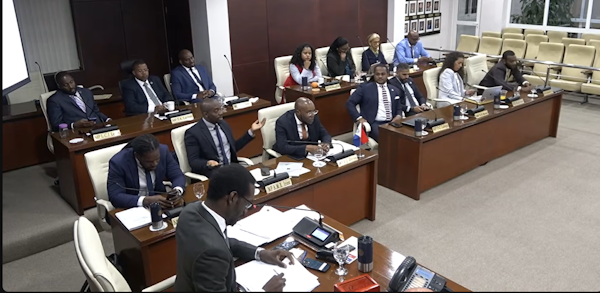 PHILIPSBURG:--- Parliament adopted 11 motions and nine budget amendments during the concluding deliberations on Sint Maarten’s draft 2026 budget on Thursday, August 27, 2026.
Of the 15 motions considered, two were withdrawn, and two were rejected. Of the 10 proposed budget amendments, Parliament incorporated nine into the draft budget and defeated one.
The decisions covered poverty reduction, consumer prices, abandoned vehicles, illegal dumping, maritime development, the creative economy, charitable donations and district improvements. Parliament also approved a motion of disapproval against VROMI Minister Patrice Gumbs, while rejecting proposals concerning firearm authorization for former justice personnel and disclosure of the Native Nations cannabis agreement.
The amended draft budget subsequently passed with 10 votes in favor and five against.
Environmental vehicle-disposal contribution approved
MP Francisco Lacroes’ motion proposing a one-time environmental vehicle-disposal contribution passed with 14 votes in favor and none against.
The proposal seeks a sustainable way to finance the removal, processing, recycling, and environmentally responsible disposal of wrecked and end-of-life vehicles.
The contribution would be attached to the vehicle and be paid once. The motion requests its incorporation into the ongoing amendment of waste legislation, rather than creating a separate system.
VROMI Minister Patrice Gumbs supported the initiative. Adoption of the motion does not introduce the charge itself; the necessary legislative work must still follow.
Scooter-registration motion withdrawn
Lacroes withdrew his proposal to strengthen registration, identification and ownership records for scooters, motorcycles and similar vehicles after Justice Minister Nathalie Tackling raised legal and practical concerns.
The proposal addressed vehicle traceability through importation, sale, registration and transfer of ownership, including the ability to identify vehicles involved in accidents, theft and other violations.
Lacroes accepted the opportunity to work with the ministry on legislative obstacles. No vote was taken.
National poverty strategy receives unanimous support
MP Dimar Labega’s motion requesting a National Poverty Reduction Strategy within six months passed 15–0.
The strategy is to include a baseline assessment of poverty and vulnerability, measurable targets, a monitoring and evaluation framework, and coordination of existing government programs.
The motion recognizes that poverty involves more than income, extending to housing, healthcare, education, employment and food security.
Annual reports to Parliament should identify results, challenges, budget allocations and recommended policy changes.
MP Omar Ottley supported the proposal but stressed the importance of implementation after the vote.
Orange Economy classification and possible tax relief approved
MP Darryl York’s motion on the Orange Economy passed 15–0.
It calls for the government to formally identify the professions and activities that make up Sint Maarten’s creative and cultural economy and assess which could qualify for possible Turnover Tax exemptions.
The work should include consultation with creative professionals and organizations, an assessment of fiscal consequences, and safeguards against abuse.
The government is expected to report within six months with a proposed classification, recommendations on possible exemptions, the estimated financial impact, and the legislative or regulatory changes required.
The motion does not immediately grant tax exemptions.
Maritime strategy adopted unanimously
York also secured unanimous support for a National Maritime Strategy and implementation framework to be presented within 12 months.
The proposed strategy covers yachting, ports, fisheries, marine services, cargo, ferries, maritime education, local employment, vessel registration, safety and environmental protection.
It also calls for recognition and support of existing training providers, including the Maritime School of the West Indies.
The motion identifies an existing Cg. 120,000 maritime-study allocation to support the work, rather than requesting a new appropriation.
VROMI disapproval motion passes 9–6
Parliament adopted York’s motion expressing disapproval of VROMI Minister Patrice Gumbs’ performance and management by nine votes to six.
Three coalition MPs—Sjamira Roseburg, Ludmila de Weever and Viren Kotai—supported the motion. Six coalition members voted against it.
The motion raised concerns about roads, waste collection, illegal dumping, abandoned vehicles, building-permit delays and management within the ministry.
It also referenced allegations concerning the treatment of employees. Those allegations should not be treated as established findings.
The vote expressed parliamentary disapproval, not a motion to remove the minister from office.
Consumer-price monitoring motion adopted unanimously
A motion presented by Roseburg with de Weever and Kotai received unanimous approval.
It seeks to ensure that consumers benefit from Turnover Tax exemptions on basic necessities by requesting temporary maximum or reference prices and price-administration measures while permanent arrangements are developed.
The motion also requests separate quarterly monitoring of exempted necessities, publication of the regulated basket of goods, twice-yearly comparative price information and a written report within 90 days on inspections and enforcement capacity.
TEATT Minister Grisha Heyliger-Marten supported the initiative and identified the need for coordination with Finance and possible legislative changes.
Combined anti-littering proposal passes 11–4
Parliament approved an expanded anti-littering and illegal-dumping motion by 11 votes to four.
The measure combined Roseburg’s enforcement proposals with elements of MP Sarah A. Wescot-Williams’ district-empowerment initiative.
It calls for scheduled enforcement patrols, signs at dumping locations, a reporting hotline or WhatsApp channel accepting photographic and video evidence, and measurable enforcement targets.
The motion also requests a coordinated implementation plan within 60 days, information about the announced island-wide cleanup, and work on administrative fines, citizen-reporting incentives, and neighborhood reinvestment.
Safeguards for evidence and confidentiality, as well as quarterly reporting, form part of the proposal. These mechanisms still require implementation and, where necessary, a proper legislative basis.
Road-safety legislative funding approved 15–0
MP Franklin Meyers’ motion reserving resources from Parliament’s legal budget for proposed road safety and driving-under-the-influence legislation passed unanimously.
During the debate, the initiative was referred to as the proposed “Ryan Gumbs” law.
Lacroes questioned linking the name specifically to a DUI proposal without official confirmation that the driver involved in the fatal collision was intoxicated.
Meyers clarified that the motion did not make that allegation. Its purpose was to reserve funding and advance bipartisan legislative work through Parliament’s Justice Committee.
The vote approved the preparatory initiative, not the proposed law itself.
Separate district-cleanup motion withdrawn
Wescot-Williams withdrew her separate district-cleanup and empowerment motion after the combined anti-littering proposal incorporated its elements.
The council took no separate vote on Motion Ten.
Charitable-donation tax review approved unanimously
Wescot-Williams’ motion requesting a review of the tax treatment of charitable and community donations passed 15–0.
The proposal asks government to examine existing income- and profit-tax provisions, including thresholds that may exclude smaller donations from recognition.
It seeks consultation and an assessment of the financial and administrative implications of a broader framework for documented contributions to registered organizations serving the public interest.
Finance Minister Marinka Gumbs supported the initiative. The motion does not amend tax deductions itself.
Cg. 500,000 district funds requested for 2027
Parliament unanimously approved Wescot-Williams’ proposal requesting that government reserve Cg. 500,000 in the 2027 budget for a Community-Driven District Development Fund.
The fund could be administered through the St. Maarten Development Fund or another appropriate entity.
Residents and community organizations would help identify small projects, supported by public costing, contributions, and completion reporting.
Government emphasized the importance of proper registration and governance for participating organizations.
The vote requests a future budget provision; it does not mean that the money has already been appropriated or distributed.
Revised price-control basket receives unanimous support
MP Egbert Doran’s motion requesting a revised price-control basket also passed unanimously.
The proposal calls for a basket organized by products and product categories rather than specific brands, together with maximum retail prices and wholesale margins.
It requests information on inspections during 2025 and 2026, violations, enforcement action and repeat offenses, as well as an implementation and public-communication plan within 60 days.
The hurricane price-control list was requested for publication within 10 days.
Firearms proposal rejected 7–8
Doran’s proposal for a legislative review and a risk-based firearm-authorization framework for former justice personnel was rejected with seven votes in favor and eight against.
It contemplated applications by former personnel from designated high-risk functions for continued authorization for up to four years after leaving service, subject to screening, competency requirements, threat assessment and review.
Justice Minister Tackling opposed the proposal, saying an application route already exists and questioning the legislative references used in the motion.
Native Nations disclosure motion defeated 7–8
De Weever’s motion requesting the Native Nations cannabis agreement and related records was also rejected with seven votes in favor and eight against.
It sought procurement and evaluation documents, government authorizations, the April 2024 agreement, annexes, legal advice and information about possible exclusivity and financial exposure.
Ottley confirmed during the debate that he signed the agreement while serving as VSA minister. He maintained that it could not override Parliament’s authority over cannabis legislation.
Heyliger-Marten requested that the motion not be adopted in its existing form while legal advice was being obtained on confidentiality and potential liability. She committed to providing information in writing or through a closed meeting following that review.
The rejection meant that the proposed six-week reporting requirement was not adopted. The vote was not a decision to legalize cannabis.
Nine amendments incorporated into the budget
The final budget proceedings confirmed adoption of nine amendments, completing the picture beyond the six amendments covered in the earlier report.
|
Amendment |
Sponsor and purpose |
Outcome |
|
1 |
Viren Kotai: Cg. 4 million from the flagpole project to tourism-product development, including public spaces and tourism zones. |
Adopted 14–1 |
|
2 |
Kotai: Cg. 750,000 from the proposed Tourism Authority subsidy to executable Tourist Bureau activities. |
Adopted 14–1 |
|
3 |
Veronica Jansen-Webster: Cg. 400,000 from calamity prevention to temporary P&O and Facility Services consultants. |
Adopted 12–3 |
|
4 |
Sjamira Roseburg: Cg. 100,000 from calamity prevention to external legislative lawyers for Legal Affairs. |
Adopted 14–1 |
|
5 |
Dimar Labega: Cg. 800,000 from the planned Agriculture, Livestock and Fisheries agency subsidy to agriculture and fisheries work, including preparatory work for the agency. |
Adopted 13–2 |
|
6 |
Francisco Lacroes: Cg. 149,307.70 from travel allocations to ECYS sports, training and capacity-building activities. |
Adopted 15–0 |
|
7 |
Franklin Meyers: amendment registered as IS 1400/2025–2026. |
Adopted 15–0 |
|
8 |
Ardwell Irion: Cg. 150,000 from four travel budgets to ECYS projects involving culture, sport and public education. |
Rejected 7–8 |
|
9 |
Raeyhon Peterson: Cg. 1,458,231 redistributed within VROMI for garbage disposal, existing security contracts, calamity prevention, and consultant-related costs. |
Adopted 13–2 |
|
10 |
Jansen-Webster: Cg. 750,000 redirected within VSA to financial assistance. |
Adopted; numerical tally unclear in the transcript |
The first six amendments account for Cg. 6,199,307.70 in reallocations. That figure is therefore not the total for all adopted amendments.
The supplied recording begins during voting on Meyers’ seventh amendment and does not contain its full explanation. The recording captures its unanimous adoption, but the passage does not establish its detailed financial provisions.
For the final financial assistance amendment, the roll-call transcription is unclear. The chair’s subsequent inclusion of IS 1404 among the amendments incorporated into the draft budget confirms its adoption.
Irion’s travel-cut amendment rejected
Irion’s proposal generated disagreement over priorities, travel spending and the proper allocation of resources within ECYS.
He advocated support for public education, culture and sport, including school needs.
ECYS Minister Melissa Gumbs opposed the additional travel reductions and raised concerns about the proposed allocations and existing funding arrangements.
The amendment failed 7–8.
Additional VROMI funding supported despite criticism
Peterson’s revised amendment received the VROMI minister’s support.
Gumbs said the reallocations would help meet rising costs and continue work within the ministry.
Ottley supported the amendment while making clear that he expected improved results and fewer excuses concerning the country’s condition.
Financial-assistance amendment addresses anticipated shortfall
The Cg. 750,000 VSA reallocation was presented as a response to an anticipated shortfall in financial assistance.
Jansen-Webster linked the need to cost-of-living pressures and increased demand for support.
Ottley questioned whether the proposal would increase individual payments or the number of recipients. Irion questioned whether the budget allocation would be backed by sufficient liquidity.
The explanation provided centered on covering the anticipated shortfall. It did not establish an across-the-board increase in individual benefits.
MPs demand follow-through
The adopted measures leave government with a substantial list of reporting deadlines, policy proposals and implementation responsibilities.
Lacroes urged Parliament and government to revisit previously adopted motions, not only those passed during the latest debate.
“If it's a wish, it is a wish of Parliament, whom the people have placed here to represent them. So they should be taken seriously,” he said.
The votes are now recorded. The next test is whether the allocations are executed and the requested reports, strategies and legislative proposals reach Parliament.