~Gumbs says Sint Maarten must first “stabilize, repair and reform” its tax system; confirms visitor-tax draft inherited from former government required major revisions, financial statements remain years behind and procurement rules are still being finalized.~
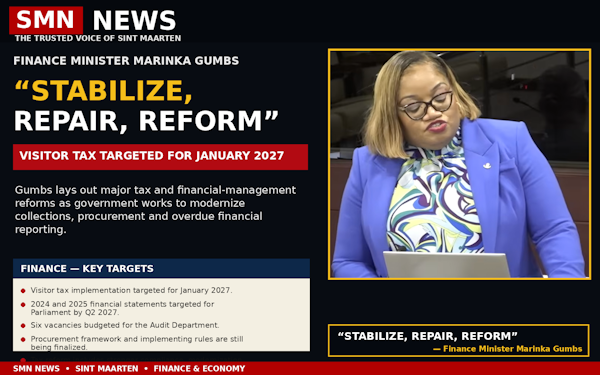 PHILIPSBURG: --- Minister of Finance Marinka Gumbs has laid out an ambitious but lengthy reform agenda for Sint Maarten’s public finances, telling Parliament that modernizing the country’s outdated tax administration, strengthening collections, completing overdue financial statements and introducing new revenue measures cannot be accomplished responsibly without first repairing the machinery responsible for collecting and accounting for taxpayers’ money.
During extensive answers in the second round of the 2026 budget debate, Gumbs repeatedly returned to a three-part philosophy for tax reform: “stabilize, repair, reform.”
The finance minister said the objective is not merely to introduce new taxes. The government must first strengthen compliance and collection so everyone pays their fair share, modernize outdated legislation and systems, improve enforcement, and establish reliable data before undertaking deeper reforms involving profit tax, wage tax, and tax relief for the elderly.
At the same time, Gumbs disclosed several important developments that Parliament will have to monitor closely: the visitor tax is now targeted for implementation in January 2027, the 2024 and 2025 financial statements are not expected in Parliament until the second quarter of 2027, six vacancies have been budgeted for the Audit Department, procurement legislation remains unfinished, and the Ministry is still finalizing recruitment of a new head of the Tax Administration.
For a Finance Ministry charged with restoring confidence in the country's financial management, the answers reveal both an extensive reform programme and the scale of the institutional backlog it inherited and continues to confront.
Gumbs: A budget must reflect reality, not look good on paper
Gumbs began with a fundamental warning about government budgeting.
She said the focus must remain on improving financial management, strengthening budget discipline and ensuring public funds are spent efficiently.
But she rejected the idea of simply cutting allocations to make expenditure figures appear lower.
A budget, she reminded Parliament, estimates expected expenditure. Reducing allocations when government already knows actual costs will be higher only produces an unrealistic financial document that fails to accurately represent government's needs.
That position is particularly important in a country where Parliament has repeatedly questioned budget accuracy, and government has struggled for years with delayed financial statements.
For Gumbs, fiscal discipline cannot mean artificially suppressing numbers. The budget must first tell the truth about what government expects to spend.
Visitor Tax Targeted for January 2027
One of Gumbs' most significant announcements concerned the long-discussed visitor tax.
Government, she said, is not afraid or hesitant to implement it.
However, Gumbs pushed back against suggestions that the draft inherited from the former administration was essentially ready to go.
According to the minister, after receiving advice in 2025 and Legal Affairs reviewing the proposal, significant legal, technical and operational issues still had to be addressed.
These included insufficient consultation with Immigration and the aviation sector, unresolved questions about revenue allocation, and incomplete collection and enforcement arrangements.
Gumbs said a legislative lawyer was subsequently engaged through TWO funding to substantially revise the proposal.
The legislation is now being finalized for submission to the Council of Advice.
Most importantly, Gumbs told Parliament:
Implementation remains targeted for January 2027, provided the remaining legislative and operational requirements are completed on time.
That gives Parliament and the public a measurable target.
Disagreement Over how bad the Original draft really was
The minister's characterization of the inherited legislation did not go unchallenged.
During an interruption, an MP said the SER advice in hand contained 11 recommendations but did not characterize the draft as inadequate, noting that its conclusion was positive subject to recommendations.
Gumbs clarified that her comments about insufficient consultation and concerns over the draft's quality also came from Legal Affairs, not solely from the advisory body.
But she agreed with the larger point:
“I do agree that it is time that we move along with the tourist levy.”
That exchange is important because it shifts the debate from whether Sint Maarten should impose the levy to why it has taken so long to get a workable law into Parliament.
Tax Reform: “Stabilize, Repair, Reform”
Gumbs provided considerably more detail about her broader tax-reform philosophy.
The ultimate objective, she said, is to stabilize, repair, and reform Sint Maarten's tax system by modernizing the Tax Administration, updating outdated legislation, and aligning the system with international standards.
Her sequence is deliberate.
First, stabilize and strengthen compliance and collections so everyone pays their fair share.
Second, repair: modernize the administration, address outdated legislation and systems, improve enforcement and broaden the tax base where appropriate.
Only then, reform: once government has dependable systems, compliance and data, it can responsibly tackle substantive changes involving profit tax, wage tax and tax relief for elderly residents.
The minister said the reform remains aligned with the framework approved under the former government, although her administration is using this phased “stabilize, repair, reform” approach.
Shift From Direct to Indirect Taxes
The finance minister confirmed that the broader reform includes consideration of a gradual shift from direct taxation toward indirect taxation.
An external law firm and the Department of Fiscal Affairs conducted a comprehensive assessment, financed through TWO.
According to Gumbs, the original reform was divided into two phases.
The first repealed taxes such as inheritance and land taxes that were ineffective or never brought into force.
The second concentrated on strengthening, modernizing, and simplifying the tax system, including the gradual movement from direct to indirect taxation.
But Gumbs emphasized that Parliament will still have the final legislative say.
The government approved the underlying reform approach and did not submit it separately to Parliament for validation. However, every legislative amendment resulting from that reform must come before Parliament before becoming law.
Is TWO Running St Maarten's Tax Reform? Gumbs says no
Questions were also raised about the influence of the Temporary Work Organization, or TWO, over Sint Maarten's tax reforms.
Gumbs rejected the suggestion that an external entity is controlling tax policy.
TWO, she explained, provides financing and technical support under the country package, including specialized personnel, change-management capacity, technical assistance, and modernization support.
Its work includes restructuring the Tax Administration, reviewing staffing and procedures, supporting procurement and implementation of an integrated tax IT system, cleaning up data, automating processes, reducing administrative backlogs and providing training and legislative expertise.
But Gumbs stressed that TWO does not determine Sint Maarten's tax policy and does not exercise the Finance Minister's legal authority.
“All proposed measures are reviewed by the Ministry of Finance and require the minister's approval before proceeding,” she told Parliament.
A working group consisting of Fiscal Affairs, the Minister's Cabinet, the Secretary General of Finance, and legislative tax lawyers financed through TWO is handling day-to-day implementation.
That working group operates under Gumbs' responsibility.
Major Tax Changes Could Take Up to Four Years
The minister also put Parliament on notice that comprehensive reform will not happen overnight.
Gumbs acknowledged that relatively straightforward tax reforms can reasonably require approximately 24 months, while more complicated reforms can take 36 to 48 months, depending on research, consultation, legislation and implementation.
She said Sint Maarten's limited institutional capacity is one reason TWO's using its technical expertise.
The Ministry does not have what Gumbs called a single “roadmap.” Instead, it is working through a phased implementation plan.
She proposed a separate meeting with Parliament to discuss that approach in greater depth.
2024 and 2025 Financial Statements Not Until 2027
One of the most striking financial-management disclosures concerned government's financial statements.
Gumbs said a final draft of the 2024 financial statements was submitted for final review several weeks earlier.
Work is simultaneously underway on the 2025 statements.
Her target?
Both the 2024 and 2025 financial statements are expected to reach Parliament by the second quarter of 2027.
That means Parliament debates and approves current and future budgets while audited or finalized historical financial information continues to lag considerably.
The minister said government already has the information requested from the individual ministries, but the 2027 budget's actual figures will rely on the 2025 implementation reports.
For Parliament's oversight function, this remains a serious structural weakness: you cannot effectively compare what government promised to spend with what it actually spent when the final accounting arrives years later.
Procurement legislation still not finished
Public procurement was another major issue.
Gumbs confirmed that the Ministry has issued terms of reference for legal assistance to finalize the long-awaited implementing national decree — the LBHAM — governing public procurement.
Several versions already exist, including drafts developed through the Tackling Law initiative and the Public Finance Management Reform Program.
The current objective is to consolidate those versions into one comprehensive procurement framework.
The project is also supposed to establish standardized procedures, templates, manuals and practical guidelines so procurement rules can be applied consistently throughout government.
When asked why approximately two years had passed without finalization, Gumbs pointed to the complexity of creating new legislation, including legal review, stakeholder consultation, policy alignment and required approval procedures.
The unanswered political issue, however, remains significant.
Sint Maarten has spent years facing criticism surrounding government tendering and procurement while the comprehensive rules intended to strengthen that system remain unfinished.
Six Vacancies Budgeted for Audit Department
Gumbs also corrected a suggestion that $1 million had been budgeted for investment in the Audit and Criminal Investigation Unit.
According to the minister, the budget contains $400,000 for technical and operational support to the Audit Department.
She also confirmed that the budget includes six vacancies specifically for the department.
CARTAC and the IMF conducted a gap analysis in March and identified recommendations to strengthen government systems and processes.
Gumbs said technical assistance will continue, although there are currently no recommendations or initiatives directed exclusively at the Audit Department.
Still No New Head of Tax Administration
Another significant institutional vacancy remains unresolved.
Gumbs confirmed that recruitment for a new head of the Tax Administration is still being finalized.
Since the departure of the previous head, the Secretary General of Finance has overseen the Tax Administration since July 2025 and signs official advices.
Given the enormous tax-reform programme now underway, filling the leadership position will be crucial.
Government is asking the Tax Administration to modernize technology, clean data, improve collections, strengthen compliance, reduce backlogs and eventually administer a substantially reformed tax system.
Yet its permanent leadership recruitment remains unfinished.
Long-Lease Collection was not stopped, Gumbs insists
Gumbs also pushed back against claims that Finance ended efforts to collect outstanding long-lease payments.
“The Ministry of Finance has not stopped any collection activities related to long-lease arrears,” she told Parliament.
Finance participates in quarterly meetings where outstanding amounts, collection efforts and problems are reviewed.
But Gumbs made an important accounting distinction.
Collecting old long-lease debt is not new revenue if that revenue was already recognized when government originally billed it.
The cash collection improves government's liquidity, but it does not create additional current-year revenue.
The Ministry nevertheless supports stronger collection because receiving the money improves government's ability to meet its obligations.
UPNAF Funds: Government says money was received in 2024
The minister also clarified confusion surrounding UPNAF.
Gumbs confirmed that government received the referenced funds in 2024, explaining that they therefore cannot be booked again as revenue in the 2026 budget.
She similarly cautioned Parliament against confusing receivables with new revenue. When income has already been recognized in an earlier year, collecting it later converts a receivable into cash but does not generate new revenue.
Gumbs also corrected the impression that she had promised to transfer the remaining UPNAF funds in August.
She said UPNAF's draft financial statements were complete, and a board meeting for their review and approval was expected by the end of August 2026.
Only after approval can remaining settlement activities proceed, including transfer of remaining funds.
French-Side Tax Leakage needs deeper examination
The finance minister also acknowledged concerns surrounding the consequences of having two different fiscal systems operating on one small island.
Gumbs said taxation and possible leakage involving the French side have been raised previously, but not yet comprehensively.
She acknowledged that cross-border economic activity, tax administration and possible revenue leakage require a deeper policy discussion.
As Sint Maarten's tax reform advances, she said it would be appropriate to examine opportunities for greater cooperation and information sharing with French authorities.
That could become one of the reform's most consequential parts.
People, businesses, vehicles, employees and economic activity move daily across an open border while the two sides operate under separate fiscal systems. Determining whether that results in revenue leakage — and what can legally be done about it — deserves considerably more attention than it has received.
Personalized license plates could become a new revenue source
Gumbs confirmed that personalized number plates are under review.
The Ministry is examining policy, administrative, legal and financial considerations before deciding whether to proceed.
However, MPs immediately challenged the lack of a deadline, with questions about whether legislation has actually begun and warnings that Parliamentarians may introduce their own legislation if government does not move.
The exchange reflects a recurring frustration throughout the budget debate: government frequently acknowledges potentially useful initiatives, but MPs want dates, documents and implementation, not simply confirmation that something is “under review.”
Gumbs Supports Orange Economy and Tax Deduction for Charity
The finance minister gave unequivocal support to two parliamentary motions.
She said she “wholeheartedly” supports MP Darryl York's motion aimed at stimulating Sint Maarten's orange or creative economy — economic activity rooted in culture, creativity, intellectual property and talent.
Gumbs also supported Chairlady Sarah Wescot-Williams' motion to make charitable gifts fully deductible under the income-tax and profit-tax ordinances without a minimum threshold.
The minister said she wants to encourage greater charitable giving benefiting the people of Sint Maarten.
Finance Ministry has set the Direction — Parliament will measure the delivery
Marinka Gumbs' answers paint a picture of a Finance Ministry trying to rebuild several critical systems at once.
Tax administration must be modernized.
Compliance and collection must improve.
The visitor levy must finally move through the legislative process.
Procurement rules must be completed.
The Audit Department needs additional capacity.
Financial statements must be brought up to date.
The permanent leadership of the Tax Administration still has to be finalized.
Major tax reform could take between two and four years.
Gumbs' “stabilize, repair, reform” approach recognizes an important reality: piling new taxes onto a weak administrative structure will not, by itself, repair Sint Maarten's public finances.
But Parliament will now have to measure the Finance Minister's programme against the deadlines she has placed on the record.
The visitor tax is targeted for January 2027. Parliament is due to receive the 2024 and 2025 financial statements by Q2 2027. Procurement reform is being finalized. Tax-administration modernization is underway.
Those targets transform promises into benchmarks.
And after years of delayed financial statements, unfinished legislation, outdated systems and repeated discussions about revenue generation, the central question for Finance is no longer whether reform is necessary. It is whether government can finally move from plans, reviews and technical assistance to laws, collections, current accounts and measurable results.
Top of Form
Bottom of Form