Doran says Parliament cannot oversee what it cannot see; questions Justice Minister over women held abroad and UNOPS neutrality, blasts VROMI performance and tables motions on firearm legislation and price controls
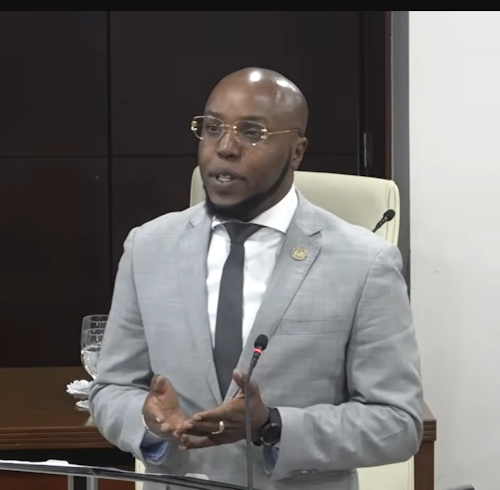 PHILIPSBURG:--- Member of Parliament Egbert Jurendy Doran used his second-round contribution to the 2026 budget debate to launch a broad but pointed examination of government, demanding greater transparency from the Council of Ministers while directing some of his toughest questions at the Ministries of Justice and VROMI.
Doran opened by challenging what he described as the government's repeated use of “confidentiality” when Parliament requests documents. He asked Prime Minister Dr. Luc Mercelina to provide Parliament with a clear explanation of what information can legitimately be withheld from MPs.
His argument was straightforward: Parliament cannot properly exercise its oversight responsibility when members are prevented from seeing the information they are supposed to scrutinize.
“It is impossible for me to oversee something that I cannot see,” Doran told Parliament, asking the Prime Minister to clarify exactly what government considers confidential to Parliament.
Doran Wants Government Property and Rental Contracts Exposed
Doran also requested a comprehensive overview of government-owned real estate and buildings, along with a separate account of properties government is renting and the corresponding rental contracts.
The request followed information he said he received concerning a derelict building sitting on what he described as prime government-owned property.
Doran said the rental expenditure he sees does not appear to correspond with information contained in the budget and argued that Parliament needs clarity on what government owns, what it rents and what taxpayers are paying.
He additionally returned to outstanding parliamentary motions concerning GEBE, asking for a point-by-point account of what government has actually implemented rather than allowing motions passed years ago to remain without clear follow-up.
Mental-Health Workers Leaving Under Difficult Conditions
The MP brought a serious warning from the mental-health sector to Parliament.
Doran relayed concerns from a mental-health professional who said nurses assisting with crisis calls are leaving the field, while those remaining work under extremely difficult conditions, including inadequate salaries and poorly maintained vehicles used to respond to emergencies.
Doran asked VSA what can be done, including through subsidy arrangements, to improve wages and retain critical personnel.
His concern was that Sint Maarten could be preparing a new mental-health facility while simultaneously losing the trained professionals required to respond to an increasing number of mental-health cases.
“If we have a crisis where those nurses are leaving the field, then we have a bigger problem on our hands,” Doran warned.
Tourism Growing — So Why Not Make Visitors Contribute?
Doran then questioned the government's hesitation over visitor taxation.
He referred to reported increases in air arrivals and cruise passengers and argued that Sint Maarten should examine revenue measures that bring money into the country rather than continuously increasing the burden on residents.
He pointed to destinations including Canada, Curaçao, Aruba and the Dominican Republic where visitors are required to pay various fees.
“Why are we scared to implement a fee?” Doran asked.
He argued that government repeatedly finds ways to extract additional money from residents who are already struggling while potentially available external revenue sources remain unfinished or unimplemented.
JUSTICE: Doran Questions Prison Overcrowding and Women Held Abroad
Doran's Justice questions moved directly into one of the country's most persistent problems: prison overcrowding.
He said there is no dispute that Sint Maarten lacks sufficient prison capacity and noted that female inmates have been transferred to other islands as a result.
Doran demanded specific numbers.
How many women are currently incarcerated outside Sint Maarten? Where are they being held? How much is government paying to accommodate them abroad? And what is the long-term plan for housing female inmates in Sint Maarten?
Those questions place the financial consequences of the prison-space shortage alongside the human and operational consequences.
The issue is no longer merely how many cells are available at Pointe Blanche. The country is spending resources to house inmates elsewhere while still requiring a permanent solution at home.
Why Was an Outside Body Needed to Recalculate a Sentence?
Doran also questioned Justice Minister Nathalie Tackling over the involvement of an outside entity in sentence calculations.
He asked whether this was the first time an external body had been brought in to recalculate work traditionally performed by officials who have handled such calculations for decades.
More importantly, he wanted to know whether this represents a new policy.
“Will that be the way moving forward?” Doran asked, questioning what happens to institutional knowledge when an external organization eventually leaves Sint Maarten.
Doran Raises UNOPS Conflict-of-Interest Question
The MP then addressed what he carefully described as a perceived or potential conflict of interest involving the Justice Minister and UNOPS.
Doran did not declare that a conflict existed. Instead, he asked Tackling to address the perception directly on the floor of Parliament.
According to Doran, concerns had circulated publicly because the minister previously worked for UNOPS and the organization now performs work for government under her ministerial responsibility.
“How can that be neutral?” he asked.
Doran asked whether another official should have handled the matter to avoid any perception of conflict.
He explicitly acknowledged that his understanding could be wrong and therefore requested clarification from Tackling.
That distinction is important: Doran raised questions about perceived neutrality and potential conflict; he did not establish wrongdoing.
Tourist Police Without Firearms?
Doran also questioned Tackling's plan for tourist police.
He said he understood the minister to have indicated that tourist police themselves would not be armed, while armed police officers would accompany them.
Doran questioned the logic of using already-existing police personnel to protect unarmed tourist police and pointed to Panama and Aruba as jurisdictions where, according to him, tourist police are armed.
He is concerned that a distinctive tourist-police uniform could lead criminals to assume the officers are armed even when they are not, potentially putting them at greater risk.
“What is the sense behind having police and not being armed?” he asked.
VROMI: “How Is Work Happening Without Tenders?”
Doran reserved some of his strongest language for VROMI Minister Patrice Gumbs Jr.
He returned to questions he said he had repeatedly asked concerning road tenders.
According to Doran, there were no road tenders carried out in 2024, 2025 or thus far in 2026. He argued that explanations involving capital expenditure do not answer the fundamental procurement question because projects financed through capital expenditure still require the appropriate procurement procedures.
Doran then made the issue broader:
If tenders are not being issued, how are roadworks, drainage works and roadside cleaning being carried out?
“I noticed a trend,” Doran said, claiming several activities were occurring within VROMI while “absolutely no tender is taking place.”
“How is the work carried out within the Ministry of VROMI without any tenders?” he asked.
These are allegations and questions raised by Doran in Parliament; the transcript provided does not contain Minister Gumbs' subsequent answers.
Wastewater Treatment, Over the Bank and Elderly Pathway
Doran also requested an update on the wastewater treatment plant, saying that earlier cost-cutting measures had produced savings of more than one million guilders and asking for the current contractual status.
He asked whether the government intends to regularize the situation of residents who have lived “over the bank” for decades, pointing to previous town-hall meetings and an existing database.
The MP additionally demanded an update on the elderly pathway project and whether Gumbs intends to continue it.
Doran Wants Ten Years of Long-Lease Revenue
Another significant demand concerns government land revenue.
Doran requested an annual breakdown from 2016 through 2026 showing what should have been collected from long-lease land and what government actually collected.
He linked the request to the dismantling of a task force that Gumbs reportedly described as non-functional.
Doran said the figures would allow Parliament to judge that claim based on actual results.
He requested the information in a clear document showing expected and collected revenue for each year.
Building Permits: Doran Wants to See the Economic Value
Building permits became another major target.
Doran requested annual estimated construction values for permits granted between 2021 and 2026, as well as corresponding information on building-permit applications received.
He said construction values can indicate how much private investment is flowing into Sint Maarten.
He stressed that building permits are not simply administrative paperwork: construction projects generate government revenue and frequently unlock mortgages, loans, employment and wider economic activity.
Later, Doran delivered his sharpest assessment of the ministry:
“VROMI's position and performance are weak, and it's weak across the board.”
He specifically singled out permits, arguing that insufficient performance in that area affects both the government's coffers and the wider economy.
Water Rights: Give Parliament the Actual Deeds
Doran was also dissatisfied with information provided concerning water rights.
He said he had requested an overview of water rights but received what he characterized as a summary sheet prepared by the minister.
He instead wants the actual deeds.
Doran also asked whether Gumbs had ever approved water rights despite receiving negative advice from VROMI and requested road-repair budget figures covering 2022 through 2026.
He separately asked whether any discussions about an Alegría settlement took place during Gumbs's visit to Curaçao. The transcript contains Doran's question but does not establish that such discussions occurred.
Two Motions: Firearms and Cost of Living
Doran closed by introducing two motions.
The first calls for review of Sint Maarten's firearm legislation, which he said still contains references inherited from the former Netherlands Antilles constitutional structure.
He also argued for consideration of provisions allowing people who served in certain Justice-related functions to retain, subject to regulation, the ability to possess a firearm for a limited period after leaving office because of risks arising from their former duties.
His second motion directly addresses the high cost of food and basic necessities.
Doran wants government to return to Parliament within 60 days with a completely revised price-control basket based on categories of essential products rather than specific brands. The proposal also seeks maximum retail prices and wholesaler margins for products covered by the revised basket.
He further called for publication of the hurricane price-control list within 10 days.
“We Can Do Better Without Burdening the People”
Across his intervention, Doran's central argument was that government cannot continue asking residents to absorb increasing costs while revenue opportunities, infrastructure projects, parliamentary motions and longstanding administrative problems remain unresolved.
He called for greater disclosure, stronger procurement transparency, clearer Justice policies and measurable performance from VROMI.
“The facts are the facts,” Doran said, adding that he had offered assistance where necessary and believed Sint Maarten could perform better “without burdening” its people.
With the second round of parliamentary questioning concluded, those questions now move to the Council of Ministers.
For Doran, however, the test will not simply be whether ministers provide lengthy responses.
It will be whether Parliament finally receives the documents, figures and direct answers necessary to verify those responses.