Parliament Chair says government workgroup was required to report quarterly, but Parliament cannot obtain the reports; MPs unanimously agree to summon ministers for updates on motions
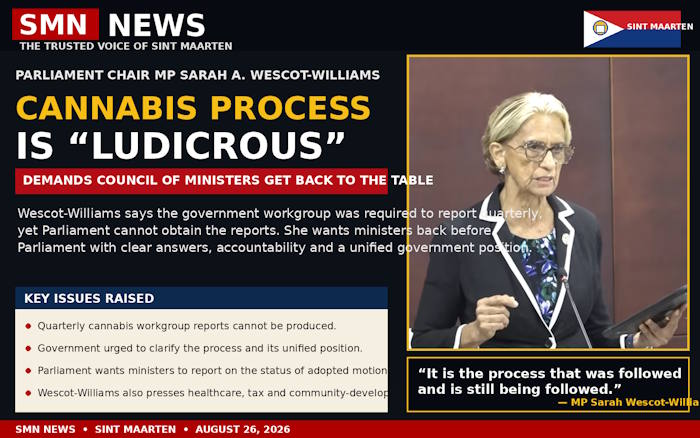 PHILIPSBURG:--- Chairlady of Parliament MP Sarah A. Wescot-Williams has described the government’s handling of the cannabis-policy process as “ludicrous” and demanded that the Council of Ministers return to the table to establish a unified position.
During the continuation of the 2026 budget debate, Wescot-Williams said government ministers had offered differing explanations concerning cannabis legislation, while questions remained about the work of the inter-ministerial cannabis workgroup established in 2024.
“This government, after all that we heard from all the different ministers regarding the issue of cannabis legislation, needs to get back around the table on this matter as a government,” Wescot-Williams said.
She called for an update within one week on whether that meeting had taken place and how the Council of Ministers intended to address the controversy.
“It is ludicrous that a working group of the government has been established in 2024 with a specific task, and that government workgroup is publicly now responding to the Prime Minister,” Wescot-Williams told Parliament.
Quarterly reports cannot be produced
Wescot-Williams emphasized that the formally established workgroup was required to report quarterly to the ministers involved.
Yet those reports have not been provided to Parliament, while Prime Minister Dr. Luc Mercelina has said he has not received official quarterly reports, meeting minutes, meeting dates or other records from the workgroup.
“This workgroup, established and published, has to report quarterly to the ministers,” Wescot-Williams said. “And we’re asking for reports, but we can’t get them. It is ludicrous.”
Her intervention strikes at the central weakness in the cannabis-policy process.
The workgroup was created to research and coordinate a policy involving public health, youth protection, mental health, law enforcement, product safety, taxation, economic development and cooperation with French St. Martin.
However, more than two years after the workgroup's establishment in 2024—and four years after the August 2022 Council of Ministers decision behind it—the Prime Minister says he is still seeking basic information about what it has done.
At the same time, Native Nations presented to the Council of Ministers, and a draft ordinance regulating the cultivation, importation, production, processing, distribution, sale and consumption of cannabis underwent a legislative and technical review.
How could legislation reach that stage while the government’s own workgroup apparently failed to provide its official reports to the Council of Ministers?
Wescot-Williams disputes workgroup’s Aruba reference
Wescot-Williams also challenged information attributed to the workgroup concerning Aruba.
According to her, the 2024 publication establishing the workgroup referred to examining Aruba’s experience and suggested that only medicinal cannabis had been legislated there.
“Absolutely not the case,” Wescot-Williams said.
She called on the government to examine the Aruba situation itself, including the relevant report from Aruba’s Council of Advice.
Her criticism was directed primarily at the process—not simply at whether cannabis should ultimately be legalized.
“It has nothing to do with the intention of government,” Wescot-Williams said. “It is the process that was followed and is still being followed.”
That distinction is crucial.
Parliament cannot responsibly judge cannabis legislation without knowing who directed the process, what research was completed, what Native Nations delivered, what the inter-ministerial workgroup recommended, and why its quarterly reports cannot be produced.
Wescot-Williams said she expects to hear within one week how the Council of Ministers is addressing the matter.
Parliament unanimously demands follow-up on motions
Wescot-Williams also secured unanimous approval for a proposal requiring Parliament to meet with ministers within one month to establish the status of motions handled during the budget meeting.
She acknowledged that some ministers have responded to parliamentary motions over time, but said many motions received no government reaction.
She argued that Parliament and its leadership have a responsibility to convene a Central Committee meeting with ministers to obtain updates on their execution.
MPs supported the proposal unanimously.
The decision could mark an important shift if Parliament follows through.
For years, MPs have presented and adopted motions directing or requesting government action. However, many disappear from public view after the vote, with no structured reporting on whether they were accepted, rejected, implemented or ignored.
Wescot-Williams’ proposal creates a one-month deadline for Parliament to begin demanding answers.
The public should now expect that meeting to be scheduled and the status of each motion to be reported openly.
Three motions target communities, taxes and littering
Wescot-Williams also presented three motions on district development, tax incentives for community contributions, and citizen participation in combating littering and illegal dumping.
Cg. 500,000 for district development
Her first motion seeks to reserve Cg. 500,000 in the 2027 budget for a community-driven District Development Fund.
Under the proposal, communities would help identify and manage feasible projects such as beautification, improved lighting, small public amenities and the rehabilitation of playgrounds.
Parliament previously approved the district-development concept unanimously. The intention was to work with the St. Maarten Development Fund to create an implementation structure and begin one or two pilot projects in 2026.
Wescot-Williams said that a start is no longer possible in 2026. She therefore wants Cg. 500,000 reserved in 2027 so the programme can begin with one or two communities once the necessary structure is established.
Tax incentives for national causes
Her second motion calls on government to review the provisions governing charitable deductions in the Income Tax Ordinance and Profit Tax Ordinance.
Wescot-Williams wants government to examine international best practices and consider tax incentives for businesses and individuals contributing to causes recognized as being in the national interest.
Possible qualifying recipients could include:
- Educational institutions and classroom-support programmes;
- Youth-development organizations;
- Sports associations;
- Cultural and heritage organizations;
- Environmental and conservation initiatives; and
- Health and social-care organizations.
Wescot-Williams said Sint Maarten’s tax system is not “charity friendly” and that people contributing to education and other national causes must currently overcome complicated procedures and thresholds.
She argued that whether someone contributes $100 or $10,000 to improve a classroom or another national cause, that contribution should be considered when the individual or business pays taxes.
Citizens helping to catch illegal dumpers
Her third motion calls on VROMI Minister Patrice Gumbs Jr. to endorse, in principle, a citizen litter-reporting and neighborhood-reinvestment pilot program.
The proposal would explore allowing residents to report littering and illegal dumping violations, with fines reinvested in the community where the offender was caught.
Wescot-Williams acknowledged that the proposal is unconventional and may require legal examination. However, she urged government to work with citizens rather than dismissing the concept without exploring what is possible.
She referred to littering at Mullet Bay Beach after a cleanup, including an empty Hennessy bottle deliberately placed in a tree despite available garbage bins.
“This is just showing that I could do it,” Wescot-Williams said. “And that is worthlessness.”
She urged VROMI to combine her proposal with other parliamentary initiatives—including those presented by MP Sjamira Roseburg—and develop a broader response to the country’s persistent cleanliness problem.
Questions on healthcare and vulnerable residents
Wescot-Williams also pressed VSA for clarity about the social registry and the proposed phased introduction of general health insurance.
She asked whether the registry is strictly an internal government instrument or whether it will eventually serve the broader public.
Regarding general health insurance, she demanded an explanation of what “phased” implementation means.
Would coverage be introduced by population group, type of benefit or timeline?
Wescot-Williams said her concern is determining when people presently excluded from medical coverage will be protected, including vendors, taxi drivers, bus drivers and sole proprietors.
She also requested an update on the old-age pension supplement measure contained in the country package. She noted that some elderly residents receive only Cg. 200 or Cg. 300 because they did not accumulate the full number of qualifying years needed for the maximum pension.
Parliament and government must work together
Wescot-Williams raised additional questions concerning budget execution, pending 2026 budget amendments, GEBE’s generator financing, government-owned companies’ annual accounts, tax leakage between Dutch and French St. Martin, corporate governance, artificial intelligence, the ring-road project, the country’s carrying capacity and cross-border difficulties affecting Dutch citizens residing on the French side.
Her central message was that government should stop treating Parliament as a body informed only after decisions are made.
“Government, ministers, you need to work more with Parliament to get things going in this country—not at an end to inform us, but to work with us to get things done,” Wescot-Williams said.
That message applies directly to the cannabis controversy.
The Council of Ministers cannot present conflicting positions, fail to produce the workgroup’s reports and still expect Parliament to trust that the process is under control.
Wescot-Williams has given government one week to demonstrate that the ministers have returned to the table.
Parliament has also unanimously committed itself to calling ministers within one month for updates on adopted motions.
The deadlines are now on the public record.
The next test is whether Parliament and government will honor them.