~MP Viren Kotai asks why electronic monitoring is not being used more extensively, how many convicted persons are waiting to serve sentences, and whether there is a “personal issue” surrounding Theo Heyliger’s continued incarceration.~
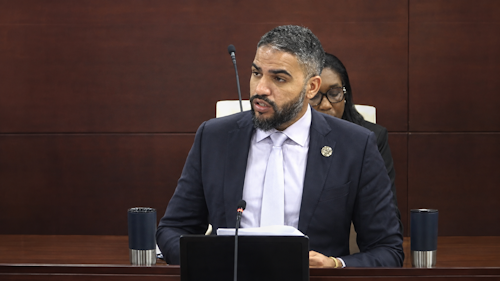 PHILIPSBURG:--- Member of Parliament Viren Kotai placed the incarceration of former politician Theo Heyliger at the center of the debate over Sint Maarten’s severe prison-capacity shortage, asking Minister of Justice Nathalie Tackling why scarce prison space is being used for people convicted of non-violent offenses while the country struggles to house violent offenders.
Kotai’s intervention during the 2026 budget debate went considerably further than a general discussion about overcrowding at the Pointe Blanche Prison.
The MP questioned whether electronic monitoring is being used sufficiently, demanded figures on convicted persons waiting to serve their sentences, and explicitly asked Tackling to address what he described as an “unfortunate notion” about who controls detention and release decisions.
He then specifically raised Theo Heyliger’s incarceration, asking whether there was some “personal issue” involving the Prosecutor’s Office, Department of Justice, or another authority that could explain why Heyliger remained incarcerated rather than being considered for another legally available form of sentence execution.
Kotai did not establish that there is improper interference in Heyliger’s case. He put the issue to the Justice Minister as a question and asked her to clarify the situation publicly.
That distinction is critical. But the question itself was unmistakable.
“Does the Prison Have Space, or Is the Prison Full?”
Kotai entered the prison debate after Tackling provided answers to MP Darryl York about releases from detention.
He referred to the Minister’s explanation concerning Articles 132 and 137 and said his understanding was that regular release under Article 132 occurs after 66.6% of a sentence, while Article 137 provides the Minister with authority, under circumstances involving an acute shortage of detention capacity, to establish an earlier percentage.
That immediately raised a problem for Kotai.
If Sint Maarten is experiencing an acute shortage of prison space, why are the available mechanisms for relieving that pressure apparently not being used more aggressively?
Kotai said his understanding is that Pointe Blanche Prison is “full to the brim.” He also referred to men reportedly being housed in the women’s ward as an indication of the pressure on the facility.
He therefore asked Tackling directly:
Does the prison have space, or is the prison full?
And if it is full, Kotai wanted another number that has repeatedly become central to Sint Maarten’s prison debate:
How many convicted persons are waiting to serve their sentences because there is no prison space available?
Kotai: Why Aren’t Ankle Bracelets Being Used?
Kotai then zeroed in on electronic monitoring.
He asked why the ankle-bracelet system available to the Ministry of Justice isn't being used to create additional capacity inside Pointe Blanche.
His questions went directly to who controls the process.
“Is the prosecutor the sole controller of what happens at the prison?”
Kotai complained that when information is requested concerning how many people are waiting for cells and how many violent offenders may be awaiting execution of their sentences, the necessary statistics are repeatedly unavailable.
That creates a serious transparency problem.
Parliament cannot properly assess whether Sint Maarten is making the best use of its extremely limited prison capacity without knowing how many beds are operational, who occupies them, how many convicted persons are awaiting incarceration, and what categories of offenses are involved.
Theo Heyliger Specifically Raised
In that discussion, Kotai raised the incarceration of Theo Heyliger.
Kotai’s argument was essentially one of prioritization: if Pointe Blanche is full and dangerous offenders are potentially competing for limited prison space, should persons convicted of non-violent or white-collar offenses occupy those same scarce cells when electronic monitoring or other legally permissible mechanisms might be available?
Kotai named Heyliger, along with O’Neal Arrindell and Frans Richardson, as offenders he believed could be monitored electronically rather than occupying prison capacity.
That was Kotai’s position in Parliament. It was not a determination that any of those individuals legally qualify for electronic monitoring, something that would depend on the applicable law and the circumstances of each sentence.
But Kotai did not leave the Heyliger issue there.
Later in his intervention, he returned specifically to Heyliger and asked Tackling to address perceptions circulating in the community about who is controlling the situation.
Kotai questioned whether there was any “personal issue” involving the Prosecutor’s Office, Department of Justice or another authority in relation to Heyliger.
His underlying question was pointed: Why is Heyliger occupying prison space when that same cell could potentially be needed for someone convicted of a violent offense?
The transcript provided to SMN News does not establish that Heyliger is being treated differently, that a “personal issue” exists, or that any prosecutor or Justice official improperly influenced his incarceration.
Those were questions Kotai placed before the Minister, and they require answers rather than assumptions.
Who Actually Decides?
Kotai’s intervention exposes a broader institutional question that goes well beyond Heyliger.
Who ultimately decides who remains incarcerated, who qualifies for electronic monitoring, and how Sint Maarten’s scarce detention capacity is allocated?
If the Prosecutor’s Office controls certain aspects of sentence execution, what authority does the Minister possess?
If the Minister has authority under Article 137 during an acute capacity shortage, under what circumstances is that authority exercised?
If electronic monitoring exists, how many people are currently using it?
How many additional prisoners could legally qualify?
And if Pointe Blanche is full, what criteria determine which convicted persons receive the available cells?
These are precisely the questions that become unavoidable when a country does not have enough prison capacity to execute every custodial sentence immediately.
Kotai Links Prison Shortage to Public Safety
Kotai also connected the prison shortage to what victims and business owners experience outside the detention system.
He told Parliament that he has spoken with business owners and questioned how victims are expected to feel when perpetrators are caught but subsequently remain or return to the streets.
“How do you think certain persons feel when they are being hunted, the perpetrators are caught, and those hunted still hear or see the same perpetrators free?” Kotai asked.
That is where his argument about Heyliger and other non-violent offenders becomes part of a much larger policy debate.
Kotai is essentially asking government whether, during a prison-capacity emergency, risk to public safety should play a greater role in determining how scarce detention space is utilized.
Parliament Needs the Numbers
The most troubling part of the debate may ultimately be the absence of numbers.
If Pointe Blanche is full, government should be able to tell Parliament exactly how full.
If convicted persons are waiting to serve sentences, Parliament should know how many.
If some of those persons were convicted of violent offenses, government should be able to say how many without necessarily compromising individual cases.
And if electronic monitoring is an available alternative for legally eligible offenders, Parliament should be told how many bracelets are available, how many are currently being used and what prevents the system from being expanded.
Kotai’s questions concerning Theo Heyliger sharpen that debate because they force government to confront the practical consequences of limited prison capacity.
The issue is no longer simply whether Pointe Blanche needs more cells.
It is who gets the cells Sint Maarten already has, who makes that decision, whether electronic monitoring is being fully utilized, and whether the country is prioritizing the incarceration of those who present the greatest danger to the community.
By explicitly asking whether there is any “personal issue” surrounding Heyliger and calling on her to address public perceptions over who controls detention decisions, Kotai has now placed another sensitive question squarely before the Justice Minister.
The answer will have to distinguish clearly between political responsibility, prosecutorial authority, sentence-execution rules and the rights of individual prisoners.
But after Kotai’s intervention, one thing is clear: Parliament is asking government to explain not only why Pointe Blanche is full, but why particular people are occupying its increasingly scarce cells while others may still be waiting outside.