~Lewis and York confront Minister over internal complaints, alleged intimidation and staff dissatisfaction; York says claims of improved morale clash with reports from inside the ministry~
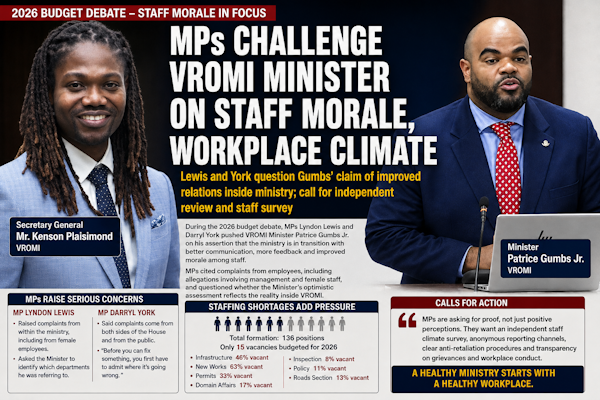 PHILIPSBURG: --- Minister of Public Housing, Spatial Planning, Environment and Infrastructure (VROMI) Patrice Gumbs Jr. came under pointed pressure in Parliament over the internal climate at his ministry after Members of Parliament challenged his assertion that relations between management and staff have improved.
Gumbs had told Parliament that despite VROMI’s longstanding struggles with trust and victimization, he now sees a ministry in transition, with increased dialogue between the Minister, management and staff, more openness to feedback and a better internal working relationship.
He said that while human conflict is unavoidable, he sees “feedback, open dialogue and learning” taking place and considers rebuilding trust an important part of restoring the ministry.
But that description was sharply contested during the clarification round.
MP Lyndon Lewis and MP Darryl York both questioned whether the Minister’s portrayal of improved morale matched complaints and concerns they said have come from within VROMI itself.
Lewis challenges Minister over complaints involving female employees
MP Lyndon Lewis directly challenged Gumbs to explain what progress he believes has been made inside VROMI’s departments.
Lewis referred to information received concerning problems within the management structure and complaints involving female employees.
He specifically asked the Minister to identify which departments he meant when he spoke about improved relations and progress among staff.
According to Lewis, different sections of the ministry have complained about the Secretary General and internal management.
The allegations Lewis raised were not independently established during the parliamentary exchange, and the Minister had not yet provided a detailed response in the material reviewed.
But raising such concerns publicly in Parliament puts workplace conditions squarely on the political record.
Lewis rejected what he called an overly positive account of the ministry and told Parliament the answers provided did not reflect the problems MPs had been hearing about.
York: “You first have to admit where it’s going wrong”
MP Darryl York took the criticism further.
York told Parliament that concerns about VROMI have not been coming from only one side of the chamber.
He said he hears complaints from the public and from Members of Parliament on both the coalition and opposition benches.
His criticism was straightforward:
“Before you can start to fix something, you first have to admit where it’s going wrong.”
York argued that listening to the Minister’s presentation could leave the impression that “everything is peaches and cream” and that there were effectively no serious problems inside the ministry.
He specifically referred to an Ombudsman report and media reports based on staff complaints, arguing that those issues could not simply be ignored when assessing whether morale has actually improved.
York questions claim of better morale
The Minister had identified increased collaboration and a better internal atmosphere as signs that VROMI is moving forward.
York challenged that claim directly.
He recalled previously asking Gumbs whether he would be willing to conduct some form of staff evaluation to measure how employees actually feel about their working environment.
York returned to that proposal during the debate, asking whether the Minister is now prepared to allow an internal assessment or “test of proof” concerning morale.
That is an important question.
A Minister can believe morale has improved.
Management can believe communication has improved.
But neither belief substitutes for actual staff feedback.
If VROMI wants to establish whether trust has genuinely been restored, an anonymous and independently administered staff-climate survey could provide measurable information on employee confidence, communication, management conduct, workplace safety, fear of retaliation, and overall morale.
The ministry itself acknowledges a history of trust and victimization
Significantly, Gumbs did not describe VROMI as a ministry without internal problems.
In his own opening response, he acknowledged that VROMI has been “long plagued with issues of trust and victimization.”
That admission matters because the dispute is not really about whether VROMI has ever had workplace problems.
The dispute is about whether those problems have actually improved under the current administration and how that improvement is being measured.
Gumbs said he sees a better relationship between the Minister, management and staff, along with more feedback, open dialogue and learning.
Lewis and York essentially told him that Parliament is hearing something different.
Staffing shortages add more pressure
The morale discussion is also taking place inside a ministry facing serious staffing shortages.
VROMI has a total formation of 136 positions, but several departments have significant vacancies.
Infrastructure was reported as approximately 46% vacant, New Works 63% vacant, Permits 33% vacant, Domain Affairs 17% vacant, while other departments also carry vacancies.
Only 15 vacancies were budgeted for 2026.
Those shortages can directly affect workload and morale.
Employees working in understaffed departments may face heavier caseloads, longer hours, increased public frustration and additional pressure from backlogs.
That becomes particularly relevant when VROMI is responsible for some of the most visible and heavily criticized government services: roads, permits, inspections, garbage, drainage, sewage, public land and infrastructure.
Permits backlog adds to internal pressure
York also linked his broader criticism of VROMI’s performance to the permits backlog.
He told Parliament that previous backlog figures had moved from 365 to 502 and then 662, questioning how the Minister could say the permitting process was improving while the outstanding number kept rising.
That issue affects employees as well as the public.
When residents, developers, and businesses become frustrated by long delays, the staff processing those applications are often the first to absorb the criticism.
A strained workplace can therefore become caught in a cycle: insufficient personnel creates backlogs, backlogs create public pressure, public pressure increases employee stress, and employee stress further weakens service delivery.
Morale cannot be established by perception alone
The parliamentary exchange now leaves Gumbs with a straightforward opportunity.
If the Minister believes VROMI’s internal climate has improved, he can demonstrate it.
That could include an anonymous staff survey, an independent workplace assessment, reporting on grievances and disciplinary complaints, clear anti-retaliation procedures and confidential channels through which employees can raise concerns.
It would also help distinguish between political accusations and verified workplace conditions.
That is particularly important when allegations involve intimidation, victimization or fear among staff.
Those matters should not be accepted as fact merely because they are raised politically — but they should also not be dismissed without investigation.
Parliament wants proof, not atmosphere
Gumbs has repeatedly described VROMI as a ministry in transition.
He says communication is improving, output has increased, and old policies are finally moving.
But Parliament’s questions have now created another benchmark for that transition:
Do the employees themselves agree?
If the answer is yes, an independent assessment should confirm it.
If the answer is no, then VROMI has a deeper institutional problem that cannot be repaired through permit digitization, new SOPs, or additional infrastructure funding alone.
A ministry responsible for rebuilding Sint Maarten’s physical environment must also be able to maintain a functioning internal environment for the people expected to carry out that work.
And until the staff themselves are heard confidentially and independently, the debate over whether morale at VROMI has truly improved will remain unresolved.