~Justice Minister says Article 137 can be used only to relieve an actual shortage of prison cells; offenders closest to statutory release date must be considered first.~
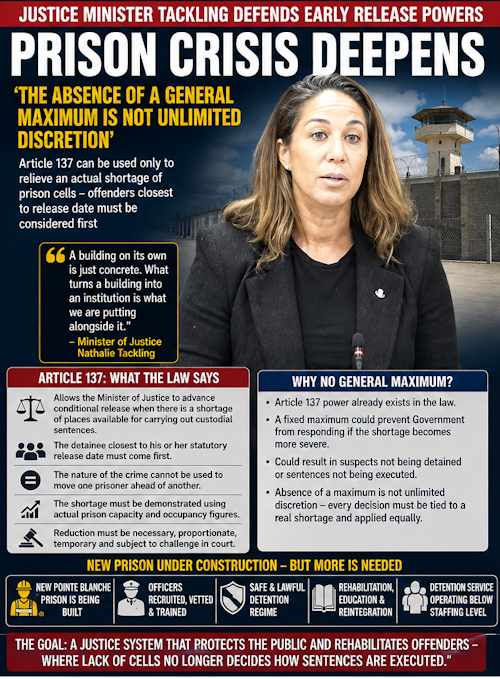 PHILIPSBURG:--- Minister of Justice Nathalie Tackling has mounted a detailed defense of the Government’s controversial use of Article 137 of the Penal Code to advance the conditional release of prisoners when Sint Maarten does not have sufficient detention capacity, insisting that the law does not give the Minister unrestricted authority to decide who walks out of prison.
Answering Members of Parliament during the continuation of the 2026 budget debate Tuesday, Tackling acknowledged the severity of the detention-capacity problem while explaining why her Ministry has not introduced a national decree establishing a fixed maximum reduction in sentences.
Her answer puts one of the most contentious issues facing the Justice Ministry squarely back before Parliament: St Maarten does not have enough prison space to execute every custodial sentence in the normal manner, and the law gives the Justice Minister extraordinary powers to respond to that shortage.
Tackling confirmed that under Article 131, ordinary conditional release occurs after two-thirds of a sentence has been served. Article 137, however, allows the Minister of Justice to advance conditional release when there is a shortage of places to carry out custodial sentences.
But Tackling stressed that Article 137 cannot be invoked simply because the Government wants to release a particular prisoner.
According to the Minister, the shortage must be demonstrated using actual prison capacity and occupancy figures, and any reduction must be limited to what is necessary to relieve that shortage.
Minister says she cannot choose prisoners based on offense
Tackling also addressed one of the most sensitive questions surrounding early release: Who gets out first?
She told Parliament that Article 137 prescribes the order and that the detainee proportionally closest to his or her statutory release date must come first.
According to Tackling, the entire detainee population is measured using the same percentage, including persons serving Sint Maarten sentences outside the country. Most significantly, she said the nature of the crime cannot be used to move one prisoner ahead of another.
That means the Minister's explanation effectively rejects the idea that Government can simply handpick prisoners for accelerated conditional release based on whether their offenses are considered more or less serious.
The policy framework, she said, consists of the conditional-release policy adopted in December 2015 and published in February 2016, together with an internal implementation note dating from July 2023. The Ministry is now working to update and harmonize that framework with current jurisprudence and implementation practices.
Why no maximum? Tackling says fixed ceiling could tie Government's hands
The Minister also gave perhaps her clearest explanation yet for why Government has not adopted a national decree establishing a maximum reduction under Article 137.
She told Parliament that the law's wording makes such a decree optional rather than mandatory.
According to Tackling, the power to advance conditional release already exists directly under the law. A national decree would therefore not create that power; its principal effect would be to establish a maximum reduction.
The Minister argued that imposing such a ceiling could create another problem.
Sint Maarten's prison-capacity shortage is unpredictable, she said. If Government sets a maximum reduction and the shortage later becomes so severe that additional cells must be freed urgently, Government could find itself legally prevented from responding.
The consequences, Tackling warned, could extend beyond convicted prisoners.
She told Parliament that an inability to free sufficient detention capacity could ultimately mean that suspects in ongoing criminal investigations cannot be detained or custodial sentences cannot be executed.
But she rejected the suggestion that this leaves the Minister with a blank cheque.
“The absence of a general maximum is not an unlimited discretion.”
Tackling said every decision must still be tied to a demonstrable shortage, must be necessary and proportionate, must be temporary, and must be applied equally according to the order prescribed by law. Decisions can also be challenged before the criminal court.
New prison will not solve the problem by itself
The bigger problem remains detention capacity.
Tackling told Parliament that the new Pointe Blanche prison is under construction, but warned that constructing cells is only one part of rebuilding the detention system.
“A building on its own is just concrete,” the Minister said.
She said the institution will also require properly recruited, vetted and trained correctional officers, a lawful detention regime, rehabilitation, education and reintegration programmes.
She acknowledged that the detention service is operating well below its required staffing establishment and said recruitment and training must therefore proceed alongside construction.
That reality means the Article 137 debate cannot be separated from the underlying prison crisis.
The question confronting Parliament is consequently larger than whether one Minister should possess early-release authority.
It is whether Sint Maarten can finally build sufficient detention capacity, recruit enough prison personnel, and create a functioning correctional system so that the lack of cells no longer determines how criminal sentences are executed.