~York rejects “political theatre” label, Irion questions sequence of feasibility study and legislation, while MPs demand Government show what has actually been completed~
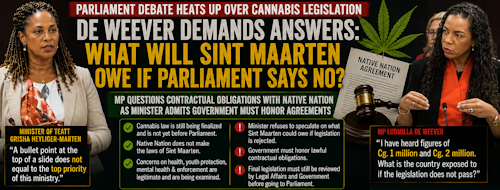 PHILIPSBURG:--- The parliamentary confrontation over cannabis has exposed a problem extending far beyond whether Sint Maarten should legalize and regulate the industry: after years of discussion, Parliament is still trying to establish exactly where the Government is in the process, what has already been completed, what remains outstanding and when elected representatives will finally receive the legislation they are expected to scrutinize.
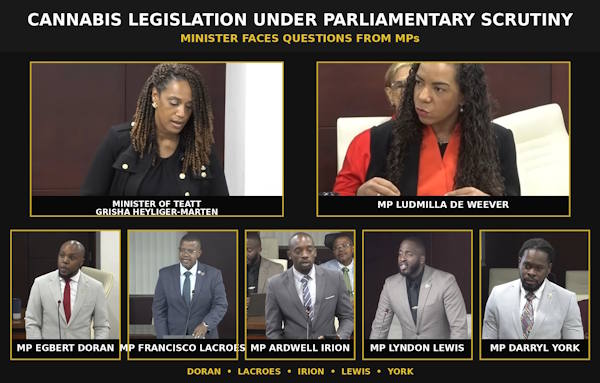
While MP Ludmila de Weever focused on the potential financial consequences of Government's contractual arrangements surrounding the initiative, MPs Darryl York and Ardwell Irion attacked the issue from another angle — process, accountability, and Parliament's right to debate Government policy before legislation reaches the floor.
Their questions matter because the cannabis initiative is not merely an abstract proposal floated by individual MPs. The executive branch is pursuing it, while Government itself acknowledges the legislation has not yet reached Parliament.
That leaves a growing gap between Government's cannabis ambitions and the legislative process required to make them law.
 York: Don't tell MPs when they can speak
York delivered one of the clearest challenges to TEATT Minister Grisha Heyliger-Marten after taking issue with her reference to premature discussion surrounding cannabis as “political theatre.”
York questioned how that characterization could be reconciled with Prime Minister Dr. Luc Mercelina's own extensive public discussion of cannabis.
“The Prime Minister has spoken extensively on the topic of cannabis,” York told Parliament, before asking whether the Prime Minister's remarks should therefore also be considered political theatre.
York then drew a line in the sand on Parliament's independence.
He made clear that the executive branch would not determine when he, as an elected representative, could express his position on cannabis.
“Whenever I see fit to share my opinion on the topic of cannabis, I will,” York stated.
His criticism raises a legitimate institutional question.
If Government is already discussing cannabis publicly, defending the initiative and advancing work toward legislation, why should MPs wait until a completed draft law lands before them to question the direction Government is taking?
Parliament's oversight responsibility does not begin on the day a draft ordinance is submitted.
Irion asks a more fundamental question: What is the actual process?
MP Ardwell Irion approached the matter differently.
Rather than debating whether cannabis should ultimately be legalized, Irion questioned the sequence the government is following to get there.
He recalled that the entity involved in the initiative was supposed to first conduct research across the relevant sectors and prepare a feasibility study.
As Irion understood the process, that study would then go to the Council of Ministers. After approval at that level, the legislative process would follow.
That may sound procedural, but it goes directly to the project's credibility.
Because if the feasibility study is supposed to determine whether and how Sint Maarten should proceed, Parliament needs to know whether major decisions and contractual commitments were made before or after that feasibility assessment was completed.
Irion therefore effectively placed another unanswered question on the table:
Is Government following the process originally established for this project, or are different stages now moving simultaneously?
Show Parliament the roadmap
The cannabis discussion also collided with a wider criticism raised during the budget clarification round: Government repeatedly tells Parliament that initiatives are “in progress,” “being worked on” or “in the pipeline,” without providing enough information for MPs to determine where those projects actually stand.
Parliament's demand was for proper roadmaps.
Those roadmaps should show where a project started, what has been completed, what remains outstanding, who is responsible for each stage, and the timeline for completion.
Cannabis may now be one of the clearest examples of why that demand matters.
Government should therefore be able to place before Parliament a straightforward chronology:
When was the cannabis initiative formally launched?
When was the inter-ministerial structure established?
What precisely was Native Nation contracted or engaged to do?
When was the feasibility work commissioned?
Has the feasibility study been completed?
Has the Council of Ministers formally considered or approved it?
What recommendations resulted from that work?
What legislative drafting has been completed?
What reviews remain outstanding?
And when will Parliament actually receive the proposed ordinance?
Until those questions are answered, Government is asking Parliament and the public to debate an initiative without providing the complete map showing how the country got to its present position.
De Weever's financial questions make the roadmap even more important
The procedural questions raised by York and Irion cannot be separated entirely from De Weever's financial concerns.
De Weever told Parliament that the Minister had acknowledged contractual obligations that Government must honor and demanded to know the country's financial exposure. She referred to figures she had heard of NAf. 1 million and NAf. 2 million but did not claim either figure was confirmed.
She also pointed to the Native Nation presentation previously made to Parliament and questioned what Government had contractually committed itself to while the legislation remained unfinished.
Taken together, the MPs' interventions produce a much bigger accountability question.
It is not only:
What could Government owe?
It is also:
At what stage of the process were those obligations undertaken?
That is why Irion's question about the feasibility study is important.
Government needs to distinguish policy from law
Government should make another distinction unmistakably clear to the public.
A Government policy decision to pursue a regulated cannabis industry is not the same thing as Parliament enacting cannabis legislation.
An inter-ministerial working group is not legislation.
A feasibility study is not legislation.
A presentation by Native Nation is not legislation.
A Council of Ministers decision is not parliamentary approval of legislation.
And a contractual arrangement entered into by Government cannot guarantee that Parliament will ultimately enact a law in the form Government wants.
That constitutional and legislative reality is exactly why MPs are entitled to scrutinize the process now.
Two years later, where exactly is the country?
Government has been working on the cannabis issue for a considerable period, and Parliament's questions now suggest impatience with hearing that various components remain under development.
If the inter-ministerial work has been underway for approximately two years, Parliament should be able to see the product of that work.
If research has been conducted, publish or provide it.
If a feasibility study exists, provide it.
If the Council of Ministers has taken decisions, identify them.
If contracts were executed, explain their purpose and financial consequences.
If draft legislation exists, explain its current stage.
And if Government still cannot provide a date for submitting legislation to Parliament, explain what remains unresolved after two years of work.
Parliament should demand documents, not promises
Cannabis is too consequential to be reduced to competing slogans about legalization.
Legitimate questions remain about public health, youth protection, mental-health capacity, enforcement, economic opportunity, licensing, taxation, and regulation.
But before Parliament can even reach many of those substantive policy choices, it needs to understand what Government has already done.
York's challenge concerns Parliament's right to debate.
Irion's questions concern the process.
De Weever's questions concern financial exposure.
Together, they point toward the same conclusion:
Government must put the complete cannabis file before Parliament.
Not another presentation.
Not another assurance that work is progressing.
Not another promise that legislation will eventually arrive.
Parliament needs the feasibility work, contractual framework, financial exposure, Council of Ministers decisions, legislative status and timeline.
Only then can MPs determine whether the Mercelina II Cabinet is methodically constructing a regulated cannabis framework — or whether Sint Maarten is being asked to follow a project whose most important decisions have already been taken somewhere outside the parliamentary chamber.