~TEATT Minister says cannabis law is still being finalized, calls De Weever’s health and readiness concerns legitimate, says Native Nation cannot make Sint Maarten’s laws and refuses to speculate on what Government could owe if Parliament rejects legislation.~
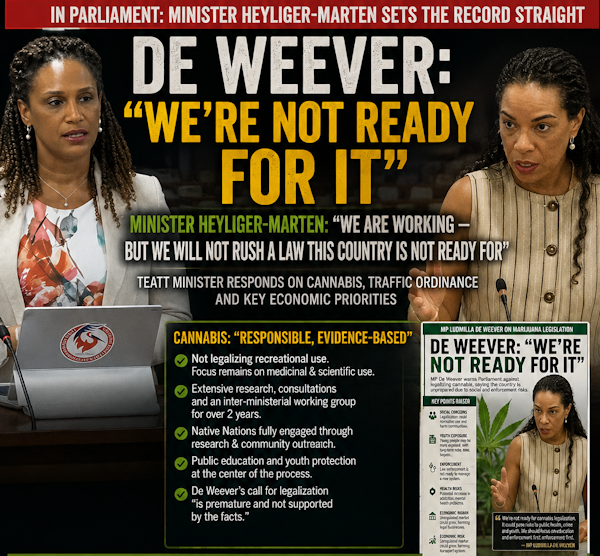 PHILIPSBURG:--- Minister of Tourism, Economic Affairs, Transport and Telecommunication (TEATT) Grisha Heyliger-Marten has mounted a strong defense of Government’s controversial cannabis legislative process, while at the same time acknowledging that several of the concerns raised by Member of Parliament Ludmila de Weever — including public health, youth protection, mental health, enforcement and whether St Maarten is actually prepared — are legitimate issues that must be addressed.
De Weever confronted the Minister over cannabis regulation appearing prominently on TEATT’s legislative agenda, questioning why it appeared ahead of longstanding matters such as public transportation, beach vending, sports, tourism and residential economic policy.
Heyliger-Marten rejected the conclusion that its placement meant cannabis had become her ministry’s number one legislative priority.
“The list presented to this Parliament was an overview of our comprehensive legislative agenda,” Heyliger-Marten told Parliament. “It was not formatted in descending order of importance, priority, or urgency.”
She then delivered her clearest rebuttal:
“A bullet point at the top of a slide does not equal the top priority of this ministry.”
The Minister said the purpose of the exercise is neither to promote cannabis nor to assume automatically that St Maarten must establish a cannabis industry.
Instead, she said Government is examining the issue, identifying risks and safeguards and developing a framework that can eventually be placed before Parliament and assessed on its merits.
De Weever's concerns are “Legitimate,” Minister concedes
Perhaps one of the most significant parts of Heyliger-Marten's response was her acknowledgment of the substance of De Weever's concerns.
The Minister specifically identified public health, youth protection, mental health, enforcement, potential Government liability, local economic participation and whether Sint Maarten is prepared as legitimate concerns.
According to Heyliger-Marten, these are precisely the matters the policy, legislative and regulatory process is intended to examine.
That acknowledgment is important.
It means the disagreement between De Weever and the Minister is not necessarily over whether those risks exist. The dispute is increasingly about whether Government should continue developing the framework while those questions are being answered — and whether Sint Maarten has the institutional capacity to manage whatever system Government ultimately proposes.
Cannabis Law Isn't Even Before Parliament Yet
Heyliger-Marten also made clear that MPs are presently debating a policy direction rather than a completed piece of legislation.
The proposed cannabis legislation is not presently before Parliament.
According to the Minister, it remains under development and must still complete the required review by Legal Affairs and the Government's approval process before it can be submitted to Parliament.
Heyliger-Marten therefore described it as premature to draw sweeping conclusions about legislation that MPs have not yet received, examined or debated in its final form.
That answer, however, also establishes something important for the public record: the cannabis legislative process is active.
Cannabis law is expressly included among the critical pieces of legislation TEATT says it is currently working on, together with reforms involving business licensing, the Competition Authority, public transportation, BTP, games of chance, hotel and short-term rental taxation, bus and taxi measures, vehicle inspection fees, the Tourism Authority and statistics legislation.
Native Nation: Minister Draws a Line
De Weever also questioned the agreement connected to the cannabis initiative and what Sint Maarten could owe if the legislation ultimately fails.
That brought Native Nation directly into the parliamentary discussion.
Heyliger-Marten was emphatic about the limits of the entity's authority.
“Native Nation does not make the laws of St. Martin.”
According to the Minister, Native Nation does not determine Government policy, regulate an industry, issue licenses or decide whether Parliament adopts legislation.
She said Native Nation was engaged to provide technical expertise within the scope of the applicable agreement.
Government remains responsible for policy and administration, while Parliament retains constitutional authority over legislation.
That distinction is critical because it places political responsibility squarely where it belongs: with the Government proposing the policy and the Parliament that will eventually be asked to approve or reject the law.
So what does St Maarten owe if Parliament Votes No?
That question remains unanswered in monetary terms.
De Weever specifically asked what Government would owe if cannabis legislation does not pass and whether the country is tied to an agreement.
Heyliger-Marten said Government must honor its lawful contractual obligations and manage the process in good faith.
But she would not give Parliament a figure.
The Minister said it would be irresponsible to announce that a particular amount would automatically become payable if Parliament refuses to approve the legislation.
Any financial consequence, she explained, depends on the terms of the agreement, work already performed, outstanding obligations and provisions dealing with amendment, discontinuation or termination.
Those matters, according to Heyliger-Marten, must be determined from the agreement itself and applicable legal advice rather than speculation on the floor of Parliament.
She also cautioned that Government must avoid actions that could unnecessarily expose the country to contractual or financial risk.
But that answer inevitably leaves a major question hanging over the debate:
What exactly are St Maarten's contractual obligations under the Native Nation agreement?
The Minister's statement establishes that lawful contractual obligations exist and that potential financial consequences would depend upon the agreement. Based on the information provided, it does not establish what those consequences would be.
Heyliger-Marten: This is not simply about making money
The Minister also rejected the suggestion that the cannabis exercise should be viewed merely as another source of Government revenue.
She said the proposed framework being examined includes protecting public health and young people, reducing illicit activity, improving consumer and product safeguards, strengthening oversight and enforcement and examining possible opportunities for local entrepreneurs and farmers.
Prevention, mental-health risks and access to appropriate support for people affected by substance misuse must also be considered.
Revenue, she said, may form part of the assessment, but it is neither the only consideration nor sufficient justification on its own for proceeding.
Minister Tells MPs: Read it, Challenge it — Then Vote
Heyliger-Marten also strongly defended Parliament's ultimate authority over the legislation.
The government can bring a law to Parliament, she said, but the Government cannot cast Parliament's vote.
MPs will remain free to examine the proposal, question it, propose amendments and ultimately vote for or against it.
Her message to Parliament was essentially: wait for the legislation.
“When it reaches Parliament, read it, question it, challenge it,” the Minister said, before emphasizing that an MP who ultimately believes the legislation should not become law has the right to vote against it.
She ended that portion of her response with one of her strongest political rebukes of the evening, arguing that Parliament should deal in established facts rather than speculation and conduct parliamentary scrutiny rather than “political theatre.”
Traffic and Public Transportation: Five Proposals already Received
While cannabis generated one of the sharper political exchanges, Heyliger-Marten's responses also revealed significant developments concerning Sint Maarten's traffic and transportation problems.
The Minister said the Government received five submissions under its Request for Information on mobility and traffic-management solutions.
An inter-ministerial technical team will assess the proposals for feasibility, scalability and potential value. The team will then consider those findings alongside a comprehensive carrying-capacity study.
If viable and cost-effective solutions emerge, the information could eventually be used to prepare terms of reference for procurement. Heyliger-Marten stressed that any subsequent procurement would have to follow an open and competitive process.
Government is examining intelligent traffic management, vehicle and fleet tracking, public-transport technology and potential financing models including public-private partnerships and concessions.
But the Minister stressed that the RFI does not mean Government has already chosen a particular system.
The Government's stated sequence is to first understand the problem through data, determine the capacity and needs of the transportation network, understand what solutions are available, and then develop a practical mobility strategy.
Heyliger-Marten said Government ultimately wants “a safer, more effective, and better organized transportation system” while recognizing Sint Maarten's physical limitations.
She said traffic cannot simply be treated as a road problem; Government must examine public transportation, vehicle movements, congestion, and the possible use of technology.
For Parliament, however, cannabis remains the politically explosive part of TEATT's legislative agenda.
Heyliger-Marten has now put several things clearly on the record: cannabis legislation is being developed; it is not yet before Parliament; Native Nation cannot make Sint Maarten's laws; the health and preparedness concerns raised by De Weever are legitimate; and the Minister has not provided a figure for what the country could owe if the initiative ultimately does not proceed.
Those facts ensure that when the actual legislation and supporting documents finally reach Parliament, the debate is unlikely to become quieter.
It is likely to become much louder.