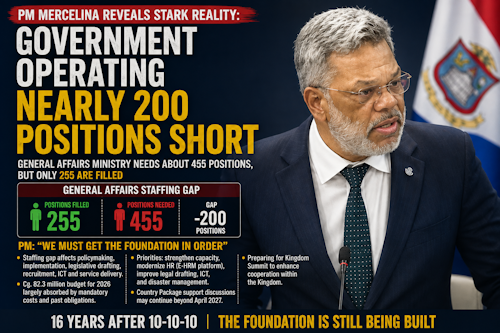
 PHILIPSBURG:--- Prime Minister and Minister of General Affairs Dr. Luc Mercelina has laid bare the extent of the capacity crisis at the heart of government, telling Parliament that his ministry needs about 455 positions to properly carry out its legal and operational responsibilities, while only about 255 are filled.
That leaves General Affairs operating with a gap of roughly 200 employees compared with what is considered necessary for its full organizational structure.
Mercelina made the disclosure during his presentation on the Ministry of General Affairs under the draft 2026 National Budget, where he acknowledged that Sint Maarten's difficulties executing policy cannot simply be separated from weaknesses within the machinery of government itself.
The Ministry has approximately 271 positions budgeted, but only around 255 are presently filled. The estimated organizational requirement is approximately 455 positions.
For a government repeatedly criticized in Parliament over delayed legislation, unfinished projects, slow recruitment, backlogs and weak execution, Mercelina's numbers provide a stark explanation of the problem — but they also raise a bigger question:
How can Government promise an ambitious programme of reforms when the ministry responsible for coordinating the machinery of Government says it is nearly 200 employees short?
General Affairs Budget Rises to Cg. 82.3 Million
Mercelina told Parliament that the General Affairs budget, excluding financing through the Temporary Work Organization (TWO), increases from approximately Cg. 79.5 million in 2025 to Cg. 82.3 million in 2026, an increase of about 3.4%.
But the additional money does not necessarily translate into significant new policy room.
According to the Prime Minister, much of the increase is consumed by mandatory expenditures, including salary indexation, higher operational costs and outstanding obligations accumulated in previous years.
That leaves Mercelina confronting the same dilemma MPs have repeatedly identified across ministries during the budget debate: Government's ambitions are considerably greater than its financial and institutional capacity to execute them.
The overall 2026 budget projects Cg. 647.1 million in revenue and Cg. 635.9 million in operating expenditure, with another Cg. 164.6 million earmarked for capital investments.
But having money allocated on paper is only one part of the equation.
Mercelina's presentation made clear that government also needs people capable of turning those allocations into policy, legislation, procurement, administration and completed projects.
“The Personnel Gap is not merely a number”
The Prime Minister did not attempt to portray the staffing shortage as an abstract human-resources problem.
He connected it directly to government's ability to function.
The shortage, Mercelina said, affects policymaking, implementation, legislative drafting, recruitment, digital services and government's ability to respond effectively to the public.
That admission is significant given what Parliament has heard throughout the 2026 budget debate.
MP after MP has questioned why legislation remains unfinished, why projects take years to execute, why reforms remain stuck in studies and reports and why government repeatedly lacks the institutional capacity to deliver on announced policies.
Mercelina's own presentation now confirms that the problem reaches directly into General Affairs.
The Prime Minister said Government is rebuilding capacity gradually through recruitment, management strengthening and efforts to address longstanding financial and administrative backlogs.
But with only 255 of an estimated 455 required positions filled, “step by step” could become a very long road.
Government's Foundation still being built 16 years after 10-10-10
Mercelina placed the problem in an even broader context.
Sint Maarten has been a constituent country within the Kingdom since October 10, 2010. Yet the Prime Minister told Parliament that after nearly 16 years, Government still needs to establish and firmly anchor its institutional foundation.
“This is not a message of pessimism,” Mercelina said, describing it instead as a call for realism and action.
His central message was that Government must first get its foundation in order.
That statement may prove to be one of the more consequential admissions of the budget debate.
For years, successive governments have launched ambitious programmes involving tax reform, digital government, social protection, housing, healthcare, infrastructure, energy, justice reform and economic diversification.
But Mercelina is effectively saying that the basic administrative machinery required to consistently deliver those programmes remains under construction.
Legal Capacity Remains Critical
One area directly affected by the shortage is legislative drafting.
That problem has surfaced repeatedly during the budget debate.
Government can commission studies, establish policy intentions and announce reforms, but many initiatives eventually require legislation.
Without sufficient legislative capacity, projects can stall between political intention and legal implementation.
Mercelina identified legal affairs as a core government-support function that must be strengthened, along with Personnel and Organization, ICT, and facility management.
That shortage has implications far beyond General Affairs.
Every ministry eventually depends on legislative and administrative support to move major reforms through Government and Parliament.
The consequence is a bottleneck: ministries can develop proposals faster than Government can legally and administratively implement them.
Government wants to end the paper trail
Mercelina also identified modernization of Government's human-resources administration as a priority.
Government intends to introduce an E-HRM platform to replace fragmented, paper-based personnel procedures and create a single reliable source of personnel information.
That modernization is important because Government has struggled for years with personnel administration, vacancies, recruitment, function books, and administrative backlogs.
A centralized electronic HR system could improve visibility over who works where, which positions are vacant, and how personnel procedures are processed.
But technology by itself will not fill the approximately 200-position organizational gap disclosed by the Prime Minister.
The government still has to recruit, finance, and retain the people needed to perform those functions.
Fire Department and Disaster Management also need strengthening
Mercelina's presentation also placed disaster preparedness among General Affairs' three strategic priorities.
The government intends to strengthen the Office of Disaster Management and the Fire Department through additional staffing, better emergency equipment, and improved crisis coordination.
For Sint Maarten, this is not an optional area of government.
The country remains exposed to hurricanes and other emergencies, making adequate disaster-management capacity essential.
Mercelina said resilience cannot begin when a crisis arrives; preparation has to be sustained and structured.
He specifically stressed the need for a Fire Department that is properly trained, compensated, and equipped.
Again, however, the same problem returns: strengthening emergency services requires personnel and money at a time when General Affairs already says its institutional requirements substantially exceed its budgeted workforce.
Country Package Support Could Continue Beyond April 2027
Mercelina also disclosed that technical discussions are continuing with the Netherlands over the possible continuation of support associated with the Country Package beyond its current April 2027 closing date.
That support remains important to the government's multi-year institutional reform program.
The disclosure raises another important question.
If Sint Maarten's institutional strengthening cannot be completed before April 2027 — something Mercelina's staffing numbers strongly suggest — how much longer will outside technical and financial support be required?
The Prime Minister himself acknowledged that strengthening Government is not something that will be completed within one budget year or even necessarily one administration.
Kingdom Summit Planned
Mercelina also placed greater cooperation within the Kingdom among his priorities.
Preparations are underway for a Kingdom Summit later this year, intended to promote more structured dialogue among Sint Maarten, Curaçao, Aruba and the Netherlands.
The Prime Minister's wider argument is that Sint Maarten cannot strengthen its institutions solely through internal government action.
He called for greater cooperation between ministries, Government and Parliament and with partners across the Kingdom and internationally.
The Real Story Is Government's Ability to Execute
Mercelina's presentation was framed around three priorities: strengthening government capacity and core services; advancing national development and external partnerships; and reinforcing disaster and crisis-response capacity.
But behind those priorities sits a much larger issue.
Execution.
The 2026 budget itself arrived in Parliament late. The draft ordinance seeks retroactive effect to January 1, even though Parliament is deliberating on it deep into the fiscal year.
The Government has acknowledged that the delayed budget affected planning, procurement, project execution and service delivery.
Mercelina is now telling Parliament that General Affairs is operating with only around 255 filled positions against an estimated requirement of 455.
That means Sint Maarten is trying to execute an increasingly complicated national agenda while the central ministry responsible for coordinating Government says it is operating with barely more than half of the positions it considers necessary under its organizational requirements.
The Prime Minister has offered his solution: to rebuild the institution gradually.
“Step by step,” he said, Government must strengthen its foundation and institutions.
But after nearly 16 years of country status, residents and Parliament may reasonably ask whether Sint Maarten still has the luxury of moving slowly.
Because the consequences of inadequate government capacity are no longer confined to organizational charts.
They appear in delayed laws, delayed recruitment, delayed projects, administrative backlogs, unfinished reforms and public services that residents expect Government to deliver now.
Mercelina has therefore identified what may be one of the most fundamental problems underlying the entire 2026 budget debate:
Government does not merely have to finance its policies. It must first build the institutional capacity to execute them.
And with an estimated 200-person gap inside General Affairs alone, that foundation remains far from complete.