~MP questions conflicting with GDP figures, government’s inability to track outstanding invoices, health-fund risks, 271 vacancies, GEBE finances, dirty roads, dangerous sidewalks and worsening traffic.~
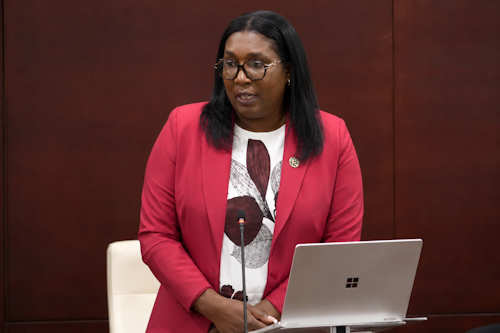 PHILIPSBURG:--- Member of Parliament Veronica Jansen-Webster used the 2026 budget debate to challenge government on what she described as fundamental gaps between the financial picture being presented to Parliament and the information government actually has at its disposal, questioning how a first-quarter surplus can be properly assessed when government cannot say how much it owes suppliers.
Jansen-Webster’s intervention ranged across virtually the entire Council of Ministers, but some of her sharpest questions were directed at Finance and General Affairs. She also pressed government on health-care financing, GEBE’s financial statements, staffing shortages, tourism, agriculture, foster care, infrastructure, garbage collection and traffic.
At the center of her financial concerns was the government’s reported first-quarter 2026 result of approximately XCG 39 million, based on roughly XCG 171 million in revenue against XCG 132 million in expenditures.
The MP said those numbers raise another question: How much of that XCG 39 million is already owed to suppliers but simply hasn't been paid yet?
According to Jansen-Webster, she previously asked government for accounts-payable figures broken down by ministry and year for invoices dating from 2022 through 2025. She said the response was that the Finance system does not allow that historical breakdown.
For Jansen-Webster, that is a serious weakness in government financial management.
She questioned how government can present a XCG 39 million first-quarter surplus without being able to establish how much of that money represents outstanding obligations to businesses and other creditors. She therefore asked whether a system capable of properly identifying outstanding invoices will be operational before Parliament handles the 2027 budget.
Conflicting GDP Numbers Put Under Microscope
Jansen-Webster also challenged what she described as inconsistent economic figures being presented by different ministries.
She said the Finance Minister’s presentation cited about 2% real GDP growth, while another ministerial presentation put real GDP growth at 3.4%.
She asked government to clarify which figure is correct and whether the discrepancy resulted from ministries relying on different sources.
“What is the real GDP growth?” was the substance of her question, as she demanded clarity on the sources behind the figures being placed before Parliament.
Similar questions were raised about Sint Maarten’s loan-to-GDP ratio. Jansen-Webster initially referred to the debt-service ratio but corrected herself during her presentation, explaining that she meant the ratio of government loans to GDP.
She said she had encountered figures of about 41% and 27%, apparently from different sources, and asked the finance minister to provide the calculation and identify the data sources used.
GEBE Financial Statements Questioned
The MP also sought clarification on GEBE's financial reporting.
According to Jansen-Webster, Parliament was told during the Finance presentation that GEBE had not had audited financial statements since 2021. However, she said answers provided during the Central Committee stage indicated that the 2023 audited financial statements had been completed and the 2024 statements were being prepared.
She asked the government to state exactly which financial statements have been completed and which the shareholder has formally approved.
The issue, she argued, is particularly important because GEBE is seeking financing.
Jansen-Webster referred to approximately XCG 28 million in additional financing and pointed out that lenders generally require reliable financial statements before extending credit.
Health Funds: Government Has Been Warning About the Same Risk for Years
Jansen-Webster then turned to what Finance itself identified as one of the country’s major fiscal risks: health-care financing.
She said the discussion surrounding general health insurance stretches back to before 2010 and noted that implementation has repeatedly been delayed.
The MP linked the problem directly to another risk identified by government: Sint Maarten’s aging population and the resulting pressure on health-care expenditure.
She questioned whether Finance, General Affairs and VSA have started discussions with the unions over possible changes to civil servants’ health-care contributions.
Jansen-Webster acknowledged that such discussions will be difficult but argued that government cannot repeatedly identify health funds as a major risk without taking the politically difficult steps required to address the problem.
She pointed to differences between private-sector and civil-service health contributions and asked whether civil servants could ultimately be required to contribute more as part of reform. She also questioned whether government would consider some form of compensation if increased health contributions reduced civil servants’ disposable income.
Her message was unmistakable: government institutions have repeated the warning long enough.
“We read about it from the Council of Advice. We read about it from the CFT, and we now have to act,” she told Parliament.
Two P&O Workers and 271 Vacancies
Jansen-Webster raised equally serious questions about the government’s ability to recruit the personnel that virtually every ministry says it desperately needs.
She said information provided in response to her questions indicated that the P&O Department has two people while being expected to provide personnel support across the entire Government of Sint Maarten.
At the same time, ministries are reporting vacancies and experienced civil servants are approaching retirement.
Jansen-Webster asked whether government has developed a genuine succession plan to ensure that decades of institutional knowledge do not simply disappear when senior employees retire. She suggested having replacements work alongside outgoing employees for several months to transfer knowledge.
The MP went further, suggesting that Parliament could consider shifting available budget funds toward strengthening P&O, including hiring consultants to assist ministries with recruitment and bringing in legislative lawyers where necessary.
She later referred to 271 vacancies the government is attempting to fill and questioned whether current recruitment practices are themselves limiting the pool of available workers.
One example was government vacancy advertisements published only in Dutch.
Jansen-Webster acknowledged Dutch as an official language but stressed that English is also an official language and argued that publishing advertisements exclusively in Dutch can unnecessarily exclude qualified residents.
She asked whether General Affairs would object to publishing applicable vacancies in English as well.
She also questioned whether the government has made entry requirements unnecessarily restrictive.
Jansen-Webster argued that qualified residents with experience should be given opportunities and training for positions, rather than the government setting qualification thresholds so high that capable applicants do not even apply.
Attracting Sint Maarteners living abroad presents another challenge.
She illustrated the problem bluntly: someone earning 6,000 euros in the Netherlands is unlikely to return to Sint Maarten for 5,600 guilders, especially when local housing costs can reach around $1,200 in rent.
Government, she argued, must make returning home financially attractive if it is serious about reversing the brain drain.
Tourism Boom — But who is getting the Money?
Turning to TEATT, Jansen-Webster picked up on government’s assertion that Sint Maarten is among the region’s stronger tourism performers and that economic growth is generating additional revenues.
Her question was whether that economic expansion is actually reaching ordinary people.
She asked what concrete projects are being implemented to ensure that economic growth becomes economic opportunity and questioned what the government is doing to stimulate greater local investment.
She also raised the possibility of linking TEATT incentives with Finance measures, including possible tax relief during the early stages of new businesses, to increase the number of local entrepreneurs benefiting from economic growth.
Agriculture needs land, not only policy
Jansen-Webster credited the TEATT Minister for remaining committed to agriculture but questioned where people are actually expected to farm on a small island with limited available land.
She specifically raised chicken farming and animal husbandry, asking whether government, working with VROMI, has identified land that could be made available to farmers.
The MP argued that Sint Maarten cannot speak seriously about food security without confronting the practical questions of land availability, zoning and the impact agricultural operations can have on surrounding communities.
She also challenged government over access to official statistics.
“Reliable data that’s not published is no data,” she said while asking when the Statistics Department’s website would be operational again.
Foster Children need somewhere to go at 18
On Justice, Jansen-Webster welcomed the increase in the foster-care stipend, noting that she had previously written to the minister about the issue and had been a foster parent herself.
She said the rising cost of living has made the previous stipend inadequate for the full range of expenses associated with caring for a child, and she hoped better financial support would encourage more families to become foster parents.
But she warned that another problem remains unresolved: What happens when foster children age out of the system?
Jansen-Webster called for transitional housing where young adults leaving foster care could live while becoming financially independent. She suggested government consider such a project in a future capital budget.
She also sought an explanation from VSA about what the approximately XCG 38.8 million OZR payment to SZV covers, noting complaints she receives about delayed payments to doctors.
“Why do regular citizens have to pick up garbage?”
Jansen-Webster’s criticism became particularly pointed when she reached VROMI.
She argued that Sint Maarten’s physical appearance has deteriorated, even though tourism is the foundation of its economy.
She recalled earlier tourism-development efforts that emphasized beautification and said the country has reached the stage where residents themselves are taking to the streets to collect garbage.
“Why do our regular citizens have to go on the road and pick up garbage?” she asked.
She acknowledged that VROMI has placed garbage and roadside-cleaning tenders into process but stressed that procurement takes time and demanded to know what government intends to do in the meantime.
If government cannot immediately organize the work, she suggested mobilizing Parliament, service clubs and the wider community for a general cleanup rather than simply allowing garbage to accumulate while waiting for contracts.
Dangerous Sidewalks could cost government more
Jansen-Webster also warned that neglected public infrastructure could become a direct financial liability.
She referred to reports of government being ordered to compensate tourists after injuries involving public pathways and warned that additional claims could follow if known hazards remain unrepaired.
She described holes and exposed metal in heavily traveled areas and questioned whether VROMI had inspected Philipsburg and Maho, where large numbers of tourists walk.
Her argument was straightforward: money paid out in damages is money that cannot be spent elsewhere in government.
Traffic and Brouwers Road Demand Coordinated Action
Finally, Jansen-Webster warned that traffic congestion is already returning as schools reopen and Sint Maarten moves toward another tourism high season.
She asked VROMI what measures it plans to take to alleviate congestion and called for cooperation among VROMI, TEATT’s transportation authorities, and Justice.
She singled out A.J.C. Brouwers Road as a road she considers dangerous because of the number of accidents and fatalities and called for the government to examine road markings, signage, pedestrian crossings and restrictions on overtaking.
Jansen-Webster also urged government to examine unconventional transportation solutions, referring to a proposed phased rail transportation concept that she understood could connect the Maho area with other parts of the island without requiring government financing.
She encouraged government to investigate that proposal and other “out-of-the-box” alternatives.
Taken together, Jansen-Webster’s intervention placed a larger question over the 2026 budget debate: Is government merely identifying Sint Maarten’s problems year after year, or does it now have the administrative capacity, financial information and political willingness to solve them?
From an accounts-payable system that cannot provide the requested historical breakdown to unresolved health-fund risks, hundreds of vacancies, aging civil servants, garbage-strewn roads, dangerous pedestrian infrastructure, and traffic congestion, the MP argued that many of the warning signs are already known.
The challenge she placed before government was no longer simply to acknowledge them — but to act.