~NA parliamentarian questions unpaid obligations, stalled renewable-energy policies, prison-capacity decisions and government’s failure to tackle the causes of crime.~
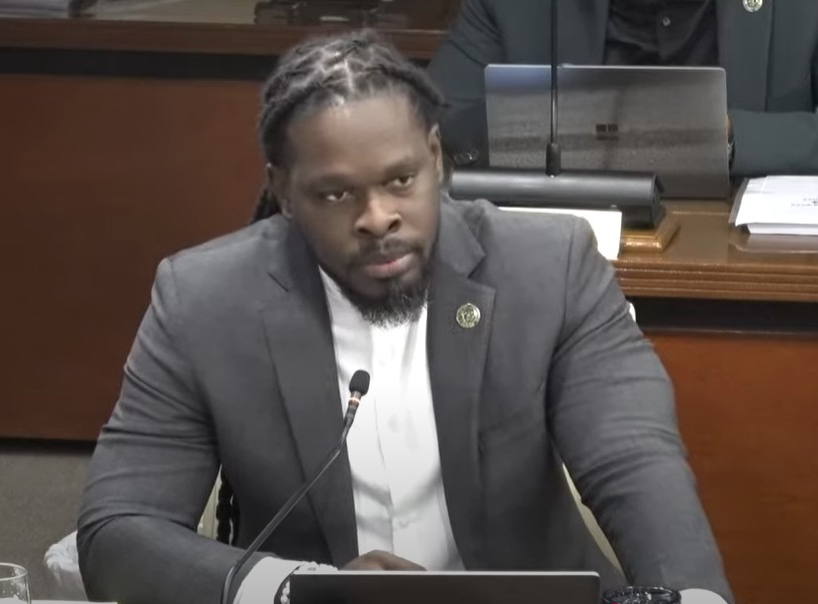 PHILIPSBURG:--- National Alliance Member of Parliament Darryl York has sharply questioned the government’s priorities, arguing that Sint Maarten cannot claim financial progress while contractors remain unpaid, families struggle with high utility bills, renewable-energy policies remain stalled, and ministries continue to address national problems in isolation.
During a wide-ranging interview on the Breakfast Lounge with Lady Grace, York addressed the delayed 2026 budget, the government’s outstanding debts, GEBE’s financial problems, violent crime, prison capacity, firearm laws, education, returning students and the uncertain future of businesses operating near Mullet Bay.
York said his focus during the budget debate will extend across the government because no ministry should escape parliamentary scrutiny.
“Every ministry deserves equal attention,” he said. “It is about time that things need to start happening.”
York Defends 2,500 Budget Questions
York defended Parliament’s submission of approximately 2,500 questions on the draft 2026 budget, saying the unusually high number resulted partly from government and Parliament’s decision to use a written process.
He explained that during a verbal budget debate, MPs can hear questions asked by their colleagues and remove duplicates from their own lists. They can also decide whether follow-up questions remain necessary after hearing a minister’s response.
Under the written process, however, MPs submitted questions without knowing what other factions had asked. They also had to include potential follow-up questions because ministers were not present to answer immediately.
“What you are going to get is a lot of duplicates,” York said.
He added that approximately one-third of his questions concerned inquiries that had already been submitted to ministers months earlier but remained unanswered.
The MP also said this is Parliament’s first budget meeting under the policy-based budgeting system. That change naturally generated additional questions about ministers’ objectives, implementation plans and expected results.
York rejected suggestions that National Alliance MPs simply used artificial intelligence to produce large numbers of questions.
“I know the MPs of the National Alliance did not just go and throw in an AI prompt and ask 12,000 questions,” he said.
Government must explain unpaid debts
York said one of the central issues requiring answers is the government’s long-term plan for paying outstanding obligations.
He pointed to repeated complaints from contractors and other creditors while government simultaneously speaks about financial surpluses.
According to York, those two accounts do not appear to correspond.
“You can say we have extra money on one end, but we do not have enough money to pay our bills on the next end,” he said.
York also wants ministers to account for projects announced and budgeted during the previous two years but apparently not executed.
“How did those projects go? How do we account for what you said you were going to do? And if you did not do it, what happened to the money?” he asked.
The MP said the government must address its existing debts before repeatedly announcing new projects and costs. He also called for comprehensive multi-annual plans from every ministry instead of what he described as a series of ad hoc initiatives.
Ministers operating in Silos
York argued that Sint Maarten’s ministries are failing to demonstrate how their policies connect.
He used crime and tourism as examples. While acknowledging that crime damages the tourism industry, York said government is focusing on what crime affects without adequately examining what drives crime.
“The reason why crime is rising is poverty, unemployment and education,” York said.
He warned that placing more police officers in Philipsburg and Maho would not address the conditions contributing to crime in Dutch Quarter, St. Peters, Sucker Garden and other communities.
York also questioned whether different government policies may be working against each other.
He referred to the granting of casino licences while government is simultaneously attempting to address poverty. According to York, reports have linked gambling problems to economically disadvantaged communities.
He said ministries must consider how decisions taken in one sector affect the responsibilities and objectives of another.
“I want to see the connection in how we are tackling the root of the problem and the symptom of the problem,” York said.
Prison space should prioritize violent crime
York also questioned how scarce space at the Pointe Blanche Prison is being used during the ongoing detention-capacity crisis.
He maintained that anyone convicted of a crime must face punishment, but said authorities may have to reconsider priorities when sufficient prison space is unavailable.
York questioned whether persons convicted of white-collar crimes should occupy scarce cells while persons involved in murder, rape, serious violence or major drug crimes cannot be detained.
“Fine, you do the crime, you do the time. But are we going to prioritize keeping them in instead of that person who committed a violent crime?” York asked.
The MP suggested that authorities could consider alternatives such as electronic monitoring for appropriate non-violent offenders during the capacity crisis.
He did not call for white-collar convictions to be erased or their sentences canceled. His position was that the consequences of using alternative detention for selected non-violent offenders would be less dangerous than failing to detain people involved in serious violence.
“In times like this, I believe we have to think out of the box,” he said.
Any alternative detention arrangement would have to comply with existing laws, court decisions and the authority of the responsible justice institutions.
Supports firearm debate but rejects “Wild West”
York expressed support for MP Dimar Labega’s call for a national discussion about modernizing Sint Maarten’s firearm and self-defense laws.
He stressed, however, that supporting the discussion does not mean supporting unrestricted gun ownership.
“I am all in support of the initiative. That does not mean that I believe everyone should have a right to carry a gun,” York said.
He said the country must strike a balance between allowing residents and business owners to protect themselves and preventing Sint Maarten from becoming the “Wild Wild West.”
York warned that not everyone has the mental capacity, judgment or training required to handle a firearm safely.
He agreed that the country’s laws are outdated and said a public discussion is necessary to determine how they should be modernized.
“Something needs to be updated in the law,” York said. “A lot of these laws are 10, 20, 30 or 40 years old.”
Why Advance 2027 Budget Before Passing 2026?
York also questioned why government is advancing the draft 2027 budget while Parliament has not yet approved the 2026 budget.
He argued that any amendments adopted during the 2026 debate could require corresponding changes to the proposed 2027 financial plan.
The MP referred to concerns raised by the Committee for Financial Supervision regarding the 2027 budget and urged government to slow the process.
“Why are we rushing the 2027 budget when the 2026 budget has not even been passed yet?” he asked.
York also questioned how ministers could unanimously approve a budget in the Council of Ministers and later appear before Parliament claiming their ministries need additional financing.
He specifically referred to the Justice Minister appealing to Parliament for help securing funding after participating in the collective approval of the budget.
According to York, ministers must raise funding objections while the budget is being prepared instead of approving the financial plan and later asking Parliament to correct it.
“It is like everybody is playing kumbaya in the Council of Ministers and then turning to Parliament to fix the issues they are causing,” he said.
Academic performance must take priority
On education, York said the country’s declining academic results, curriculum weaknesses and poor school facilities require greater attention.
He acknowledged the importance of the controversy surrounding school hair rules and said he understands the discrimination experienced by people with natural hair and locks.
However, he believes falling performance in reading comprehension and mathematics should receive greater urgency.
“I want to hear about curriculum. I want to hear what we are doing to fix the grades,” York said.
He also referred to basic problems within schools, including inadequate bathroom facilities.
York said schools should be permitted to establish rules, but those rules must be applied fairly and consistently.
“You cannot have two children sitting next to each other, allow one and disallow the next one,” he said.
The MP opposed simply removing school rules because some parents or students disagree with them. His position is that the implementation must be corrected where rules are discriminatory or applied unequally.
Slow Recruitment Driving Professionals Away
York also criticized the time the government takes to recruit Sint Maarten professionals who are studying or working overseas.
Recalling his own return from the Netherlands, York said the private sector quickly decided to hire him, while the government’s recruitment process was considerably slower.
“I think if I had to wait on government, I would still be in Holland today,” he said.
York warned that a professional interested in returning today may no longer be available six months later when government finally responds.
He said Sint Maarten must maintain contact with students while they are overseas and inform them about future employment opportunities before major projects become operational.
York used the new medical center as an example, arguing that authorities should already be communicating with Sint Maarten medical professionals abroad so they have sufficient time to plan a return.
Government cannot wait until a facility opens and then expect professionals to abandon their established jobs, homes and families at short notice, he said.
Mullet Bay vendors face uncertain future
Asked about the Sun Resorts court case and the position of businesses operating near Mullet Bay beach, York described the situation as “uncharted territory.”
He said he did not know what would happen if government and Sun Resorts failed to negotiate an agreement concerning access and the future of existing vendors.
York referred to statements that the responsible minister was holding discussions with Sun Resorts and expressed hope that negotiations could produce a workable solution.
He acknowledged that public access to the sea and practical access through privately controlled property are separate issues requiring careful resolution.
The overall message from York was that government must stop treating budget management, crime, education, energy and social development as separate problems.
He argued that the country’s financial claims must match the reality experienced by residents, that ministries must coordinate their policies and that difficult choices should be explained openly rather than left for Parliament and the public to decipher.