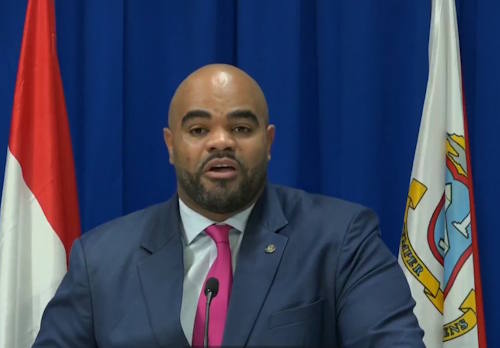
 PHILIPSBURG:--- Minister of Public Housing, Spatial Planning, Environment and Infrastructure Patrice Gumbs Jr. has acknowledged that VROMI’s limited enforcement capacity means construction sites can escape timely inspection, as questions emerge about alleged excessive excavation and property damage in Indigo Bay.
The issue was raised during Wednesday’s Council of Ministers press briefing. The minister was told that a developer allegedly excavated beyond the depth authorized in a civil-works permit, potentially affecting neighboring homes, foundations, walls and swimming pools.
Gumbs said he had not yet familiarized himself with the specific file and could not confirm the allegations. He nevertheless acknowledged the Ministry’s wider enforcement limitations.
“We do, of course, as everyone knows, have an issue with capacity to enforce,” Gumbs said.
VROMI conducts construction-site inspections throughout Sint Maarten, but the minister conceded that some sites are missed.
He warned developers that receiving a civil-works permit does not provide blanket permission to change an approved project. Construction and excavation must remain within the conditions established in the permit.
If a permit authorizes excavation between one and four meters, excavation beyond four meters would constitute a violation unless an amendment had first been requested and approved, he explained.
“What is permitted is supposed to be executed, and anything additional in terms of changes has to be requested and approved by the Ministry,” Gumbs said.
Where unauthorized work is discovered while construction is ongoing, VROMI can issue a stop order. The Ministry can also require remedial measures, including the replacement of earth that was removed beyond the permitted limit.
Gumbs was told during the briefing that VROMI may already have generated a report on the Indigo Bay matter and that the dispute may have reached court. He promised to verify the information and examine the file.
If the matter is already before the court, Gumbs said, the dispute becomes a civil matter between the developer and affected property owners. VROMI could nevertheless provide documentation or statements showing what was and was not authorized under the permit.
The Ministry could also consider hiring an independent assessor to help determine possible solutions where the required technical expertise is not available internally. Gumbs said VROMI is already using external assessors in several other cases.
He stopped short of committing the Ministry to a particular intervention in Indigo Bay, saying he first needed to study the case and determine what assistance VROMI could provide and where its legal or operational limitations lie.
The disclosure again raises questions about whether issuing permits without adequate capacity to monitor compliance leaves neighboring homeowners exposed until damage has already occurred.
Gumbs said the Ministry has strengthened its Inspection Department by reinstating special enforcement officers who can prepare documentation for court proceedings. Previously, inspectors were largely limited to stop orders.
Additional training is planned this year, while the Ministry works to finalize the operational framework for administrative enforcement.