~More than NAf. 164 million allocated to two critical Ministries as Questions mount over outcomes and economic vision.~
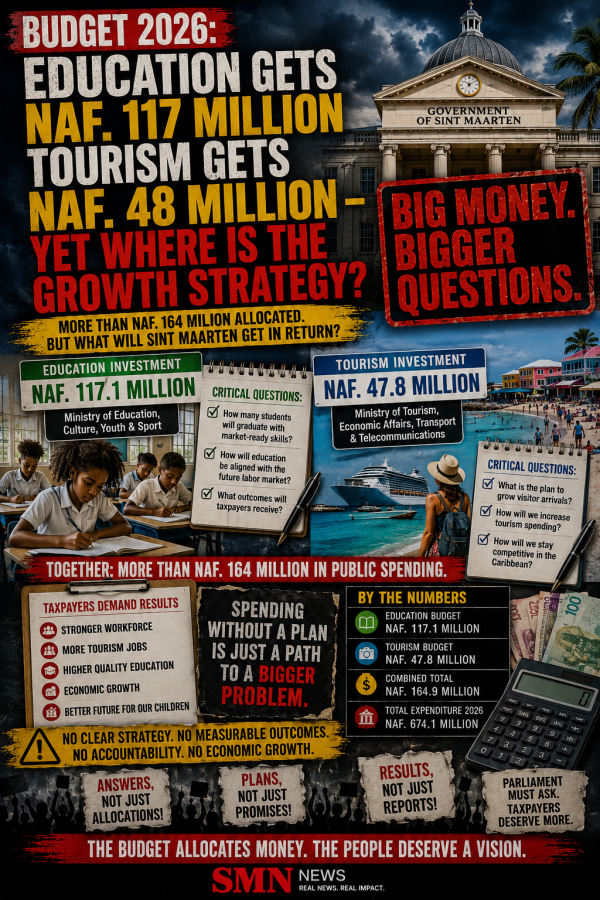 PHILIPSBURG:--- The Government's 2026 Budget reveals a striking reality about Sint Maarten's priorities: more than NAf. 164.9 million will be allocated to the country's Education and Tourism ministries, yet the budget provides limited evidence of how those investments will translate into measurable economic growth, workforce development, or national competitiveness.
According to the draft 2026 Budget, the Ministry of Education, Culture, Youth and Sport is allocated approximately NAf. 117.1 million, making it one of the largest recipients of government funding. The Ministry of Tourism, Economic Affairs, Transport and Telecommunications will receive approximately NAf. 47.8 million. Together, the two ministries account for nearly one-quarter of the country's ordinary expenditure budget.
The figures immediately raise an important question:
What exactly is Sint Maarten getting in return for this investment?
Education continues to absorb one of the largest portions of public spending year after year. Yet the budget provides little indication of a transformative strategy to prepare students for the realities of a rapidly evolving economy.
Across the island, employers continue to report difficulty finding qualified workers. Businesses increasingly seek employees with digital skills, technical expertise, language proficiency, and specialized vocational training. Yet there is limited evidence within the budget of a comprehensive plan to aggressively align educational outcomes with labor market demands.
The result is a growing disconnect between education and employment.
Taxpayers are entitled to ask how many students will graduate with market-ready skills, how many young people will enter high-demand professions, and how the government intends to measure success beyond simply funding the system.
The concerns become even more pronounced when examining Tourism.
Tourism remains the backbone of Sint Maarten's economy. Government revenues, business activity, employment opportunities, and consumer spending all depend heavily on the strength of the tourism sector. Yet despite receiving approximately NAf. 47.8 million, the budget offers limited detail regarding how the government intends to strengthen Sint Maarten's competitive position in an increasingly crowded regional marketplace.
Across the Caribbean, competing destinations are investing heavily in destination branding, digital tourism infrastructure, sustainability initiatives, airlift expansion, and improvements to the visitor experience.
The tourism industry is evolving rapidly.
Success can no longer be assumed.
It must be strategically earned.
Yet the most significant concern may be what appears to be missing altogether: a clear connection between education and tourism.
In a small island economy, the two sectors should be working hand in hand.
Schools should be preparing future hospitality managers, aviation professionals, entrepreneurs, information technology specialists, marketers, and tourism executives.
Training programs should be aligned with industry needs.
Students should be leaving classrooms with pathways into the country's most important economic sectors.
Instead, the budget appears to fund two separate systems without clearly demonstrating how they contribute to a unified national development strategy.
At a time when the government plans approximately NAf. 674.1 million in overall expenditures, taxpayers deserve more than spending allocations.
They deserve results.
How many new tourism jobs will be created?
How much visitor spending growth is expected?
How many students will graduate with workforce-ready skills?
How will the government measure performance?
How will these investments strengthen the economy over the next decade?
The budget allocates the money.
What remains far less clear is whether it provides the vision.
And for a country seeking sustainable growth in an increasingly competitive region, that may be the biggest concern of all.