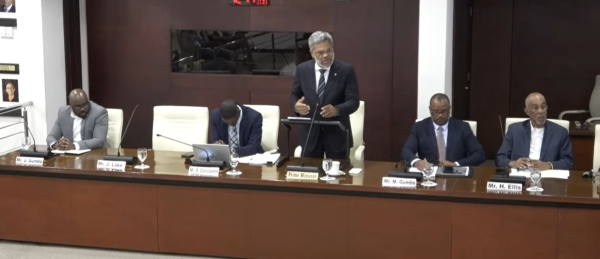
 PHILIPSBURG:--- Prime Minister Dr. Luc Mercelina on Friday defended the government's actions regarding NV GEBE, answering a series of questions originally posed nearly a year ago as Parliament resumed a long-delayed public meeting on the utility company's governance, finances, and operations.
The continuation meeting, first requested in August 2025, focused on concerns raised following the 2022 PricewaterhouseCoopers (PwC) review and the 2023 Integrity Chamber report. However, the Prime Minister's responses often referred to circumstances that existed when the questions were submitted, highlighting how significantly the situation at GEBE has evolved since then.
Perhaps most notably, the two temporary managers who were responsible for guiding the company through a difficult transition period have since resigned, with today, Friday, marking their final day in office. A new temporary manager has already been appointed, meaning that several operational matters discussed during the parliamentary session no longer reflect GEBE's present management structure.
Governance Concerns Remain Central
Responding to questions concerning the Integrity Chamber's recommendations, Mercelina acknowledged that GEBE did not have a dedicated compliance officer or confidential advisor during the period under discussion. Instead, compliance functions were being performed through the company's Internal Audit Department while discussions continued regarding the creation of dedicated positions.
The Prime Minister stressed that governance reforms have been ongoing, including the development of competency-based criteria for Supervisory Board appointments and efforts to strengthen transparency and accountability within the utility.
He further emphasized that responsibility for implementing many governance recommendations rests not only with the government, but also with GEBE's Supervisory Board and management.
New Supervisory Board, New Management Phase
Several parliamentary questions referred to previous boards and management structures that have since changed.
Mercelina noted that a new Supervisory Board has been appointed and that additional members are still expected to be recruited to complete the board's composition. He described the current board as possessing expertise in governance, finance, law, public administration, and business management.
The Prime Minister repeatedly reminded Members of Parliament that the government, as shareholder, cannot issue operational directives to GEBE management or the Supervisory Board under the country's corporate governance framework.
While the government may provide recommendations, expectations, and policy direction, operational authority remains with the utility's governing bodies.
Infrastructure Upgrades Near Completion
Among the more concrete updates provided was the status of a US$5.1 million infrastructure project aimed at improving the resilience of the electricity network.
According to the Prime Minister, the project, which includes installing underground electrical cabling to reduce vulnerability to storms and hurricanes, is approximately 99 percent complete.
Mercelina also addressed concerns regarding water losses within the utility network. Contrary to claims raised in Parliament that losses had reached 36 percent, he stated that verified figures placed non-revenue water at approximately 19.6 percent, a level he said falls within accepted international benchmarks.
To further reduce losses, GEBE has implemented leak-detection programs, smart-metering initiatives, and infrastructure-replacement projects.
Tariff Reform Still Under Review
A significant portion of the Prime Minister's presentation focused on tariff reform and regulatory oversight.
Mercelina confirmed that the government is moving forward with legislation aimed at strengthening the regulatory role of the Bureau of Telecommunications and Post (BTP) in utility oversight and tariff evaluations.
The Prime Minister said BTP has already developed a phased framework for future utility regulation and is expected to play a larger role in evaluating tariff methodologies and ensuring transparency.
He also disclosed that GEBE has undertaken a comprehensive tariff study intended to examine disparities between residential and commercial water rates and assess whether adjustments may be necessary in the future.
Fuel Supply Challenges Continue
The Prime Minister acknowledged ongoing challenges regarding fuel procurement and negotiations between GEBE and fuel supplier Sol.
According to Mercelina, efforts to negotiate a new fuel supply agreement were complicated by disagreements regarding transparency in fuel pricing components and cost structures.
The government is now examining longer-term strategies to reduce the utility's vulnerability to dependence on a single supplier while maintaining stability in electricity generation.
Clean Audits Following Cyberattack Recovery
Addressing concerns about delayed financial reporting, Mercelina stated that GEBE has completed its audited 2023 financial statements and is finalizing its 2024 accounts.
The delays were largely attributed to the 2022 cyberattack that severely disrupted the company's financial systems.
According to the Prime Minister, both audits resulted in clean opinions, signaling progress in restoring financial reporting and accountability.
Relief Measures Remain a Government Objective
The issue of consumer relief remained a recurring theme throughout the session.
Mercelina said the government continues to explore measures that could ease financial pressure on households and businesses struggling with utility costs. However, he cautioned that any relief initiative must be balanced against the utility's financial sustainability.
The Prime Minister indicated that both the Ministry of Finance and the Ministry of TEATT continue to evaluate options while awaiting further technical and regulatory assessments.
Debate Reflects Past and Present Realities
While Friday's parliamentary session provided answers to longstanding questions, it also underscored the challenge of discussing issues that originated nearly a year ago within a company that has undergone substantial changes.
Many of the questions posed by Members of Parliament were framed around circumstances that existed under previous governance and management arrangements. Since then, GEBE has seen changes to its Supervisory Board, the departure of its temporary management team, the appointment of a new temporary manager, and continuing efforts to reform governance and regulatory oversight.
As Parliament continues its examination of the utility company, attention is expected to shift from historical concerns toward the challenges and opportunities facing GEBE under its new leadership structure.