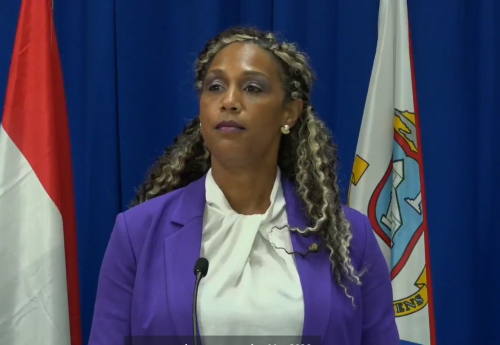
 PHILIPSBURG:--- Minister of Tourism, Economic Affairs, Transport and Telecommunication (TEATT) Grisha Heyliger-Marten defended the government’s ongoing cannabis legalization initiative on Wednesday, stating that the current administration inherited the framework and contractual obligations from a process initiated under the previous government in 2022.
The issue arose during the question-and-answer segment of Wednesday’s Council of Ministers press briefing, where the minister was asked about concerns surrounding the company involved in both drafting the cannabis legislation and potentially participating commercially in the future cannabis industry.
Responding to the questions, Heyliger-Marten clarified that the process did not originate under her administration.
“The process did not originate with me during my tenure,” the minister said. “It started in 2022 when the former government issued a bid specifically seeking a partner that could both assist with developing the legal and operational cannabis framework and potentially remain involved in the industry afterward.”
According to the minister, the original request for proposals (RFP) invited bidders to outline not only how they would assist with legislation and operational planning, but also their potential future investment and involvement in the cannabis sector.
The company Native Nations was ultimately selected under that process before the current administration assumed office.
“My administration inherited a project under that contract, and we continue to meet those obligations based on that contract,” Heyliger-Marten explained.
The minister acknowledged public concerns about potential conflicts of interest but stressed that the current government’s role has been primarily to continue and refine an existing agreement.
She added that her administration, alongside the Ministries of Justice, Finance, and VSA, negotiated additional benefits for the country as part of the ongoing framework discussions.
Those additions reportedly include a proposed US $750,000 contribution toward a local non-profit organization as well as the incorporation of agricultural development initiatives aimed at supporting local farmers and food production alongside the cannabis sector.
“We were able to negotiate additional benefits for the country,” the minister stated.
When asked what the government’s primary interest was in pursuing cannabis legalization, Heyliger-Marten indicated that the initiative serves both economic and judicial purposes.
“Based on what is there, based on what we received, it’s both for judicial and economic reasons,” she said.
The minister did not provide a timeline for when legislation could formally reach Parliament but indicated that government continues working within the framework established under the previous administration while seeking to maximize benefits and safeguards for St. Maarten.
The discussion surrounding cannabis legalization has generated increasing public debate in recent months as government continues examining regulatory, economic, agricultural, and law enforcement implications tied to a potential legal cannabis industry on St. Maarten.