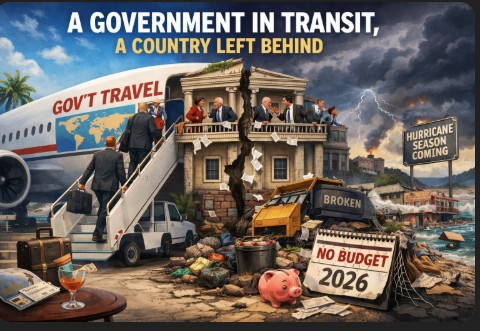
 PHILIPSBURG:--- While St. Maarten stands on the edge of another hurricane season, its leadership appears permanently airborne.
Since taking office, the URSM–PFP–DP–SAM coalition has cultivated a reputation not for governance, but for movement—constant, costly, and questionably productive movement. Almost weekly travel has become the norm for members of the executive branch, with delegations shuttling overseas under the banner of “meetings” that yield little visible return for the people they serve. Meanwhile, the business of running the country remains neglected, deferred, or outright ignored.
At the center of this dysfunction is a government that seems more preoccupied with internal conflict than national responsibility. The fractures are no longer whispers; they are glaring, public, and paralyzing. Coalition partners openly undermine one another. Ministers feud instead of functioning. Leadership appears absent, or worse, indifferent.
This is not governance. This is disarray.
For the first time since St. Maarten attained its constitutional status on 10/10/10, the Council of Ministers appears so deeply divided that cohesion has become impossible. Policies stall, priorities blur, and accountability evaporates. The result? A government that drifts while the people it was elected to serve are left to endure the consequences.
And endure what they do.
While citizens struggle with rising costs, limited opportunities, and basic service failures, those in power continue to enjoy generous salaries, per diems, and international travel perks. The contrast is stark—and insulting. It paints a picture of leadership detached from reality, insulated from the very hardships it was elected to address.
Parliament, rather than acting as a corrective force, has proven equally complicit. Instead of demanding results, many Members appear content with optics—photo ops, travel, and superficial engagement. Legislative productivity is virtually nonexistent. Not a single transformative law has emerged to improve people's lives or strengthen the country’s foundation.
The silence is deafening. The inaction, inexcusable.
Critical sectors are unraveling. At VROMI, even basic responsibilities—such as garbage collection contracts—have descended into chaos. Infrastructure is neglected. Equipment lies broken. Procurement processes fail. And as hurricane season looms just months away, essential preparations like trench cleaning remain undone.
There is no urgency. No plan. No accountability.
Even more alarming is the absence of a national budget for 2026. A government without a budget is a government without direction—a ship drifting without a compass. Yet Parliament remains eerily relaxed, as if the stakes were not existential.
Because they are.
If a catastrophic hurricane were to strike St. Maarten tomorrow, what would this government do? Scramble? Deflect? Or once again turn outward, cap in hand, seeking assistance that proper governance should have safeguarded against?
The uncomfortable truth is this: St. Maarten is being governed by a coalition that appears more invested in privilege than performance, more focused on appearances than outcomes, and more committed to survival than service.
Leadership is not about travel. It is not about titles or perks. It is about responsibility—especially in moments of uncertainty and risk.
Right now, that responsibility is being abandoned.
And the people of St. Maarten are paying the price.