Sint Maarten takes climate financing concerns to COP31 in Antalya.

Youth delegate Riddhi Samtani will discuss how islands can put climate data to work as a new study identifies five ways overseas territories could finance projects.

copi09112026PHILIPSBURG:--- Sint Maarten will bring its climate adaptation priorities to COP31 in Antalya, Türkiye, where youth delegate Riddhi Samtani is scheduled to speak about turning climate data into action. The island completed its first national climate adaptation report in 2026, setting out the risks it faces and priorities for protecting communities and the economy.

According to the EU-funded Green Overseas Programme, the report highlights Sint Maarten’s remaining 22.7 hectares of mangroves and the value of its coastal ecosystems, which provide services valued at more than US$76 million annually. The program estimates that about 80 percent of the economy depends on tourism, making coastal protection an economic priority as well as an environmental one.

Samtani is scheduled to speak at the Benelux Pavilion on November 13. She will also join Najannguaq Berthelsen of Greenland and Ilona Mayerau-Lonné of New Caledonia at the Climate Mobility Pavilion on November 16 to discuss climate vulnerability, biodiversity and gaps in funding for adaptation and disaster risk reduction. Mayerau-Lonné is also scheduled to speak at the France Pavilion on November 13 about how climate policy, jobs and investment can support one another.

Five ways territories could finance climate projects

The Green Overseas Programme, implemented by Expertise France, commissioned ODI Global to assess 18 financing mechanisms. The study identified five with potential for overseas territories. The program presented its findings at a four-day closing forum in Paris before taking them to COP31.

The program says many major international climate funds are structured around sovereign states. Overseas territories participate in the Paris Agreement through the countries to which they are constitutionally linked, and those countries’ income levels can affect access to financing even when a territory has substantial adaptation needs.

  • Green and blue bonds. Caribbean Utilities Company in the Cayman Islands raised US$50 million in 2024 for renewable energy, energy efficiency and climate adaptation projects.
  • Carbon markets. The study points to roughly 4,500 square kilometers of peatland in the Falkland Islands and extensive seagrass beds in New Caledonia and the Turks and Caicos Islands as opportunities to explore whether carbon finance could support conservation and coastal protection.
  • Conservation trust funds. Ascension Island established its AIMPACT fund with a £2 million endowment. In the British Virgin Islands, 40 percent of a US$10-per-passenger tourism levy goes to a trust fund supporting climate resilience and renewable energy. Niue’s program lets donors contribute NZ$250 to protect one square kilometer of ocean for 20 years.
  • Blended finance. Combining public, concessional and philanthropic funding can reduce risk for private investors. In the Caribbean, an EU-backed initiative is using this approach to support start-ups making commercial products from sargassum.
  • Environmental levies. Aruba collects a US$20 visitor contribution that provides a local revenue stream for climate infrastructure and conservation.

The study found that viable options depend on local laws, the capacity of institutions and financial markets, and the size of individual projects. Smaller investments can be especially difficult to finance when legal and technical work absorbs a large share of project costs.

“The funding exists. The challenge is to match OCTs with the right funding opportunities and build their capacity to turn priority projects into fundable proposals,” said Nicolas Andrade, the program’s project manager.

From adaptation plans to projects that can attract funding

Over six years, the Green Overseas Programme supported 31 projects in 23 territories. The work covered water security, coastal management, local food production, building efficiency, electric mobility and renewable energy, alongside training and policy studies.

In the Falkland Islands, where water demand in Stanley is projected to rise by 35 to 40 percent by 2050, the program helped assess the costs of developing groundwater supplies, building a river intake or installing desalination. On Ascension Island, a study identified about £87,000 in proposed investments that could raise local vegetable self-sufficiency to 65 percent. Those investments are awaiting funding.

In French Polynesia, researchers used public meetings and interviews to inform a study of future shoreline changes across six Tuamotu atolls and Pointe Vénus in Tahiti. In New Caledonia, the program helped develop a vehicle emissions label that lets buyers compare cars imported from markets with different rating systems. It also helped Greenland develop the evidence for its first climate strategy, including different approaches for towns connected to hydropower and settlements that depend on diesel.

At the Paris forum, the United Kingdom presented a separate £20.5 million pilot expected to begin in 2027. The three-year initiative is intended to help UK Overseas Territories develop climate projects that can attract investment. The EU has also proposed more than €999 million for its Overseas Countries and Territories under its 2028–2034 programming, with half earmarked for Greenland.

In Antalya, the program and its partners are scheduled to take part in sessions on climate finance, energy cooperation, youth-led climate action and the use of climate data in island planning. For Sint Maarten, the national adaptation report provides a local starting point for those discussions by identifying what needs protection and what the island stands to lose if its coastal ecosystems continue to decline.


Police investigate kidnapping of two men on Richmond Drive in Cole Bay.

kidnapping09112026COLE BAY:---  The Police Force of Sint Maarten (KPSM) is investigating the reported kidnapping of two men on Richmond Drive in Cole Bay on Monday, November 9, 2026.

Shortly after 2 p.m., Central Police Dispatch received several calls reporting that four men dressed in dark clothing and carrying what appeared to be long firearms had forcibly abducted two men. Callers said the suspects forced the men into vehicles and drove away in an unknown direction.

Several police patrols, detectives, and forensic personnel were immediately dispatched to Richmond Drive. At the scene, detectives took statements from several people who reportedly witnessed the abduction. Police also searched the surrounding area for the two victims and the suspects.

KPSM said the investigation remains ongoing and that officers are making every effort to establish the circumstances of the kidnapping and locate the two victims. Police said they will release further information as the investigation progresses.

Anyone who witnessed the incident or has information about the victims' whereabouts or the suspects is urged to contact police immediately.

  • Emergency — 911
  • Police station — +1 (721) 542-2222
  • Anonymous tip line — 9300

KPSM warned the public against approaching anyone believed to be involved because they may be armed and dangerous.

2027 budget under scrutiny as MPs press Gumbs for loan and tax reform timelines.

Sarah Wescot-Williams questions why capital projects keep rolling over, Darryl York seeks a date for gasoline relief, and Ardwell Irion asks who is leading the transaction tax review.

budgetreview09112026PHILIPSBURG:--- Members of Parliament pressed Finance Minister Marinka Gumbs on Monday, November 9, to say when the government could realistically secure its 2027 capital loan, which projects would be ready to start once financing was in place, and how its review of a financial transaction tax fits into the broader tax reform agenda.
The follow-up questions came after Gumbs outlined how Finance assesses capital projects and said the tax administration was still in the stabilization phase, with some work already underway to modernize the system. MPs Sarah Wescot-Williams, Darryl York and Ardwell Irion asked for details on how that work would translate into projects, legislation and relief that residents and businesses could count on.

Wescot-Williams questions why projects keep rolling over

Wescot-Williams said the government’s difficulty carrying out capital projects had persisted for years. She pointed to the timing of the 2026 budget, saying projects approved in October could hardly be expected to start and be completed before the end of the same year.

“Just moving the projects from year to year and just putting an amount in the budget and then looking for approval of the amount, I don’t think that we’re getting anything out of budgeting for capital projects the way we do it,” she told Parliament.

She asked whether the six financial considerations Gumbs had outlined were already being applied and how the government determines whether a project is ready to begin once money becomes available. Gumbs had explained that each ministry submits and justifies its own capital requests, while Finance evaluates whether the country can afford them. That assessment can include borrowing limits and liquidity, the reliability of cost estimates, how future maintenance will be paid for, procurement and implementation risks, and whether the project offers value for money.

Wescot-Williams also asked whether the government’s tax reform vision had been put in writing and sent to Parliament as a single document. She sought an update on how grants and loans provided to small businesses through the National Recovery Program Bureau’s enterprise support program were treated for tax purposes. She asked whether the issue had been resolved for businesses that had to register and file to qualify for support, and what options remained if it was still outstanding.

York presses for a 2027 loan timetable and a date for gasoline relief

York picked up the capital financing question, focusing on the 2027 borrowing request. He said the minister’s answers suggested work on several matters raised by the Board of Financial Supervision (Cft) was still incomplete. He asked when the government expected to finish that work and be in a position to submit its request.

York also asked what the Cft expects to see on new revenue and cost savings. He wanted to know whether the government must have specific measures worked out before submitting its request, whether a timetable would suffice, and whether those measures could require an amendment to the 2027 budget. Gumbs identified May, August and November as the periods when budget amendments could be made during the fiscal year.

York then challenged the timeline reported for gasoline price relief. He said he had heard Gumbs outline the steps taken so far but had heard no date on the floor of Parliament. After seeing a media report that referred to relief within three months, he asked whether the ministry had communicated that timeline separately and urged the minister to tell Parliament when motorists could expect relief. Irion followed up by asking whether the measure would be paid from a surplus, saying he had seen no allocation for it in the budget.

York also asked whether the government had assessed how changes to the room tax could affect boutique hotels and other small accommodations. He argued that smaller operators could be hit harder and asked what analysis the ministry had done.

Irion asks who is leading the transaction tax review

York and Irion both questioned whether Finance and the Ministry of Tourism, Economic Affairs, Transport and Telecommunication (TEATT) had enough staff to study a financial transaction tax while continuing work on the existing reform package. York asked whether the joint working group was already operating and whether the study could delay reforms already underway.

Irion raised a sequencing question. If TEATT sees a transaction tax as a way to reduce or replace other taxes, he asked whether Finance should first see the results of that research before proceeding with measures that could be affected. He also asked which ministry would lead the research and decide where it ranks among the government’s priorities.

Gumbs had told Parliament that the transaction tax remained under review and was behind existing legislative priorities. She said Finance was working to improve compliance and collect revenue already due under the law while preparing broader changes. For 2027, she listed improvements to the taxpayer register, a business taxpayer portal, better payment processing, filing relief for qualifying AOV pensioners, stronger reporting and a program to establish a baseline for tax compliance. She said an implementation date for broader changes to wage and profit taxes would follow the necessary assessments and policy decisions.

Irion also asked whether proposed procurement legislation discussed by MP Raeyhon Peterson had reached Parliament and what feedback it had received. Separately, he asked whether the government’s reporting obligations extend to donations, services and other in-kind contributions received through public-private partnerships.

The chair called a five-minute recess after the follow-up questions. At that point in the proceedings, Parliament was still waiting for answers on when the loan request could be submitted, which ministry would lead the transaction tax review, and when motorists could expect gasoline price relief.

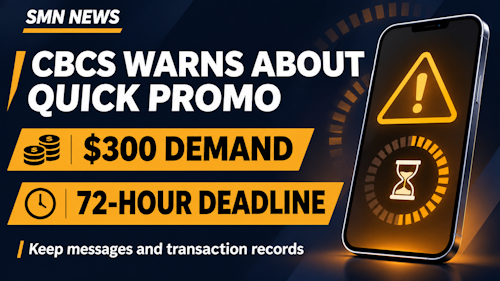
CBCS warns consumers regarding developments at Quick Promo.

quickpromo09112026Willemstad/Philipsburg:--- The Centrale Bank of Curaçao and Sint Maarten (CBCS) issued a warning to consumers after a recent message circulated on the platform Quick Promo.

The message requires participants to deposit an additional USD 300 within 72 hours to verify their account. It further states that those who fail to comply risk losing their accounts and, consequently, any funds they have already invested.
The CBCS views this development as a serious indicator that a pyramid scheme may be under financial strain and potentially on the verge of collapse. In such schemes, payouts to existing participants are typically funded by new participants' contributions. When the influx of new
capital slows down, difficulties in making payouts often arise.

Demanding additional deposits to pay out existing balances can indicate that the scheme can no longer meet its financial obligations. Making an additional payment offers no guarantee that previously invested funds can be recovered. On the contrary, consumers risk losing even more money.
The CBCS advises participants to keep all communications and transaction records and to resist pressure, whether in the form of short payment deadlines or threats about losing their funds.


Willemstad, November 9, 2026
CENTRALE BANK VAN CURACAO EN SINT MAARTEN

One victim found alive after Cole Bay kidnapping, police seek second man.

kidnapping11102026PHILIPSBURG:---  Detectives have found one of the two men kidnapped on Richmond Drive in Cole Bay on Monday, November 9, 2026, alive, the Police Force of Sint Maarten (KPSM) said. Information gathered during the investigation suggests the second man may also be alive, but detectives have not yet independently verified his whereabouts.

Acting on information obtained during the investigation, detectives searched an apartment in the Fort Willem area under the authority of the Acting Judge of Instruction. Police arrested one man in connection with firearm possession and seized evidence relevant to the kidnapping investigation for further examination.

KPSM said it was withholding further details because releasing them could compromise the ongoing investigation.

Police are asking the second man to contact them as soon as he is able so they can confirm his safety and whereabouts. They are also asking anyone who knows where he is or has been in contact with him since the kidnapping to come forward.

Anyone with information can call 911, the police station at +1 (721) 542-2222, or the anonymous tip line at 9300.


Subcategories