Roseburg pushes GEBE inquiry, consumer refunds and disconnection protections: “Who is protecting the people?”

MP presents draft reforms on utility charges, room tax and temporary contracts, challenging government to replace repeated promises with a coordinated legislative agenda.

roseburgbudget04112026PHILIPSBURG:--- MP Sjamira Roseburg has called on the government to pursue a court-backed inquiry into GEBE, establish clear protections against disconnection, and examine legislative changes to make fuel and utility charges transparent and independently reviewed.

Speaking during the 2027 budget debate, Roseburg said she had prepared draft legislation and a draft disconnection policy that she was willing to share with the responsible ministries.

Her contribution centered on using Parliament’s legislative role to help resolve problems rather than repeatedly describe them.

“Sitting still is not an option,” she said.

Roseburg also proposed increasing room tax from five to ten percent as an interim revenue measure, requested action on temporary employment contracts, and demanded a single legislative agenda showing which laws government intended to prioritize.

The proposals she described remain subject to review and the applicable legislative or policy processes. Her statement did not establish that the measures had been adopted.

GEBE and Sol: Time for an inquiry?

Roseburg renewed her request for an inquiry into GEBE, saying she had written to Prime Minister Dr. Luc Mercelina in May 2026 and received an August 5 response emphasizing due diligence and care.

She said she respected that position and gave the government time to proceed.

But she argued that continuing uncertainty surrounding the fuel clause, combined with consumers’ financial distress, made further action necessary.

Roseburg cited the BTP report, which said the fuel clause could not be validated, and asked whether the Council of Ministers’ position on an inquiry had changed.

She urged government, as GEBE’s sole shareholder, to use the legal route she identified rather than wait for the Public Prosecutor’s Office.

Her proposed inquiry would examine how fuel costs were calculated, what Sol charged GEBE, what the utility passed on to consumers, and how the relevant agreements were approved.

She also wanted scrutiny of fuel losses and how water-production costs were treated in electricity billing.

Those were questions Roseburg sought to have investigated. Her speech did not establish wrongdoing by particular individuals or companies.

Referring to reports that Sol had retained legal representation, she said the company was entitled to protect its interests.

“But who is protecting the people?” she asked.

Roseburg argued that seeking an inquiry should not be treated as an admission of government failure, but as a means of establishing responsibility for a longstanding problem.

Draft legislation would require closer scrutiny of charges

Roseburg outlined a draft involving changes to the electricity concession framework and price regulation.

As she described it, the proposal would enable maximum prices for fuel and associated storage and throughput charges, require detailed disclosure of underlying costs and strengthen review of changes to GEBE’s fuel clause.

She said changes would first have to be reported to BTP, which would help prevent unsupported adjustments.

Her proposal also contemplated an audit of the fuel clause dating back to March 2022, with amounts found to have been overpaid returned to consumers.

Roseburg said the draft included protections for vulnerable people.

She acknowledged that the text might require changes and offered it as a contribution to work already underway within TEATT, rather than a finished answer to every issue.

“It is a suggestion; it’s not perfect,” she said.

Roseburg calls for immediate relief alongside legislation

Roseburg argued that government should also examine what could be done under existing arrangements while preparing legislative changes.

She proposed requiring a detailed fuel-cost breakdown and using the government’s shareholder position to seek a reversal of the increase she referenced.

She also called for approximately 6.9 million to be returned to consumers through their bills.

That was Roseburg’s proposed response based on her reading of the available information. Her statement did not include a completed reconciliation establishing each consumer’s entitlement or confirm that government had approved refunds.

She further suggested revising the National Decree on Electricity Tariffs within three months.

Her broader position was that consumers should not have to wait for every legislative step before government examined the tools already available.

“Where is this disconnection policy?”

Roseburg pressed Mercelina over the continued absence, as she described it, of a clear, published disconnection policy.

She said a policy had been expected in June 2026 but had still not been provided.

“What is the holdup?” she asked. “Where is this disconnection policy?”

Roseburg said she had prepared a draft drawing on policies elsewhere in the Kingdom and was willing to make it available to GEBE.

She argued that customers needed to understand the circumstances in which disconnection could occur and the procedures that would apply.

Her proposed safeguards included specific consideration for seniors, vulnerable households and people whose medical needs made a loss of electricity particularly serious.

Pending adoption of a clear framework, she asked whether GEBE would stop disconnecting seniors and vulnerable households without an appropriate plan.

She linked the request to accounts raised by other MPs of residents struggling to meet basic living expenses.

One legislative agenda, with priorities and dates

Roseburg asked Mercelina to provide Parliament with a consolidated legislative agenda, even in draft form, before the second round of the debate.

She wanted one list covering the ministries, showing priority laws, their position in the drafting and advisory process and an estimated date for reaching Parliament.

Separate announcements that each ministry was working on legislation did not provide that overview, she argued.

“Without one agenda, we’ll be continuing being all over the place,” she said.

Roseburg also linked the agenda to deploying legislative lawyers and other support. A ranked list, she argued, would allow limited drafting capacity to be directed toward agreed priorities.

She offered her legal background and draft texts as additional assistance, saying government could review, amend or take over the initiatives where useful.

Room tax proposal would seek revenue while visitor levy is prepared

Roseburg questioned the timetable for the proposed visitor tax and suggested an interim increase in room tax from five to ten percent.

She said she had a draft available if the ministries had not already advanced the measure.

Roseburg proposed using the additional revenue for purposes such as cleaner neighborhoods or targeted assistance with household utility costs, including support for seniors and people receiving social assistance.

Those were possible uses she raised, rather than allocations already established in the budget.

She also said the rate could be reviewed when the broader visitor-tax legislation arrived to prevent overlapping charges.

Her questions to Finance and TEATT were whether the proposal formed part of their legislative priorities and whether they would support examining it.

Temporary contracts leave workers unable to plan

Roseburg asked for an update on temporary employment contracts, referring to advice she said she had sought from the Social Economic Council in December 2025.

She described young workers facing repeated short contracts, uncertainty about their employment and difficulty planning family life or obtaining a mortgage.

She also raised concerns about arrangements involving extended probation periods and workers without contracts.

Her contribution did not include individual employment files establishing the legal position in those cases. She used the examples to press VSA for the reform’s status and priority.

Roseburg said she had prepared a draft in this area as well and offered to assist if the ministry needed support.

SER delays are holding up legislation

Roseburg asked the Prime Minister for a concrete timetable to resolve outstanding SER appointments and restore the council’s full functioning.

She described its advisory role as important to the country’s institutional framework and warned that stalled advice was affecting legislative progress.

She referred to initiatives involving rental legislation, admission and expulsion rules, and the use of multiple judges in certain criminal cases.

Roseburg said some initiatives had been in the process since 2024 and 2025.

She questioned how MPs could explain ongoing delays to residents expecting solutions, while also emphasizing the need for a proper process.

She asked VSA when it had sent its request concerning minimum wage to SER and what alternative arrangements it was considering while the council’s functioning remained unresolved.

Screening legislation and police facilities

Roseburg requested an update on the screening legislation Mercelina had said he was working on.

She asked whether it was on the legislative priority list and when a draft could reach Parliament.

Her concern was the need for clear rules rather than uncertainty about the procedures applied when prospective ministers were assessed.

She also asked about assistance requested from the Netherlands in December 2025 concerning police facilities.

Roseburg cited leaks, mold, and criticism of holding cells, and asked for an update on the assistance and what resulted from it.

Justice back pay, second chances and victim support

Roseburg asked Justice to confirm the November 30, 2026 deadline she said had been provided for written clarity on completed personnel files and the timing of back-pay payments.

She also requested the promised staffing plan.

Turning to the Crime Fund, she questioned whether an updated project plan was being prepared and whether resources could support second-chance employment and training initiatives in cooperation with VSA and businesses.

She asked whether the second-chance project carried forward from 2026 had started and, if not, when implementation would begin.

Roseburg also sought updates on the Drive Safe campaign, the tourist-police pilot and whether officers under that proposal would be armed.

On criminal procedure reform, she asked whether the first-quarter 2027 timetable still applied.

She questioned the adequacy of victim compensation arrangements, citing the maximum amounts described in her statement and asking whether the advance-payment mechanism could be expanded.

Her concern was that victims could face further hardship when people ordered to compensate them lacked the means to pay.

Breakfast assistance needs a lasting plan

Roseburg asked ECYS what would happen to approximately 60 children benefiting from a school breakfast initiative when its existing funding was exhausted.

She referred to a 50,000-guilder allocation supported through a 2025 motion and said the initiative was in its second year.

She requested clarity on whether a structural breakfast program was in place and what alternative would protect the children if the current funding ended.

She also requested an evaluation of the CRT pilot as it approached its first year in December, including whether it would incorporate role models and mentorship.

Separately, she raised concern about an electricity disconnection affecting a food-assistance provider and the potential loss of food intended for vulnerable residents.

She said she understood a temporary arrangement had been found but wanted the lasting solution explained.

Garbage tender: Explain the process in plain language

Roseburg asked VROMI Minister Patrice Gumbs Jr. for a step-by-step explanation of the garbage collection tender process.

She wanted to understand how the previous procedure worked, how the current electronic system operated, and what the terminology displayed to bidders meant.

She referred to public screenshots and reports of messages using words such as “winner” and “awarding,” while emphasizing that she did not want to rely on hearsay.

She asked the minister to explain the difference between the system’s messages and the formal decisions the government had taken.

She did not declare that the screenshots proved contracts had been awarded.

Roseburg also requested progress on the illegal-dumping motion she had brought with MP Sarah Wescot-Williams, including signs and a reporting tip line.

Her closing message returned to the approach she had outlined at the start: Parliament should scrutinize government, but MPs could also contribute draft solutions.

She said the texts she had prepared could be reviewed and adjusted to help move the work forward, and she awaited ministers’ responses to both her questions and her offers of assistance.
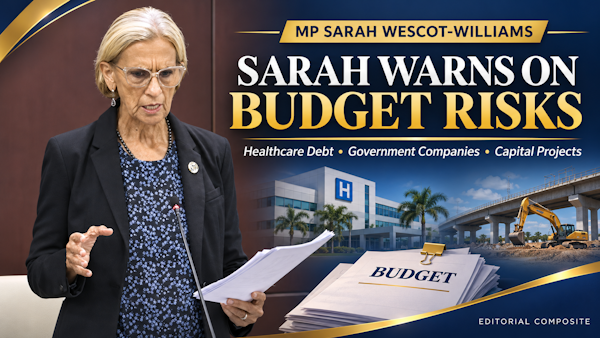

Wescot-Williams warns government: financial risks cannot keep being pushed into the next budget.

DP leader demands answers on capital projects, healthcare debt and government-owned companies, urging Cabinet to confront the CFT’s advice on the 2027 budget itself.

sarahbudgetrisks04112026PHILIPSBURG:---  Democratic Party leader MP Sarah Wescot-Williams has warned that St. Maarten cannot continue preparing budgets without fundamentally addressing healthcare liabilities, financially troubled government-owned companies and the country’s limited cash position.
During the 2027 budget debate, Wescot-Williams urged ministers to move beyond the controversy surrounding the CFT’s assessment of the adopted 2026 budget and explain how they intended to address the supervisory body’s concerns about the draft now before Parliament.

“What about the CFT’s advice on the budget, which is before us?” she asked.

Her intervention challenged the entire Council of Ministers to produce a collective financial strategy, rather than leave successive Finance Ministers defending budgets constrained by the same unresolved problems.

“If you don’t take action now, everything is going to run out on you,” she warned.

The warning concerns 2027, too

Wescot-Williams distinguished between the CFT’s advice on the draft 2026 budget and its subsequent assessment after parliamentary adoption.

She argued that the concerns about healthcare funds and government-owned companies were longstanding, recalling supervisory warnings dating back to approximately 2015.

But her central concern was the advice on the draft 2027 budget.

Reading from that advice during her contribution, she said several budget components required amendment and that considerable risks involving healthcare funds, government entities and liquidity needed to be incorporated.

She also cited the CFT’s acknowledgment that government recognized the risks and had begun addressing them.

According to the passage she read, the supervisory body wanted continued engagement to improve public finances and avoid advising the Kingdom Council of Ministers to issue a new formal instruction.

Wescot-Williams presented that as a warning requiring action. She did not say a new instruction had already been issued.

Her demand was for the government to explain how it would prevent the risks identified in the advice from continuing to undermine its financial plans.

Where do the capital projects come from?

Wescot-Williams asked Finance Minister Marinka Gumbs to explain how projects entered the capital budget.

Who submitted them? What requirements did they have to meet? And how did government establish that they were ready to proceed?

She said an earlier request to identify “shovel-ready” projects had not produced an answer.

That distinction mattered, she argued, because projects expected to receive financing late in 2026 needed to be sufficiently prepared to allow execution within the remaining time.

“I want the government, I want the ministers to explain how we come to capital projects in a budget,” she said.

Wescot-Williams suggested government produce a clear public explanation of the budget preparation process, similar to Parliament’s educational videos.

Her concern was that including a project in a budget did not, by itself, demonstrate that its preparation, financing and implementation requirements had been met.

“We cannot continue like this,” she said.

Healthcare debt remains a structural threat

Wescot-Williams questioned whether general health insurance would be enough to resolve the country’s financial and healthcare pressures.

She acknowledged that reforms and additional visitor revenue could help but challenged the government to explain the scale of the problem they would actually address.

“They’re going to fill a hole, but how much of a hole?” she asked.

She referred to the repeated appearance of SZV-related debt and healthcare risks in budget discussions.

Her argument was that liabilities could not remain a recurring warning without a broader decision about the system's sustainability.

Wescot-Williams asked whether St. Maarten could continue with its current healthcare model or should explore closer alignment with a larger healthcare institution or organization.

She framed the issue around the care residents could realistically receive as costs increased.

Her remarks were a call for strategic assessment, not an announcement that the government had decided to replace the existing system.

Government companies require solutions

Wescot-Williams said the CFT referred to PSS, Telem and GEBE as insolvent entities and was seeking solutions.

She presented that characterization through her account of the supervisory advice.

She challenged the government to explain how it would address the financial risks of its companies and reflect them in the country’s wider financial picture.

She also requested the agreement involving government and GEBE for the generators, which she understood was being signed that evening.

Whether the arrangement was a purchase, lease-purchase or another form of agreement, Parliament should receive it, she said.

Her request linked a major investment decision to the need to scrutinize the utility’s obligations and the government’s financial exposure.

Recovery funding cannot carry the country indefinitely

Wescot-Williams placed the debate within the longer history of St. Maarten’s financial pressures.

She recalled that problems involving tourism growth, immigration, crime and traffic were already prominent before Hurricane Irma.

The hurricane was followed by recovery funding, and the COVID period brought additional lending and the country package.

She argued that successive governments had continued operating with the support of those arrangements without resolving enough of the underlying problems.

Her criticism focused on the danger of letting temporary or exceptional support substitute for sustainable revenue and spending decisions.

Cabinet must return with a collective position

Wescot-Williams asked when a 2027 budget amendment would address measures she identified as absent from the draft, including gambling taxation, formal tax-law revisions and withholding relating to political officeholders.

She also requested a clearer assessment of government’s liquidity.

Parliament’s duty to scrutinize that position applied regardless of political affiliation, she said.

“Opposition? Coalition? In between? Both sides? Whichever one. We got a duty in here.”

Wescot-Williams argued that unless fundamental issues changed, future Finance Ministers would encounter the same pressures and public backlash.

She urged the Council of Ministers to return together with a realistic account of its direction for the country.

As the administration approached the midpoint of its term, she said, the government needed to take stock of both its starting position and the decisions still required.

“I would really like the Council of Ministers to come back and together give us something,” she said — something reflecting what ministers collectively envisioned for St. Maarten’s future.

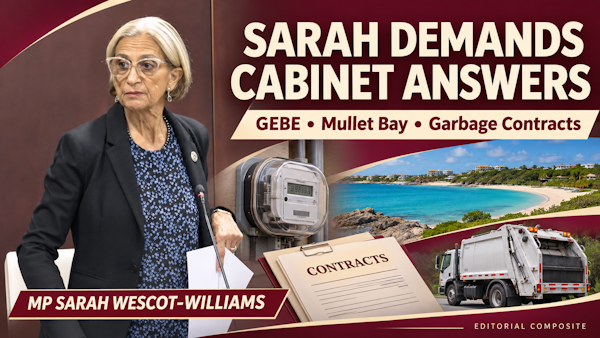
Wescot-Williams demands cabinet answers on GEBE, Mullet Bay and three-year garbage contracts.

DP leader seeks a public-private partnership policy, questions whether waste contracts allow investment recovery and presses ministers for specific answers instead of broad assurances.

sarahgebe04112026PHILIPSBURG:---  MP Sarah Wescot-Williams has demanded a coordinated government response to unresolved questions involving GEBE, Mullet Bay, garbage collection contracts and public-private partnerships, telling ministers that broad explanations are not enough.
During the 2027 budget debate, the Democratic Party leader said she wanted to direct her questions to government collectively, rather than allow issues spanning several portfolios to remain divided among individual ministers.

“I want to direct them to the government,” she said. “And I expect answers from the government.”

Her contribution combined requests for documents with questions about how policy decisions were being implemented.

GEBE recommendations: Answer each question

Wescot-Williams requested detailed responses to her letter to Prime Minister Dr. Luc Mercelina, TEATT Minister Grisha Heyliger-Marten, and VROMI Minister Patrice Gumbs Jr. on implementing the RAC/BTP recommendations.

She wanted each responsible minister to explain which actions could be taken.

“Can you do A, can you do B, can you do C, can you do D,” she said, illustrating the level of specificity she expected.

She also requested the agreement between the government and GEBE for the generators, which she understood was being signed that evening.

Parliament needed to know the nature of the arrangement, she argued, rather than rely solely on announcements about the investment.

Are three-year garbage contracts financially realistic?

Wescot-Williams questioned whether a three-year contract term made sense for garbage collection services requiring substantial investment.

Her concern was not which company received a contract, she said, but whether the duration allowed an operator to recover the expenditure necessary to provide the service.

She questioned whether some investments could be recovered even within five years.

Wescot-Williams said she had previously raised the issue with Gumbs and understood that a report had been received or was expected that supported reconsidering the approach.

She asked whether its findings could influence the process currently underway.

Her contribution did not include a financial model establishing an appropriate term. It challenged the minister to explain how contract duration aligned with investment requirements and the available advice.

Public-private partnerships need a policy

Wescot-Williams asked VROMI to provide its public-private partnership policy.

She noted that such partnerships formed part of the governing accord but argued that an agreed political objective still needed an underlying framework.

“Do you have a public-private partnership policy?” she asked. “And if so, please share it.”

Her request sought the rules by which government would assess, approve and manage the arrangements.

It came amid wider parliamentary scrutiny of privately financed public infrastructure projects.

Wescot-Williams did not suggest rejecting every partnership. She demanded the policy needed to explain how they were being pursued.

Mullet Bay: What has government actually agreed?

Wescot-Williams sought a fuller account of the Mullet Bay process.

She questioned the relationship between litigation involving Sun Resorts, an appeal, and the parties she understood were expected to cooperate with government on the matter.

She also revisited an earlier answer stating that Sun Resorts had submitted a draft zoning plan.

According to her account, the response referred to Mullet Pond as a buffer, public beach access and the golf course.

But she said her questions about the road and the government’s position concerning the property had not been directly answered.

She wanted ministers to address those points rather than repeat the general conditions surrounding the zoning proposal.

Her statement did not include the court judgment or the full agreements. Her intervention sought clarification of the policy and legal position.

Road Fund explanations have left her confused, too

Wescot-Williams joined other MPs in demanding clarity on the Road Fund.

“I too kind of lost it in the articles,” she said.

She requested a clear explanation rather than expecting Parliament to reconcile different public statements.

Wescot-Williams also asked how zoning decisions would be handled while the country awaited a broader zoning framework.

She sought confirmation of whether an agreement with VNG International was in place.

Her questions reflected broader concern about the rules guiding current decisions while longer-term plans and staffing arrangements were still being developed.

Vehicle registration and wreck removal need follow-through

Wescot-Williams asked whether government considered vehicle registration a sufficient priority to act on it across traffic management, crime and abandoned vehicles.

If it was a priority, she wanted to know what remained necessary to get the work done.

She welcomed the vehicle-wreck collection tender but asked whether the program could now be executed.

Referring to Orange Grove Road, she described one abandoned vehicle being stripped, removed, and then replaced by another undergoing the same treatment.

“We can’t continue like this,” she said.

She also requested progress on administrative enforcement, linking the issue to the government’s ability to act on persistent problems in public spaces.

Community fund requires more than a promise of discussions

Wescot-Williams asked VSA for more detail on the community-driven fund proposed through an earlier parliamentary motion.

She said the response referred to discussions with SMDF and the development of a strategic plan.

She wanted concrete information about how the proposal would be worked out.

Wescot-Williams described the initiative as a reduced version of her earlier smart-city and smart-district ambitions.

She thanked VROMI for supporting the motion but emphasized that the revised proposal still needed implementation details.

Healthcare referrals and senior care need a clearer framework

Wescot-Williams asked VSA whether St. Maarten had a strategic agreement with Colombia concerning medical referrals.

Referring to an arrangement she said Curaçao had entered into, she asked whether a similar approach would suit St. Maarten.

She also sought clarity on the Social Registry Program and senior care.

On professional regulation, she asked whether government still intended to pursue BIG legislation or would limit its approach to the Healthcare Professionals Registration framework discussed in the debate.

Those questions sought the ministry’s policy direction rather than assuming that the different arrangements were equivalent.

Regional cooperation: Give a yes-or-no answer

Wescot-Williams said the replies had not made the government’s position on regional cooperation sufficiently clear.

She referred to an internal note mentioned in the answers but asked whether government intended to continue pursuing associate membership with organizations including CARICOM.

“Yes or no?” she asked.

She also welcomed Heyliger-Marten’s engagement with charter operators over Anguilla’s policies and requested similar attention to French-side rules affecting charters from Dutch St. Maarten.

On the Simpson Bay Lagoon, she asked who managed it, how the arrangement worked and what income it generated.

She also questioned whether fees were charged for the Causeway Bridge and, if so, who collected them.

Cannabis confidentiality advice must be shared

Wescot-Williams requested the status of legal advice concerning confidentiality in the cannabis matter.

If Parliament had received the advice, she asked whether It could obtain it.

The request sought clarity on the legal position governing access to information, rather than relying on a general reference to confidentiality.

Legislative support and classroom devices also draw questions

Wescot-Williams asked Mercelina how the proposed legislative pool involving BZK would operate.

She wanted clarity on recruitment, funding and the placement of lawyers within St. Maarten’s administration.

She also requested an ECYS update on the discussion about devices in classrooms.

Rather than automatically copying restrictions adopted elsewhere, she supported examining how devices could be used more effectively for education and asked what follow-up had occurred.

Lewis intervenes, but Wescot-Williams clarifies the timing

MP Lyndon Lewis interrupted to question why the President of Parliament appeared to be seeking so many answers from coalition ministers.

Wescot-Williams acknowledged that ministers did not always respond promptly to MPs.

But she clarified that the letters she had just listed were recent and that she had emailed them directly because official transmission could take time.

That distinction prevented her requests from being read as proof that every letter mentioned had been ignored for an extended period.

Her demand remained for responses precise enough to permit follow-up.

If an idea could not be pursued, she argued, ministers should say so. If it could be examined, they should explain the next step and give a timeframe.

As government approached the midpoint of its term, Wescot-Williams urged Cabinet to review the governing accord and identify which commitments had been completed, which were underway and which remained ahead.

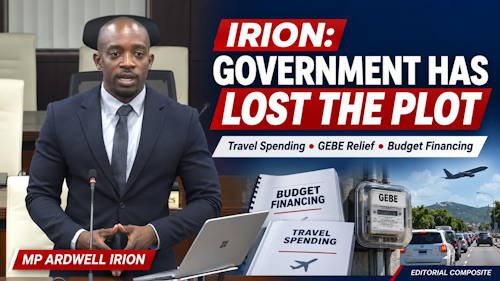
Irion: Government has “Lost the plot,” warns he will not support budget without travel amendment.

Former Finance Minister challenges spending priorities, demands collection of outstanding revenues and offers to help address CFT concerns before Parliament approves the 2027 budget.

irionbudget0411202026PHILIPSBURG:---  National Alliance Member of Parliament Ardwell Irion delivered a sweeping attack on the government’s 2027 draft budget, accusing ministers of increasing travel spending while households struggle with electricity bills, rising living costs, traffic congestion and inadequate public services.

The former Finance Minister warned that his support would depend on an amendment addressing travel expenditure. He also questioned whether the government could secure financing for its capital projects without first resolving concerns raised by the Committee for Financial Supervision, known as the CFT.

“I believe that this government has totally lost the plot,” Irion said.

But alongside his criticism, Irion offered to work with Finance Minister Marinka Gumbs and other officials during the budget proceedings to strengthen the document, adjust projects and address outstanding financial questions before its approval.

Travel spending becomes a condition for support

Irion argued that the government’s spending priorities failed to reflect the financial pressure facing residents.

He contrasted what he described as repeated increases in travel allocations with constrained resources for vulnerable groups and the Justice Ministry. His central objection was that ministers appeared unwilling to accept the same financial discomfort being experienced throughout the community.

“I'm not going to support the budget if there's not some type of amendment when it comes to travel,” he said.

According to Irion, both he and MP Francisco Lacroes had previously pursued amendments to reduce travel spending during the 2026 budget process.

He acknowledged that external developments, including war, contributed to rising living costs. Nevertheless, he maintained that the government remained responsible for deciding how to allocate the money available to it.

Residents, he said, were being pushed into increasingly difficult circumstances while government spending continued without sufficient adjustment.

Civil servants deserve credit; ministers must answer for policy

Irion expressly separated his criticism of the budget’s priorities from the work of the civil servants who prepared it.

He acknowledged improvements in the quality of the budget and credited Minister Gumbs with continuing that trajectory. He also recognized its timely presentation.

However, he rejected the suggestion that criticism of the budget amounted to criticism of public servants.

“The civil servants are not responsible for the vision and the decisions of the leadership of the government,” he said.

Irion thanked personnel working under staffing constraints, including those handling payments and senior officials carrying multiple responsibilities. He argued that ministers could not continually increase administrative demands without ensuring that departments had sufficient personnel.

He also questioned what had happened to earlier initiatives involving corporate governance training, youth entrepreneurship and financial literacy. He asked whether these programs had been discontinued, reduced or simply omitted from the government’s presentations.

GEBE relief requires an actual funding plan

Electricity costs formed a central part of Irion’s intervention.

He said the ministerial presentations did not provide a convincing, coordinated plan to reduce the burden of GEBE bills. To illustrate the pressure on families, he recounted an encounter involving a minimum-wage household where, he said, a child was seeking work to help meet household expenses.

Irion challenged the government to explain whether lowering electricity bills would require a cash injection and, if so, where that money would come from.

He asked whether the 2027 budget contained a specific plan to subsidize fuel costs, rather than merely suggesting that relief might become possible.

He also challenged the Finance Minister’s explanation of a larger projected surplus. In his assessment, part of the improvement reflected an accounting movement between operating and capital expenditure rather than additional cash available for spending.

If a surplus could support fuel relief in 2027, he asked, why could the government not provide assistance under the existing budget?

His broader argument was that an accounting surplus and money available to pay bills were different matters.

Redirect some generator funding into solar, Irion proposes

Irion renewed his opposition to the government financing the full generator investment he described as approximately 72 million guilders.

He proposed retaining part of the available capital for solar projects and having GEBE finance a portion of its own generators, subject to its ability to do so.

His suggested investments included solar installations on government buildings, schools and parking facilities.

Irion argued that the government should pursue projects capable of producing benefits sooner, rather than relying exclusively on a generator program that, in his assessment, would take years and would not automatically reduce customers’ bills.

He also asked Prime Minister Dr. Luc Mercelina for a written explanation of GEBE’s financial capacity to invest in solar energy.

Following reports of GEBE visiting solar companies, Irion wanted to know whether the utility had the liquidity to execute such investments in 2027. He warned against creating expectations without identifying the funding needed to deliver them.

Collect outstanding revenue before imposing additional charges

Irion urged the government to intensify collection of existing revenues before introducing further burdens on residents.

He focused on casino and lottery-related fees, as well as outstanding long-lease payments.

Recalling his tenure as Finance Minister, he said agreements had been reached requiring gambling operators to pay current obligations and address arrears. He maintained that the possibility of losing their licenses had encouraged payment.

He asked Minister Gumbs how much was collected in 2023, how much remained outstanding and whether enforcement had continued.

Irion also alleged that political relationships with some businesses had weakened the coalition’s willingness to pursue outstanding payments. He claimed that campaign support had come with expectations of reduced scrutiny. Those allegations were not substantiated with documentary evidence in the remarks provided.

His policy demand was that businesses with outstanding obligations should be pursued before the government placed additional pressure on households.

Long-lease arrears and the Road Fund

Turning to VROMI Minister Patrice Gumbs Jr., Irion questioned why an earlier long-lease collection initiative had, according to him, been stopped.

He estimated that outstanding payments could amount to approximately 20 million guilders and said some commercial obligations dated back several years. He requested an official accounting from the government.

Irion argued that stronger collection could help finance road improvements and reduce the pressure on the Finance Ministry to identify money elsewhere.

He also questioned whether the Road Fund would be executable if the associated capital financing did not materialize.

The issue, he said, was whether the promised road program had dependable funding behind it.

Irion further asked whether VROMI had coordinated with Justice to identify land for storing confiscated vehicles and scooters. He questioned the use of government long-lease land by entities advertising property for rent and requested accountability over its allocation and use.

On proposed tipping fees at the landfill, he acknowledged that waste services would eventually require payment. However, he argued that introducing another charge was difficult to justify while existing revenue sources remained insufficiently pursued.

CFT concerns must be addressed before approval

Irion warned that Parliament should not approve a budget full of capital projects without resolving questions about their preparation and financing.

Referring to CFT correspondence, he said concerns included the reliability and explanation of budget figures, expenditure substantiation, government liquidity and the readiness of capital projects.

He argued that ministers should provide drawings, construction estimates, realistic schedules and clear execution plans before projects were included for financing.

Irion questioned the wisdom of taking on additional borrowing when projects were delayed. He cited interest expenditure that he said stood at approximately 5.5 million and could increase further in 2027, asking the government to explain the cost of financing projects that were not being executed.

He offered to support amendments removing insufficiently prepared projects or adding the information needed to strengthen their justification.

“What can we do to address the concerns of CFT?” he asked.

Irion warned that unresolved issues could jeopardize financing and potentially lead to a formal instruction. These were his warnings about possible outcomes; his intervention did not establish that the 2027 budget had already been rejected or that an instruction had been issued.

Wescot-Williams challenges political labeling

An interruption came after Irion referred to a CFT board appointment in political terms.

MP Sarah Wescot-Williams said she agreed with several of his substantive points but objected to labeling individuals appointed in a professional capacity.

She urged MPs to respect the professionalism of board members regardless of their political affiliations.

Following the interruption, Irion returned to his concerns about financing and repeated his offer to assist the Finance Minister in addressing them.

He also questioned the proposed purchase of the TeleM building, asking where the acquisition appeared in the capital budget and what would happen if the required financing was unavailable.

He requested clarity on whether the CFT had provided positive advice on financing the revised 2027 capital program.

Healthcare payments and SZV sustainability

Irion asked the Finance and VSA ministers for a year-by-year breakdown of government payments to SZV, including percentage increases from 2022 through the proposed 2027 budget.

He referred to reports of unpaid physiotherapists and other healthcare providers and asked whether government payment delays were contributing to those difficulties.

He also questioned the status of an earlier agreement concerning approximately 95 million guilders in government obligations to SZV. According to Irion, the previous administration had agreed on the amount, but the current government had reopened the process.

He warned about the longer-term sustainability of social health insurance financing and asked VSA Minister Claret Connor for an update on General Health Insurance legislation, any proposed changes and its anticipated parliamentary timetable.

His warning about possible funding problems by 2029 was presented as a concern he attributed to financial reports, rather than a confirmed date on which SZV would cease operating.

Schools, procurement and basic services

Irion questioned ECYS Minister Melissa Gumbs about the proposed Educational Care Center, including staff status, the official staffing structure, funding arrangements and its relationship with the Student Support Services Division.

He also sought answers about a social worker vacancy, the availability of psychologists and the impact of staffing gaps on services.

Supporting concerns previously raised by MP Darryl York, Irion questioned obstacles facing MPs who wanted to assist public schools.

He said reports of parents purchasing toilet paper and schools selling pizza to finance basic necessities showed that essential needs were not being met.

He requested an update on education personnel placement and asked why earlier work had not resulted in implementation.

Separately, he challenged the procurement arrangements for work in Sucker Garden and asked whether the entity involved had begun construction before obtaining a building permit. These were questions and allegations raised during his intervention, not established findings of procurement or permitting violations.

He also requested an update on landfill-related litigation and outstanding payments, as well as the building and civil works permits for the prison project.

An offer to help, coupled with a demand for accountability

Irion closed by questioning why ministers were not making greater use of legislative proposals prepared by MP Sjamira Roseburg.

He argued that the government should examine work already available instead of repeatedly presenting legislative capacity as an obstacle.

Throughout his intervention, he described the administration’s central weaknesses as a lack of unity, decision-making and execution.

His challenge to Minister Gumbs was to hold her colleagues accountable for supplying information, collecting revenue and preparing projects that could actually be delivered.

Despite his criticism, he repeated his willingness to assist.

For Irion, the test of the 2027 budget was whether it could produce practical improvements in electricity costs, roads, schools, healthcare and public safety—and whether ministers were prepared to adjust their own spending to make those improvements possible.

Irion challenges government: Collect from the “Big Fish” before burdening struggling residents.

Former Finance Minister demands answers on gambling-sector arrears and long-lease collections, alleging political connections are weakening enforcement while ministers complain about insufficient funds.

ardwellbigfish04112026PHILIPSBURG:---  National Alliance MP Ardwell Irion challenged the government to pursue outstanding payments from businesses and government landholders before imposing additional charges on residents, accusing the coalition of failing to collect revenues already within its reach.

During the 2027 draft budget debate, the former Finance Minister directed pointed questions at Finance Minister Marinka Gumbs and VROMI Minister Patrice Gumbs Jr. over gambling-sector obligations, commercial long-lease arrears and the financing of the proposed Road Fund.

His argument was direct: ministers cannot credibly plead financial hardship while leaving existing obligations uncollected and asking struggling households to carry more of the burden.

“Why put pressure on the small man when you're not willing to go after the donors?” Irion asked.

Irion alleged that political relationships with some businesses had affected the government’s willingness to enforce collection. He did not present documentary evidence of those alleged arrangements during his remarks.

Gambling-sector collections under scrutiny

Irion demanded a detailed explanation of how much casinos and lottery companies owe the government and what the Finance Ministry is doing to recover those amounts.

He recalled that, during his tenure as Finance Minister, operators were required to address both their current fees and accumulated arrears.

According to Irion, the previous administration made clear that political support did not exempt a company from meeting its financial obligations.

He described an encounter in which an operator said he was supporting his party. Irion said he responded that the company still had to pay its fair share so the government could support the people of St. Maarten.

He maintained that the threat of license withdrawal produced payments within a short period and urged the current minister to consult collection officials about the results.

Irion asked how much money had been collected in 2023, how much remained outstanding and whether those collection arrangements were still being enforced.

His challenge went beyond identifying another potential revenue measure. He wanted the minister to explain what had happened to an enforcement approach that, he said, had already produced results.

Allegations of political protection

Irion alleged that some coalition parties were supported by gambling interests and were consequently reluctant to pursue them.

He further claimed that campaign contributions in 2024 had come with expectations that certain businesses would no longer face the same scrutiny.

Those claims remain allegations made by the MP. His intervention did not establish that any particular company had secured an exemption, that a specific donation was unlawful or that a minister had entered into such an arrangement.

Nevertheless, Irion placed a clear question before the Finance Minister: are all businesses being held to the same collection standards?

He argued that government revenue policy would lack credibility if residents faced additional demands while politically connected businesses were allowed to leave obligations outstanding.

Long-lease arrears could help finance roads, Irion argues

Irion also challenged VROMI Minister Patrice Gumbs Jr. over collecting payments for government land issued under long leases.

He alleged that an initiative begun under the previous administration had been stopped and asked the minister to explain why.

According to Irion, the earlier process had identified significant arrears, including commercial obligations dating back to 2018 and 2019. He said officials had already prepared lists of major outstanding accounts and payment commitments.

Irion estimated that approximately 20 million guilders could now be outstanding. That figure was his estimate; he requested an official accounting from the government.

He questioned why the VROMI Minister was seeking approximately five million for the Road Fund while, in his assessment, substantial revenues associated with his own ministry remained uncollected.

“Have you contacted the Minister of Finance in the last year and said, ' Hey Minister, I want to stop this project '?” Irion asked, referring to the earlier collection initiative.

He argued that recovering outstanding long-lease payments could help finance public infrastructure and reduce pressure on other government resources.

Finance Minister urged to hold colleagues accountable

Irion described the public disagreement over Road Fund financing as embarrassing and urged Minister Marinka Gumbs to exercise firmer financial leadership within the Council of Ministers.

He noted that ministers repeatedly told Parliament they lacked money to execute their plans.

But he argued the Finance Minister should not be left responsible for finding additional resources while other ministries failed to pursue revenues or provide the information needed to support their requests.

His challenge was for the minister to hold her colleagues accountable for both sides of the budget: what they wanted to spend and what they were doing to collect.

Irion also questioned whether the Road Fund could operate without securing the associated capital financing.

The government, he argued, needed to explain whether the road program had a dependable funding source, rather than leaving Parliament to approve allocations whose execution remained uncertain.

Tipping fees questioned amid collection concerns

Irion questioned the proposed introduction of tipping fees at the landfill while other revenue avenues remained insufficiently pursued.

He acknowledged that waste services would eventually require payment and did not reject the principle of charging for waste management.

His objection concerned timing and fairness.

Residents already facing high electricity bills and rising living costs should not be asked to absorb another burden before the government demonstrated that it had seriously pursued outstanding payments elsewhere, he argued.

For Irion, collecting existing obligations from businesses with the means to pay should come before placing additional pressure on households.

Government land must serve public needs

Irion extended his criticism to how government land is allocated and used.

He asked whether VROMI had consulted the Justice Ministry about land needed to store confiscated vehicles and scooters.

At the same time, he questioned reports of entities holding government land on long leases and advertising property for rent.

He challenged the minister to explain those arrangements and whether the land was being used consistently with the purpose for which it had been issued.

His questions highlighted what he portrayed as a failure to coordinate scarce public resources: Justice was identifying a practical land need while other allocations continued.

The remarks did not establish a legal violation in any specific lease arrangement.

A demand for figures and enforcement

Irion’s intervention emphasized collection records, outstanding balances, and ministerial decisions.

He asked the government to account for gambling-sector revenues, explain the status of long-lease enforcement and demonstrate how promised road improvements would be funded.

He also challenged the administration to show that collection policy applied consistently, regardless of a debtor’s political relationships.

With ministers citing limited resources and residents struggling to meet basic expenses, Irion argued that the government’s first responsibility was to pursue money already owed.

His message to the Finance Minister was to stop accepting insufficient funds as the end of the discussion—and to require her colleagues to explain what they were doing to bring those funds in.


Subcategories