Minister: Police cannot compel blood tests after suspected impaired-driving crashes.

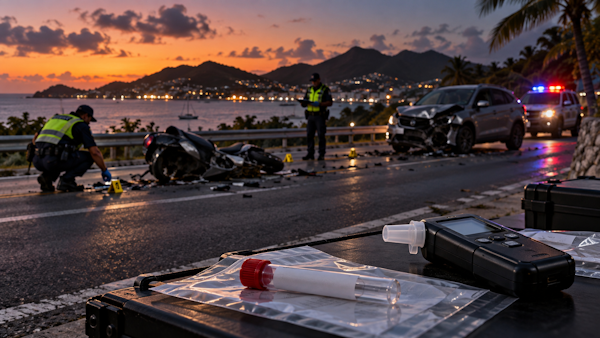
breathlyzers24092026PHILIPSBURG:--- Police investigating a serious traffic collision cannot compel a driver to provide a blood sample under Sint Maarten’s current criminal and traffic laws, Justice Minister Nathalie Tackling told Parliament. She acknowledged that the lack of compulsory testing can make it harder to establish impairment, particularly when a driver leaves the scene before police arrive.

Tackling said officers may administer a roadside alcohol assessment when a suspected driver is present, but that assessment does not definitively establish how much alcohol or another substance the person consumed. Blood or urine testing, she said, requires the person’s voluntary cooperation.

The timing matters. If a driver leaves before police arrive, investigators may still use witness accounts, camera footage, evidence from the scene and lawfully obtained forensic material. Tackling cautioned, however, that the passage of time can reduce the value of evidence concerning alcohol or drug use.

The minister was answering questions about how police investigate fatal collisions and how prosecutors decide whether the evidence supports charges involving negligent or reckless conduct. She said a fatality does not automatically make everyone involved a criminal suspect. Police investigate under the authority of the Prosecutor’s Office, prosecutors assess the evidence and decide what charges to pursue, and the court determines criminal liability.

Tackling said the existing framework permits traffic prosecutions, but she called for breathalyzers and other equipment that can accurately measure alcohol levels, along with stronger legislation governing impaired driving. She also said she had only recently learned of an earlier policy document on modernizing the road traffic ordinance. A proposal connected to that work carried a quoted cost of €352,800 and included plans for a mobility authority.

The minister reported 681 traffic collisions through week 27 of 2026, compared with 719 over the same period in 2025 and 812 in 2024. Those figures show fewer recorded collisions, but they do not resolve the evidence problem she described: in a suspected impaired-driving case, investigators may lose a chance to measure impairment when a driver leaves the scene or declines voluntary testing.


Justice workers’ back pay has no payment date; Retirees remain in third phase.

policebackpay24092026PHILIPSBURG:---  Justice workers waiting for salary adjustments dating back to the start of Sint Maarten’s country status still have no firm date for receiving the outstanding money. Justice Minister Nathalie Tackling told Parliament that the ministry expects to complete its calculations for the next phase by the end of November, but could not say when it will make payments.
The first phase of back pay extended only to January 1, 2023. The second phase covers the period from October 10, 2010, through December 31, 2022, where applicable. Tackling said ministry staff are preparing the calculations and advice for that period. Once completed, the files must go to the Ministry of Finance for further processing.

“I cannot provide a definitive date,”  Tackling said of the payments. She told Parliament that the budget allocates approximately five million guilders annually for a structured payout, while actual disbursements remain subject to the broader government payment process.

Retired justice workers are still assigned to the third phase under a schedule that predates Tackling’s term as minister. She acknowledged that some people entitled to adjustments have died while waiting. Tackling said she has asked ministry staff to examine whether retiree cases can be processed sooner, but made no commitment to change the schedule.

The minister’s answers leave serving and retired workers with two different milestones: a target date for the ministry to finish its second-phase paperwork, and no confirmed date for the money to reach them. For retirees and the families of those who have died, even the start of their phase remains uncertain.

Jansen-Webster defends Minister over laughing image, demands answers for families of victims.

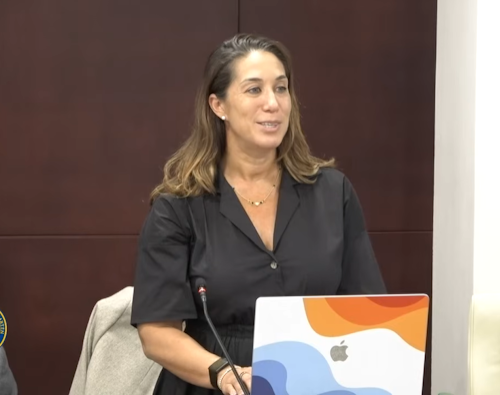
nathalietackling24092026PHILIPSBURG:--- MP Veronica Jansen-Webster told Parliament that an image depicting Justice Minister Nathalie Tackling as laughing during a meeting attended by the family of a fatal traffic collision victim may have given the public the wrong impression. The MP said she had also seen Tackling laughing while answering questions at the latest meeting on Thursday morning and suggested it could simply be the minister’s manner of speaking.

“I don’t know if it’s a nervous laugh,” Jansen-Webster said. She did not claim to know what Tackling was feeling or why she smiled.

But the MP’s principal concern was the family. Jansen-Webster recalled being told at the earlier meeting that the minister had not contacted them. In a small community, she said, grieving relatives should not be left feeling that nobody in authority cares.

She asked Tackling what contact the Justice Ministry has with families after a fatal collision or murder, who makes that contact, and how long it continues. She also pressed for clarity on whether prosecutors keep families informed during an investigation and before sentencing.

Jansen-Webster said families have told her that after an autopsy and burial, they struggle to obtain updates and often do not know whom to call. She asked whether the ministry directs them to Victim Support Services and whether police, the minister’s cabinet or another office is responsible for making that referral.

Her intervention shifted attention from the minister’s expression to a question the families need answered: When a loved one dies, who takes responsibility for keeping them informed?  The transcript records Jansen-Webster’s questions but does not include Tackling’s response.

York presses government on Justice Funding; Tackling agrees revenue must increase.

darrylyork24092026PHILIPSBURG:---  MP Darryl York’s criticism of justice funding drew an acknowledgment from Justice Minister Nathalie Tackling during Parliament’s debate on crime: the country needs to discuss how to raise more revenue.

York accused the Council of Ministers and Parliament of repeatedly approving budgets that leave police and other justice services short of the money they need, then asking later why those services cannot solve the problems. He called it a “laugh-now, cry-later” approach.

The MP pointed to the condition of the police station, questioned how police vehicles are maintained, and asked what the working conditions say about young people considering a career in law enforcement. He said officers are doing what they can, but cannot be expected to deliver more without adequate resources.

York said his faction had sought a meeting on revenue generation for roughly a year and a half. When MP Sjamira Roseburg noted that parliamentarians can amend budgets, York replied that amendments alone cannot create new revenue. He also claimed that recently passed 2026 budget amendments were absent from the proposed 2027 budget. The budget documents were not provided with the parliamentary transcripts, so that claim remains York’s assertion.

The exchange continued when Tackling called for a wider discussion about the social conditions behind crime. York interrupted, saying government and Parliament must examine their own responsibilities as well. Families struggling at home need support, he argued, and that support costs money.

“I’m tired of the buts,” York said, rejecting another cycle of proposals followed by explanations that there are too few funds or staff.

Tackling agreed that revenue needs attention. She said there is not enough money to meet every ministry’s requests and acknowledged York’s broader point about the choices made in the Council of Ministers. York, in turn, urged ministers to examine the priorities in the budgets they send to Parliament.

The minister also clarified a question York had asked about recruitment. He wants the government to reach Sint Maarteners living abroad, particularly in the Netherlands, who might return to join the police force. Tackling said vacancies could be circulated more broadly through channels that reach the diaspora, and acknowledged that the government does not publicize them widely enough.

For York, the test is what happens after the debate: whether the requested revenue discussion takes place and whether future budgets provide for the justice services Parliament says it expects.

Irion calls for visible border presence as robbery suspects cross to French side.

ardwellirion24092026PHILIPSBURG:---   MP Ardwell Irion has urged the government to consider placing officers near the border at selected times, saying a visible presence could deter criminals who expect to escape to the French side after committing an offense on the Dutch side.

Irion made clear that he was not proposing routine checks of every vehicle or a closed border. “I’m not saying border control, stopping all vehicles,” he told Parliament. He asked instead whether officers could maintain a physical presence at particular times so that a person contemplating a crime would know the route out might be watched.

The MP questioned Justice Minister Nathalie Tackling about her discussions with French-side counterparts. He wanted to know what information the two sides share, what support French authorities have offered, and whether they are working together on suspects who cross the border.

“We are starting to subsidize crime from the other side,” Irion said, expressing his concern about the cross-border dimension of local crime. He did not provide figures establishing where suspects live or how many crimes involve a crossing.

Irion also warned against relying solely on reported-crime statistics. Residents are experiencing chain snatchings and hold-ups, he said, while some victims have become too discouraged to file reports. Those remarks describe concerns he has heard; the parliamentary transcript does not establish the scale of unreported crime.

He called for a government-wide plan, saying Justice cannot address the problem alone. Irion asked Tackling and the ministers responsible for other parts of traffic and public safety to present concrete measures, and said the coming budget debate should show how those measures would be supported.

Tackling has since told Parliament that she has requested assistance from the Marines and the Royal Netherlands Marechaussee and that a response to crime must also address pressures within households and communities. In the transcripts provided, however, she did not set out a decision on Irion’s proposed border presence or give details of any agreement with French-side authorities. Those questions remain unanswered.


Subcategories