Jansen-Webster questions confidential cannabis agreement, social aid shortfall and government’s capacity to deliver.

Coalition MP says aspects of the cannabis document concern her, challenges increased borrowing and asks how economic growth will improve residents’ lives.
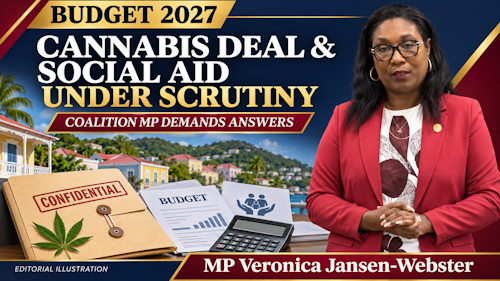
veronicawebster03112026PHILIPSBURG:---  Coalition MP Veronica Jansen-Webster raised concerns about a confidential cannabis agreement, inadequate financial assistance funding and the government’s readiness to execute capital projects during the continuation of the 2027 budget debate on Wednesday, November 4.

Her contribution supported the timely presentation of the budget while raising pointed questions about its priorities, implementation capacity and benefits for residents.

Jansen-Webster questioned why proposed borrowing had increased substantially while ministries’ project preparation remained unclear. She also pressed government on overseas medical referrals, unpaid suppliers, outstanding financial statements and the resources available to support vulnerable households.

Explaining her approach as a coalition member, she said direct discussions with ministers sometimes reduced the number of questions she needed to ask publicly. Nevertheless, she emphasized that unresolved matters still required answers before she could make an informed decision on the budget.

Cannabis Agreement Raises Concerns About Access and Confidentiality

Jansen-Webster requested improved parliamentary access to a cannabis agreement discussed in an October 25 newspaper commentary.

She said the document had been submitted confidentially and that she had taken the opportunity to inspect it. However, she explained that the confidential viewing arrangement did not allow her to write down information or make notes.

She identified approximately 12 to 15 points that she considered concerning, without disclosing their substance during her contribution.

Her concern intensified, she said, when some matters she had noticed appeared in the published commentary.

“If a columnist has this information, why can we not have it in Parliament?” she asked.

Her complaint was therefore about the form of parliamentary access and the ability to examine the agreement properly, rather than a claim that she had been denied any opportunity to see it.

She requested that the document be made available through a route that would permit more effective review and note-taking.

Her remarks did not establish how the columnist obtained the information or whether any confidentiality rule was breached. Nor did she identify enough contractual detail publicly to assess the provisions troubling her.

They nevertheless place a significant question before TEATT Minister Grisha Heyliger-Marten: how can MPs scrutinize an agreement effectively when their ability to record and examine its contents is restricted?

Financial Assistance Provision Falls Below Anticipated Need

Jansen-Webster also challenged the proposed financial assistance funding.

VSA Minister Claret Connor had indicated that approximately 8.2 million guilders were budgeted, while anticipated requirements were around 10 million guilders.

She asked how the ministry intended to address that gap.

For Jansen-Webster, the figures had to be considered alongside evidence of hardship. She referred to census findings that she said showed approximately 7% of the population experiencing hunger, linking that concern to the adequacy of social support.

That percentage was cited by the MP during the debate; her contribution did not explain the underlying survey question, reference period or methodology.

Her policy question was clear: why wasn't assistance strengthened in line with the needs the government itself anticipated?

VSA’s Declining Budget Prompts Questions About Priorities

Jansen-Webster described VSA as the ministry losing ground financially while other portfolios received increases.

She identified an approximately 4.6% reduction in its overall budget and questioned the direction of spending when public discussion emphasized economic growth.

The reduction requires context. Connor had earlier attributed most of the overall decline to externally financed reform projects reaching completion or their final phase, rather than an equivalent reduction in every domestic service.

Nevertheless, that explanation does not resolve the separate financial assistance gap.

Jansen-Webster asked how the government intended to protect people who depend on support while advancing reforms in healthcare and social protection.

She also questioned when general health insurance legislation would reach Parliament and whether phased implementation would begin in January 2027.

Her intervention sought to connect the budget’s projections to improvements residents could actually experience.

Why Increase Borrowing Without Clear Project Readiness?

The MP questioned the proposed increase in 2027 borrowing from about 53 million to 94 million guilders.

She wanted to know whether ministries had prepared the projects they were seeking to finance, including procurement, permits, and designs.

If staffing shortages were preventing execution, she asked how government could justify expanding the project portfolio.

She requested an account of which 2026 projects could still start and which had been delayed because preparatory work was not complete.

Her questions distinguished securing financing from being ready to spend it effectively.

In her view, a larger borrowing request required a credible explanation of implementation capacity and project sequencing.

Ministries Asked to Report Actual Recruitment

Jansen-Webster requested staffing information in a specific format: the number of vacancies budgeted for 2026, how many employees had been recruited and how many further appointments were expected before year-end.

She said that would help Parliament assess preparation and execution following the late budget.

She praised the Justice presentation for clearly distinguishing vacancies, completed recruitment, and appointments still expected.

For General Affairs, she separately asked how many vacancies the personnel department had processed since approval of the 2026 budget.

The request would allow Parliament to compare funded positions with actual recruitment rather than treating vacancy allocations as completed capacity improvements.

Overseas Medical Referrals Need Closer Examination

Addressing Connor, Jansen-Webster raised concerns about patients traveling abroad without accompaniment and about the time required to arrange referrals.

She recalled visiting a woman receiving cancer treatment in Colombia who was alone and asked how frequently patients had traveled unaccompanied during 2025 and 2026.

She wanted to understand the circumstances behind those decisions, including whether patients lacked someone available to accompany them.

Jansen-Webster also questioned referral timeframes she recalled from earlier answers: approximately 11 days for cases described as emergencies and three days for acute cases.

She expressly invited the minister to correct those figures if her recollection was inaccurate. They should therefore be treated as timeframes she questioned, rather than confirmed service standards.

She said she had requested a closed-door meeting involving the minister and SZV to examine referrals and related concerns.

Consultant Contracts and Legal Costs Require Fuller Answers

Jansen-Webster said earlier responses about consultancy contracts remained incomplete.

She asked what services were covered where a consultant’s function was described only as “other,” suggesting that Parliament needed to know whether the work involved purchasing, event coordination, marketing or another activity.

She also requested an explanation for an apparent doubling of a legal advisory allocation and asked how much had actually been paid to the adviser during 2026.

Her questions sought the information needed to compare the proposed increase with expenditure and services already delivered.

The contribution did not establish that any contract was improper or that an increase lacked justification. It challenged government to provide that justification clearly.

Supplier Payments and Financial Statements Also Challenged

To Finance Minister Marinka Gumbs, Jansen-Webster asked whether centralized purchasing had improved visibility over outstanding invoices and unpaid suppliers.

She relayed complaints from departments about lengthy approval processes and asked for the average time required to approve supplier payments.

She also wanted to know how payment priority was determined: whether invoices were handled in order of receipt or according to another ranking system.

Separately, she requested completion dates for the country’s 2023–2025 financial statements, along with outstanding civil servant healthcare accounts and settlements with SZV.

She argued those records are necessary for Parliament to understand actual expenditure and make informed decisions.

Tourism Growth Should Reach Residents’ Pockets

Jansen-Webster asked Finance and TEATT whether they were working together to convert tourism growth into direct benefits, including possible tax reductions.

She requested comparisons showing how the number of individual and business taxpayers had changed over the past decade, alongside concrete measures to broaden participation in the tax system.

On food affordability, she encouraged the proposed essential-goods study to consider suppliers in the Caribbean and South America.

She also called for clearer visitor guidance on local expectations, including dress and respectful coexistence, and asked what ministries were doing together to address traffic ahead of the busy season.

Accountability Questions Extend Across Government

Other requests included the status of the prison building permit, implementation of ASYCUDA, stronger victim support arrangements and school prevention and referral protocols for substance use among minors.

For VROMI, she asked whether additional road resurfacing would take place before year-end and requested an update on suspended senior personnel, given the ministry’s reported capacity shortages.

Jansen-Webster’s contribution ultimately placed a practical test before government: whether its plans, contracts and spending decisions can be explained in enough detail for Parliament to assess their value.

Timeliness earned her praise. Project readiness, social protection and measurable improvements in residents’ quality of life remained the questions requiring answers.


Doran challenges Gumbs on Alegria, garbage tender and road funding: “What are they getting in return?”

National Alliance faction leader demands explanations for VROMI’s negotiations, a bridge repair partnership and the gap between infrastructure promises and execution.

jurendydoran04112026PHILIPSBURG:---  National Alliance faction leader MP Egbert Jurendy Doran launched a sustained challenge to VROMI Minister Patrice Gumbs during the 2027 budget debate, questioning whether the ministry is protecting the public interest in its negotiations, managing procurement fairly and turning available funding into work residents can actually see.
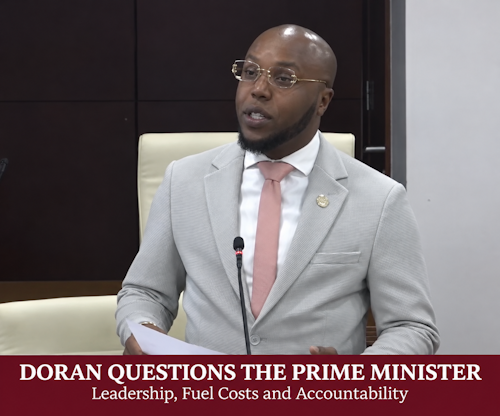
Drawing on his experience as a former VROMI minister, Doran challenged Gumbs over the Alegria dispute, a privately financed bridge repair arrangement, the controversial solid waste tender, road maintenance and stalled housing development.

His central demand was for decisions, documents and explanations that Parliament could examine.

“What are they getting in return?” Doran asked while questioning the terms of the bridge repair partnership.

Alegria: Why negotiate after defending government’s position?

Doran’s sharpest criticism concerned how the government handled the longstanding Alegria matter.

He questioned why the minister was meeting with company representatives to explore an arrangement involving water rights when, according to Doran, the government had successfully defended its position through years of litigation.

Doran maintained that substantial public resources had already gone into those proceedings. He argued that any attempt to negotiate a different outcome required a clear explanation of what government intended to achieve and what the public would gain.

He also alleged that efforts had been made to delay the legal process while discussions took place. Doran made those allegations in Parliament; his statement did not establish a judicial finding of improper conduct.

The former minister portrayed the issue as a test of whether Gumbs was preserving the position government had defended or preparing to make concessions.

His criticism also revisited the controversy surrounding the removal of the great tree in Simpson Bay. Doran rejected attempts to place responsibility on a building permit issued during his tenure and argued that the current minister had to answer for inspection and enforcement under his own administration.

The exchange was deeply political, but the underlying questions were specific: What discussions have taken place with Alegria? What concessions, if any, are being considered? And why would an agreement serve the country better than maintaining the government’s existing legal position?

Bridge partnership: What is the full arrangement?

Doran said he supported public-private partnerships and recognized that the bridge and road infrastructure under discussion needed repairs.

His objection concerned the transparency of the particular arrangement.

He questioned the relationship between a private company’s commitment to finance bridge work and a building permit issued to that company. He also alleged the permit was published only one day before the objection period expired.

Doran asked both Gumbs and Prime Minister Dr. Luc Mercelina to explain the timing and whether the Council of Ministers had approved the arrangement.

“How does that look to you?” he asked.

He questioned whether the private contribution, which he described as exceeding one million dollars, was connected to benefits the developer received from government.

Doran did not find that the permit had been exchanged for the bridge work. He raised that concern as an inference from the sequence of events and expressly invited correction.

“If I’m wrong, correct me,” he said. “I hope I’m wrong.”

His questions nevertheless placed the terms of the partnership squarely before Parliament: What exactly is the company providing? What obligations has government accepted? What approvals were obtained? And how were the interests of other parties and potential objectors protected?

Road promises meet questions about execution

Doran also challenged the ministry’s road maintenance record, asking what had happened to money and preparations he said were left for road signs, road markings and repairs.

He said signs had been ordered during his tenure and questioned why residents were not seeing the corresponding improvements.

“What has happened to that money?” he asked.

Doran alleged that no road repair tender had been published during the current minister’s tenure and questioned how a larger program could be delivered when smaller allocations had not visibly translated into work.

That allegation concerned road procurement; it should not be confused with his separate criticism of the garbage tender process.

He also challenged what he described as conflicting explanations from Finance Minister Marinka Gumbs and VROMI Minister Patrice Gumbs about the proposed Road Fund.

“Gumbs versus Gumbs,” he said, demanding a clear explanation on the floor of Parliament.

Doran asked how the disagreement affected the five million guilders in road funding he referenced and whether the proposed expenditure depended on borrowing that had not yet secured favorable financial oversight advice.

He argued that putting a figure in a budget did not establish that the money was accessible, that procurement was ready, or that work could begin.

He asked the Prime Minister how he viewed the situation as leader of government, bringing VROMI’s performance directly to the Cabinet’s leadership.

Garbage tender: Doran challenges the process

Turning to the 2026–2029 solid waste collection process, Doran questioned the distinction between the minister’s statement that no contracts had been awarded and reports that leading bidders had already received notifications and invitations to discuss contracts.

An invitation to discussions does not, by itself, establish that a final contract has been awarded. Doran challenged whether the ministry’s public explanation adequately reflected how far the process had advanced.

He also questioned the disqualification of bidders during the earlier tender process, particularly requirements involving initials on supporting documents issued by other institutions.

Doran asked Mercelina, as minister responsible for General Affairs and legal affairs, to explain the legal basis for excluding bidders on those grounds.

He further argued that restarting the competition after bid information had become known could affect fairness if the scope and budget remained substantially unchanged.

He warned that procurement shortcomings could expose the government to litigation and potential financial consequences.

Those consequences were presented as risks, rather than established liabilities. Doran nevertheless insisted that government explain how it had protected the integrity of the competition.

“I am, however, concerned with the process and how the ministry is handling things,” he said.

Housing and recovered land also require answers

Doran requested an update on the Vija­net housing project, arguing that its potential contribution to the housing shortage warranted a clear account of what had happened since the litigation he referenced.

He also questioned whether outstanding payments associated with the approximately 17 hectares of Rainforest Adventures land that he said the government had recovered had been settled.

Both questions reflected the broader theme of his intervention: announcements about land, housing and infrastructure should be followed by an explanation of the financial position and the next steps.

Doran’s speech placed Gumbs under pressure to provide more than a general defense of the ministry’s intentions. The questions he raised require records, dates, procurement explanations, and measurable progress.

The supplied statement does not include the minister’s responses. It does, however, pose a clear parliamentary challenge: show how these decisions protect the public interest and when residents will see results.

Doran puts Mercelina on notice: Fuel bills, firefighters and cabinet accountability demand answers.

National Alliance leader challenges the Prime Minister to explain the government’s results, defend its legal safeguards, and resolve outstanding commitments.

jurendybudget202704112026PHILIPSBURG:--- National Alliance faction leader MP Egbert Jurendy Doran placed Prime Minister Dr. Luc Mercelina at the center of a broad accountability challenge during the 2027 budget debate, arguing that the leader of government must answer for unresolved problems across the Cabinet.
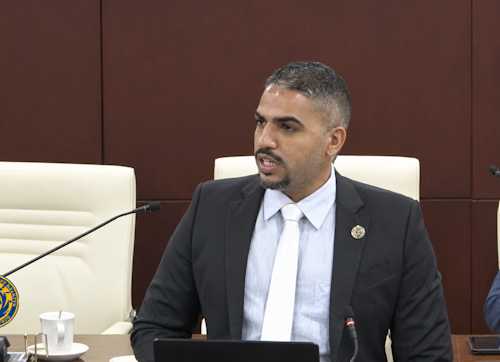
Doran questioned the Prime Minister about fuel costs, the performance of government-owned companies, legal oversight of procurement, conflict-of-interest safeguards and outstanding commitments to firefighters.

He also called on Mercelina to intervene over a school safety concern and explain how government would move beyond responding to crises toward preventing them.

His closing warning was blunt: the country could not continue on the same course for another two years.

“The time to act is now,” Doran said. “Enough is enough.”

Fuel costs: Doran rejects a blame-shifting exercise

Doran challenged the Prime Minister to explain a reported statement linking high fuel costs to Sol rather than GEBE.

He asked Mercelina to clarify the statement and the reasoning behind it, pointing out that residents receive their electricity bills from the government-owned utility.

“Because according to me, when I get my bill, it does not say Sol,” Doran said.

His argument was that government could not treat the conduct of a private fuel supplier as a substitute for examining the decisions and responsibilities of its own companies.

Doran described Sol as a commercial business pursuing profit and argued that public policy should rest on enforceable rules and decisions within government’s control.

He called for scrutiny of the arrangements that had allowed fuel infrastructure to become concentrated in private hands and asked for evidence of efforts by GEBE’s former management to acquire the Texaco tanks.

MP Veronica Jansen-Webster challenged part of his argument about the ability to prevent a private company from buying tanks. Doran subsequently clarified that he was questioning what efforts GEBE had made to acquire them.

He demanded records that could establish what had actually been attempted.

Could the port’s throughput fee reduce the burden?

Doran disclosed that he had attended a meeting involving the Prime Minister, the Finance Minister, Sol representatives and other faction leaders to discuss possible solutions.

He defended his participation, saying his responsibility extended beyond party politics.

“I don’t represent one person, one party and/or one group,” he said.

But attendance did not amount to an endorsement of the meeting’s results.

Doran identified the port’s fuel throughput fee as an issue requiring a direct answer. Because the port is government-owned, he asked whether lowering that fee could reduce energy costs for consumers.

He directed the question to the Prime Minister or the TEATT minister and demanded an explanation of the actual effect on the end user.

The proposal remained a question, rather than a demonstrated saving. Doran did not provide a calculation showing how much bills would fall or establish that a reduction would automatically be passed through.

His challenge was for government to determine whether that option could produce relief and explain the result publicly.

Cabinet coordination comes under scrutiny

Doran also highlighted what he interpreted as criticism from TEATT Minister Grisha Heyliger-Marten of how the fuel discussions had been presented.

He read a reported statement from the minister about judging meetings by the answers they produce and characterized it as a pointed criticism of the Prime Minister.

That was Doran’s interpretation of her remarks; it did not establish that the ministers were engaged in a personal dispute.

Nevertheless, he used the episode to question Cabinet cohesion.

He made a similar argument about what he described as conflicting explanations from the Finance and VROMI ministers concerning the Road Fund.

For Doran, those differences required Mercelina’s attention because residents needed a coherent government position on financing and delivery.

The Prime Minister’s role, as framed in the speech, was to ensure that Cabinet decisions produced a clear account of what government could fund, what it had approved and what it would deliver.

Legal oversight: Why Doran directed VROMI questions to the Prime Minister

Although many of Doran’s complaints concerned VROMI, he repeatedly asked Mercelina to address their legal implications.

He questioned how bidders were treated in the solid waste tender and the fairness of restarting a competition after earlier bid information had become known.

He also asked about the timing of publishing a building permit associated with a private company involved in a bridge repair partnership.

Doran explained that he was directing these questions to the Prime Minister because of the legal responsibilities under General Affairs.

His intervention sought to prevent the issues from being treated solely as disputes between an opposition MP and an individual minister.

The questions concerned whether the government’s procedures were legally defensible, whether Cabinet had approved the relevant arrangements and whether public decisions had been adequately explained.

Doran’s allegations did not establish that the procedures were unlawful. They did demand a reasoned response from the government officials responsible.

Firefighters: Which commitments have been fulfilled?

Doran pressed Mercelina for a detailed update on the Fire Department’s placement process, outstanding payments and employment protections.

He referred to the function book’s approval in March 2025 and the government’s previously indicated target of completing placements during the fourth quarter of 2026.

He asked whether that timetable remained achievable and how many placements were still outstanding.

Doran also wanted to know whether government had calculated the additional back pay that could accumulate if the process continued to slip.

Referring to the April 9 agreement with WICSU/PSU and Fire Department representatives, he asked which commitments had been fulfilled and which remained open.

He requested an update on negotiations concerning the broader agreement and on life insurance and protection for firefighters.

These questions sought an account of implementation: the remaining cases, the financial exposure, the outstanding obligations and the deadline for resolving them.

Who polices conflicts of interest in oversight bodies?

Doran asked the Prime Minister to explain how potential conflicts of interest are handled within the General Audit Chamber, Integrity Chamber, Ombudsman, Council of Advice and Social Economic Council.

He requested institution-specific answers about who determines whether a conflict exists, whether individuals must declare it and when they must withdraw from a matter.

He also asked what safeguards protect the independence and credibility of those bodies.

Doran did not identify a particular official as having committed a conflict-of-interest violation in this section of his statement.

His question focused on whether procedures were clear and adequate when an institution investigated, reviewed, or advised on a matter involving one of its own members or officials.

School safety and the cost of constant crisis management

Doran also asked Mercelina to intervene over an area at a school where he said concrete had fallen and cracks remained visible.

He described the caution tape as an inadequate barrier and called for a more effective way to keep children away from the area.

He asked for an immediate protective measure while the safety concern was addressed.

That appeal connected to the broader criticism with which he opened his speech: government, he argued, had become too accustomed to chasing problems after they escalated.

“Sometimes when somebody is working on fixing a crisis, somebody else should be working on planning the future,” he said.

Doran acknowledged the return to timely budget preparation but challenged the assumption that meeting a submission deadline demonstrated an ability to execute the plans.

He characterized the proposed budget as lacking sufficient new revenue measures and warned that unresolved borrowing conditions could undermine capital projects. His prediction about future financing remained a political assessment, rather than a decision already made by financial supervisors.

The challenge to Mercelina was ultimately about responsibility for the whole government: explain the decisions, reconcile conflicting positions, fulfill outstanding commitments and show residents what has improved.

The supplied statement does not include the Prime Minister’s answers. Doran’s intervention nevertheless set out a concrete test for those answers—whether they identify actions, responsible officials and deadlines that Parliament can subsequently measure.

Kotai confronts finance minister over CFT findings: “More money with less of a plan”

DP parliamentarian demands answers on threatened investments, unexplained spending and stalled tax reform, questioning why the government is studying a development bank before producing an investment plan.

virenkotai0411202PHILIPSBURG:--- Democratic Party MP Viren Kotai delivered a pointed challenge to Finance Minister Marinka Gumbs during the 2027 budget debate, questioning how the government could seek a larger investment loan while failing to provide the planning documents repeatedly requested by the Committee for Financial Supervision, CFT.
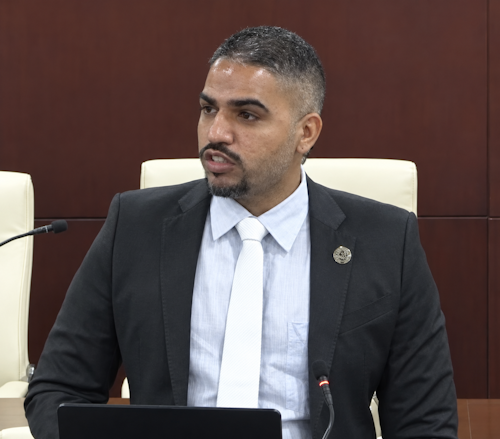
Kotai placed the management of taxpayers’ money at the center of his contribution, arguing that the latest advice on the adopted 2026 budget exposed failures with consequences extending well beyond the government’s accounting records.

“This is not simply a matter of figures on paper,” he said. “It is a matter of accountability, of responsible governance.”

His intervention was particularly significant because it came from within the Democratic Party, the same party as the Finance Minister.

Kotai acknowledged both Parliament’s responsibility for the late adoption of the 2026 budget and the minister’s progress toward restoring the timetable for 2027. But he rejected those points as explanations for the shortcomings he outlined.

Neither, he argued, explained why the government had been asked twice to provide essential information and nevertheless sought “more money with less of a plan.”

A larger loan request without the investment plan

Citing the CFT’s advice, Kotai said the supervisory body received the adopted 2026 budget on September 24, nine months after the December 15, 2025 legal deadline.

He said the CFT could not determine whether the budget met the applicable legal requirements and could not issue positive advice on the 42.1 million-guilder investment loan request.

He noted that the request had increased from 37.5 million guilders even though the supporting investment plan had not been delivered.

Kotai described a pattern of inadequate follow-up: the CFT requested five items in February, largely repeated its requests in July, and subsequently concluded that the matters had not been sufficiently addressed.

He demanded the written status of each item and the minister’s written response on decision-making, which he said the CFT had requested twice.

The distinction in his criticism was important. Kotai argued that the problem was not a demonstrated inability to afford the investment, but the government’s failure to provide sufficient information for the budget and investment plans to be assessed.

In his assessment, the resulting development setback was “self-inflicted by process.”

Which projects will residents lose?

Kotai challenged Gumbs to identify the investments associated with the 42.1 million-guilder request and explain what would now happen to them.

He wanted projects named, locations identified, intended beneficiaries specified, and original delivery dates disclosed.

Of the 98 million guilders in new investments the government had announced, how much would realistically proceed in 2026?

“Is it going to be zero?” he asked.

His warning that investment would not materialize was a parliamentary assessment of the consequences of the unfavorable financing position. He also asked whether any borrowing route remained available before year-end or whether projects could be financed from the government’s own resources.

Kotai demanded to know whether any affected projects had already been tendered or contracted. If so, he asked who would pay the contractors and from which budget line.

He also asked whether the minister had warned the Council of Ministers and Parliament that the loan request was at risk, and when those warnings had been given.

His questions extended to the cost of postponement: higher construction prices, deteriorating infrastructure, possible loss of co-financing, expiring grant conditions and employment that delayed projects would otherwise have generated.

“Our people won’t feel the paragraph,” he said of the supervisory advice. “They will feel it as the projects do not start.”

Spending explanations and cash figures under scrutiny

Kotai highlighted several other findings he attributed to the CFT.

He said approximately 30 million guilders in additional personnel and goods-and-services expenditure had been explained only in general terms, without sufficient substantiation.

He also questioned why social benefits had been budgeted five million guilders below the previous year’s actual expenditure, which he said had occurred for a second time without explanation.

Another concern was an apparent inconsistency in the presentation of available cash: five million guilders in a table against 41 million in the accompanying text.

Those figures mattered, he argued, because government needed to establish whether it could finance investments itself if borrowing did not proceed.

Kotai also cited the CFT’s assessment that the country had little to no room to absorb unexpected setbacks or introduce new policy.

His criticism therefore concerned pressure on both sides of the government’s finances: uncertainty over capital investment and limited flexibility in day-to-day operations.

Tax reform: Who is actually steering?

Kotai rejected the suggestion that the budget difficulties could be treated as an isolated bad year, pointing to the pace and management of tax reform.

He traced the first phase to legislation submitted in October 2025 to repeal tax ordinances that had fallen into disuse. Parliament considered it in a Central Committee meeting in February, he said, yet the minister’s presentation on November 3 still described the 2027 focus as advancing that first phase.

Kotai said the minister had previously indicated that there was no single roadmap and that substantive profit-tax and wage-tax reforms were 36 to 48 months away.

He argued that such a timetable extended beyond the current parliamentary term.

He also questioned the dependence on externally financed technical assistance, saying the ministry itself had only two staff members assigned to the reform and that the Tax Administration had been without a head since July 2025.

Kotai did not reject technical assistance. He questioned who controlled the direction, timetable and accountability of the work.

“I question who is steering,” he said.

“A reform the Minister approves but does not direct on a timeline the Minister cannot show us is not a reform. It’s a process.”

He demanded a phased implementation plan with dates, the external assessment and the relevant country-package implementation agenda.

He also asked for the visitor levy’s implementation date and confirmation of whether its revenue was included in the 2027 budget, noting that the measure had reportedly not reached the Council of Advice by August despite a January 2027 target.

Why study a development bank before delivering the plan?

Kotai turned next to the proposed development bank, questioning the sequence of the government’s priorities.

He said the minister confirmed on October 22 that a feasibility study had been commissioned, but Parliament had not received its completion date, cost or terms of reference.

He agreed with the minister’s own acknowledgment that new financing mechanisms would not automatically resolve difficulties in executing capital projects.

For Kotai, that acknowledgment reinforced the need to complete project preparation and multi-year investment planning first.

He also questioned the separate investment fund mentioned by the minister: whether it involved another study, who was conducting it, what it cost and whether it would borrow.

Before creating another state institution, he argued, government owed Parliament a plan for the institutions it already owned, particularly given the financial risks he said the CFT had identified in government participations.

Kotai requested a commitment that Parliament would not take any decision to establish the development bank before receiving the multi-year investment plan.

Answers with dates

Kotai’s demands went beyond explaining past delays.

He asked which investments would move into 2027, whether the next loan request had been increased to accommodate them and whether the missing plan had finally been prepared.

Otherwise, he warned, the government risked encountering the same obstacle again.

He also questioned whether delayed investment would affect economic growth and the revenue projections underpinning the next budget.

Throughout his contribution, Kotai presented scrutiny as an obligation applying regardless of which government was in office.

Parliament, he said, had to satisfy itself that the figures were credible, the plans realistic and the public interest protected.

“I expect some answers with dates,” he said.

Kotai presses VROMI on Setai permits: Has government exposed taxpayers to legal liability?

DP MP demands application deadlines, technical advice and written grounds for outstanding decisions, while challenging government to act on longstanding tax-compliance recommendations.

kotai04112026PHILIPSBURG — Democratic Party MP Viren Kotai has demanded a detailed explanation from VROMI Minister Patrice Gumbs Jr. about outstanding permits for the Setai development at Indigo Bay, asking whether delays have resulted in court proceedings and exposed the government to potential legal or financial liability.

During the 2027 budget debate, Kotai sought an application-by-application account of the development’s permitting position, including submission dates, decision-making deadlines, completed technical assessments and the reasons final decisions remained outstanding.

His questions challenged the minister to explain the administrative and legal basis for the handling of a major development rather than offer a general statement about the project.

Kotai asked whether government had provided formal written decisions and what specific steps it intended to take to bring the outstanding matters to a lawful conclusion.

His statement did not establish that government had acted unlawfully or that a court had imposed liability. It sought confirmation of the proceedings and the facts needed for Parliament to assess the ministry’s handling of the applications.

Has the dispute reached court?

Kotai first asked Gumbs to confirm whether the developers had initiated legal proceedings against the government over how it handled the permit applications.

If proceedings had begun, he wanted the minister to identify the administrative matters at the center of the dispute and explain how the situation had reached that point.

He then requested a complete overview of the outstanding applications.

For each, Kotai asked when it was submitted, what legal decision-making deadline applied, and why the ministry had not issued a final decision.

He also asked whether any applications had exceeded their prescribed decision periods and, if so, by how long.

Those questions placed the ministry’s processing record under scrutiny without assuming that every outstanding application should necessarily be approved.

The issue Kotai raised was whether government had assessed the applications, reached decisions within the applicable framework and properly communicated its grounds.

What did the technical departments recommend?

Kotai asked whether VROMI’s technical departments and the relevant advisory bodies had completed their assessments.

He wanted to know what recommendations had been submitted and whether any were positive.

Where assessments were complete, he asked what specific legal or technical considerations still prevented the minister from issuing final decisions.

He also questioned whether those reasons had been formally communicated to the developer.

The distinction between technical advice and a final ministerial decision was central to his intervention. Kotai sought to establish where the process stood and which outstanding considerations were preventing it from moving forward.

Can one permit issue hold up another application?

Kotai also asked whether decisions on some applications had been delayed because of concerns relating to other permits associated with the same development.

If that was the case, he requested the legal provisions allowing the government to withhold a decision on one application because of matters arising under another.

He further asked whether each application had been assessed independently according to its own legal requirements.

That line of questioning called for a precise explanation of the relationship between the applications, rather than treating the development as a single unresolved file.

Kotai concluded by asking whether delays had exposed government to potential legal or financial liability.

He referred to the scale of the investment and its anticipated economic contribution, but his request remained focused on lawful administration: written grounds, identifiable decisions and concrete steps toward resolving the matters.

An import-registration recommendation still awaiting answers

Kotai’s wider economic contribution also challenged government over the implementation of a longstanding recommendation on commercial imports and exports.

He referred to March 2016 advice from the Social Economic Council calling for a registration system linking commercial trade through the harbor and airport to businesses’ CRIB numbers.

The objective, he explained, was to strengthen tax compliance, improve revenue collection, support information-sharing and create a more level playing field.

“Nearly 11 years later, my question is, what have we actually implemented?” he asked.

Kotai wanted to know whether all commercial imports and exports were registered against verified CRIB numbers.

He also asked whether Customs and the Tax Administration were sharing and reconciling the information and using it to identify unregistered economic activity and strengthen turnover-tax compliance.

His challenge concerned whether an existing recommendation had become an operational system capable of producing results.

Transaction tax: Model the proposal before deciding

Kotai asked Finance Minister Marinka Gumbs for her position on the financial transaction tax concept presented by TEATT Minister Grisha Heyliger-Marten.

He did not call for immediate implementation.

Instead, he asked whether the minister considered the concept worthy of economic and fiscal modeling, even if she had reservations.

He specifically questioned whether a transaction tax could form part of a broader restructuring in which existing taxes might eventually be reduced, restructured or replaced.

Kotai referenced approximately 11.8 billion guilders in payment transactions examined for 2022 in the TEATT presentation.

He asked whether the scale of that recorded activity warranted further investigation of a broad transaction base as an alternative way to raise revenue.

That figure was presented as a reason to study the concept; it did not establish the size of a workable taxable base or the amount a new tax would collect.

Kotai proposed comparing a transaction-tax model with the present structure on revenue collection, compliance, administrative costs, and effects on economic activity.

His final question was whether the concept should be rejected in principle or examined through modeling before a decision.

Could the port and airport work under a unified structure?

Kotai also called for an assessment of closer cooperation between Port St. Maarten and Princess Juliana International Airport.

He described them as government-owned gateways central to the tourism economy and questioned whether their largely separate operations overlooked opportunities for shared services, coordinated investment and economies of scale.

He asked whether government had formally assessed a unified air and seaport authority.

If not, he wanted to know whether the TEATT minister would consider commissioning that assessment as part of the medium-term economic strategy.

Kotai requested an independent cost-benefit analysis to establish what savings could be achieved without compromising safety, service quality or operational efficiency.

He also asked whether coordinated financing and investment could improve profitability and strengthen the entities’ negotiating position.

Cooperation requires financial and legal groundwork

Kotai acknowledged that the port and airport had distinct assets, financing arrangements and obligations.

He therefore proposed financial and legal due diligence before pursuing any unified holding structure.

That work, he said, would need to protect existing assets, preserve financial stability and respect lender covenants and regulatory obligations.

He suggested beginning discussions with the supervisory boards and management toward a formal memorandum of understanding on strategic cooperation.

An independent feasibility study and a phased roadmap over approximately three years could then determine whether a unified authority served the country’s interests.

The proposal was for an assessment, rather than an immediate merger or an assertion that consolidation would automatically save money.

Across his contribution, Kotai demanded evidence on both existing problems and new proposals: the legal grounds for delayed permits, the actual implementation of import controls, the modeled effects of a transaction tax and the financial case for closer port-airport cooperation.

He left further questions for the second round of the debate.


Subcategories